

Hypanus say
Hypanus say (Lesueur, 1817)
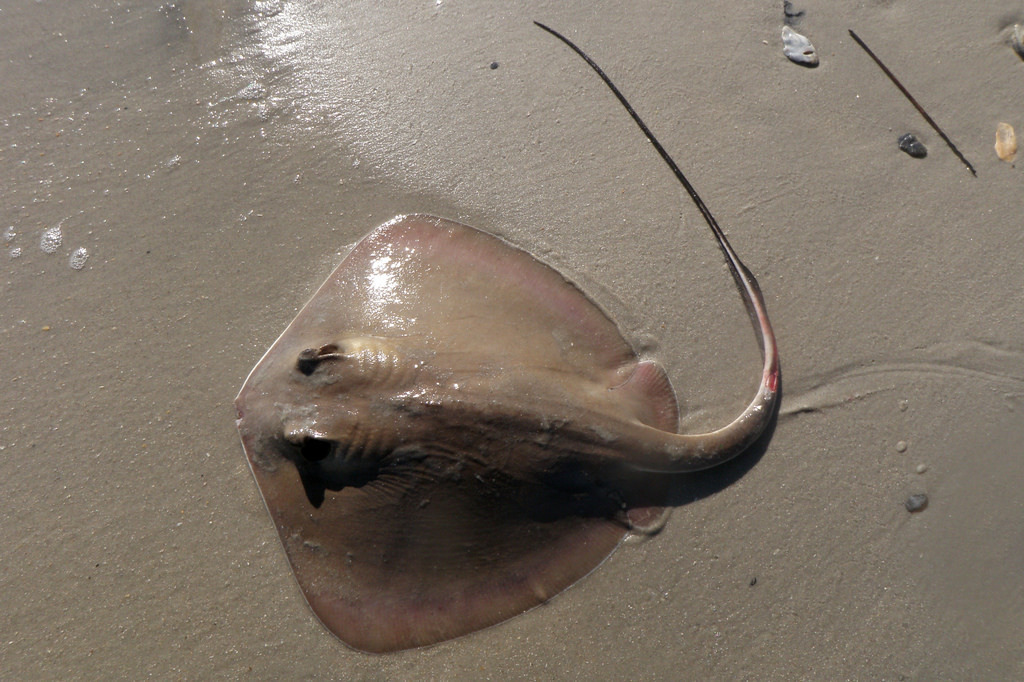
The bluntnose stingray or Say's stingray (Hypanus say, often misspelled sayi) is a species of stingray in the family Dasyatidae, native to the coastal waters of the western Atlantic Ocean from the U.S. state of Massachusetts to Venezuela. It is a bottom-dwelling species that prefers sandy or muddy habitats 1–10 m (3.3–32.8 ft) deep, and is migratory in the northern portion of its range. Typically growing to 78 cm (31 in) across, the bluntnose stingray is characterized by a rhomboid pectoral fin disc with broadly rounded outer corners and an obtuse-angled snout. It has a whip-like tail with both an upper keel and a lower fin fold, and a line of small tubercles along the middle of its back.
More active at night than during the day when it is usually buried in sediment, the bluntnose stingray is a predator of small benthic invertebrates and bony fishes. This species is aplacental viviparous, in which the unborn young are nourished initially by yolk, and later histotroph ("uterine milk") produced by their mother. Females give birth to 1–6 pups every May after a gestation period of 11–12 months, most of which consists of a period of arrested embryonic development. The venomous tail spine of the bluntnose stingray is potentially dangerous to unwary beachgoers. The International Union for Conservation of Nature (IUCN) has listed this species as near threatened.
- Also published as
- Dasyatis say (Lesueur, 1817); Dasyatis sayi (Lesueur, 1817); Raja say Lesueur, 1817
From Wikipedia (CC BY-SA), quoted section by section
Description
The bluntnose stingray has a diamond-shaped pectoral fin disc about a sixth wider than long, with broadly rounded outer corners. The leading margins of the disc are nearly straight and converge at the tip of the snout at up to a 130° angle; the anterior disc shape distinguishes this species from the similar Atlantic stingray (D. sabina), which has a longer, more acute snout. The mouth is curved, with a central projection on the upper jaw that fits into an indentation on the lower jaw. There is a row of five papillae across the floor of the mouth, with the outermost pair smaller and set apart from the others. There are 36–50 upper tooth rows; the teeth have quadrangular bases and are arranged with a quincunx pattern into flattened surfaces. The tooth crowns are rounded in females and juveniles, while those of males in breeding condition are triangular and pointed. The pelvic fins are triangular with rounded tips. The whip-like tail measures over one and a half times as long as the disc and bears one or two long, serrated stinging spines on top, about a quarter of the tail length back from the base. The second spine, if present, is a replacement that periodically grows in front of the existing spine. Behind the spine, there are well-developed upper and lower fin folds, with the lower fold longer and wider than the upper. …
Range & habitat
The bluntnose stingray is found in the western Atlantic Ocean, from Long Island, New York southward through the Florida Keys, the northern Gulf of Mexico, and the Greater and Lesser Antilles; on rare occasions it is found as far north as Massachusetts, as far south as Venezuela, and as far west as Mexico. It is absent from the southern Gulf of Mexico and the Caribbean coast of Central America. Reports of this species from off Brazil and Argentina likely represent misidentifications of the groovebelly stingray (D. hypostigma). Common in coastal habitats such as bays, lagoons, and estuaries, the bluntnose stingray is a bottom-dwelling species usually found at a depth of 1–10 m (3.3–32.8 ft), though it has been recorded from as deep as 20 m (66 ft). It frequents sandy or muddy flats, preferring water with a salinity of 25–43 ppt and a temperature of 12–33 °C (54–91 °F). Adult bluntnose stingrays are seldom found in seagrass meadows or shoals, though the latter serves as a habitat for young rays. Along the U.S. East Coast, schools of bluntnose stingrays migrate long distances northward into bays and estuaries to spend the summer, and move back to southern offshore waters for winter.
What it does
The bluntnose stingray has generally nocturnal habits and spends much of the day buried in the substrate. It has been known to follow the rising tide to forage in water barely deep enough to cover its body. This species preys upon small invertebrates, including crustaceans, annelid worms, and bivalve and gastropod molluscs, and bony fishes. It mainly targets benthic and burrowing organisms, but also opportunistically takes free-swimming prey. In Delaware Bay, this species feeds predominantly on the sand shrimp Crangon septemspinosa and the blood worm Glycera dibranchiata, and its overall dietary composition is virtually identical to that of the roughtail stingray (Bathytoshia centroura), with which it shares the bay. The bluntnose stingray is preyed upon by larger fishes such as the bull shark (Carcharhinus leucas). Known parasites of this species include the tapeworms Acanthobothrium brevissime and Kotorella pronosoma, the monogenean Listrocephalos corona, and the trematodes Monocotyle pricei and Multicalyx cristata. Like other stingrays, the bluntnose stingray is aplacental viviparous. with the embryos initially sustained by yolk. Later in development, finger-like extensions of the uterine epithelium called "trophonemata" surround the embryo and deliver protein and lipid-rich histotroph ("uterine milk") produced by the mother. …
Where it has been recorded
Recorded sightings
—
geo-referenced records in GBIF, from museums, herbaria and field observers.
Drag the globe to turn it. Dots are where records exist, not a range map; darker means more records.
In the stacks
Searching the stacks…
Every page naming Hypanus say in the Biodiversity Heritage Library →
References
- Lesueur, C. A. (1817). Description of three new species of the genus Raja. Journal of the Academy of Natural Sciences, Philadelphia, v. 1 (pt 1, no. 3): 41–45.
From the Catalogue of Life (catalogueoflife.org), compiled from its specialist databases; CC BY 4.0. This name in the Catalogue of Life.