- Animals
- ›Chordates
- ›Vertebrates
- ›Mammals
- ›Therians
- ›Placental Mammals
- ›Primates, Rodents, and Allies
- ›Rodents
- ›Mice, Rats, and Hamsters
- ›Muroids
- ›Old World Mice and Rats
- ›Murines
- ›Australasian Mice and Rats
- ›Pseudomys
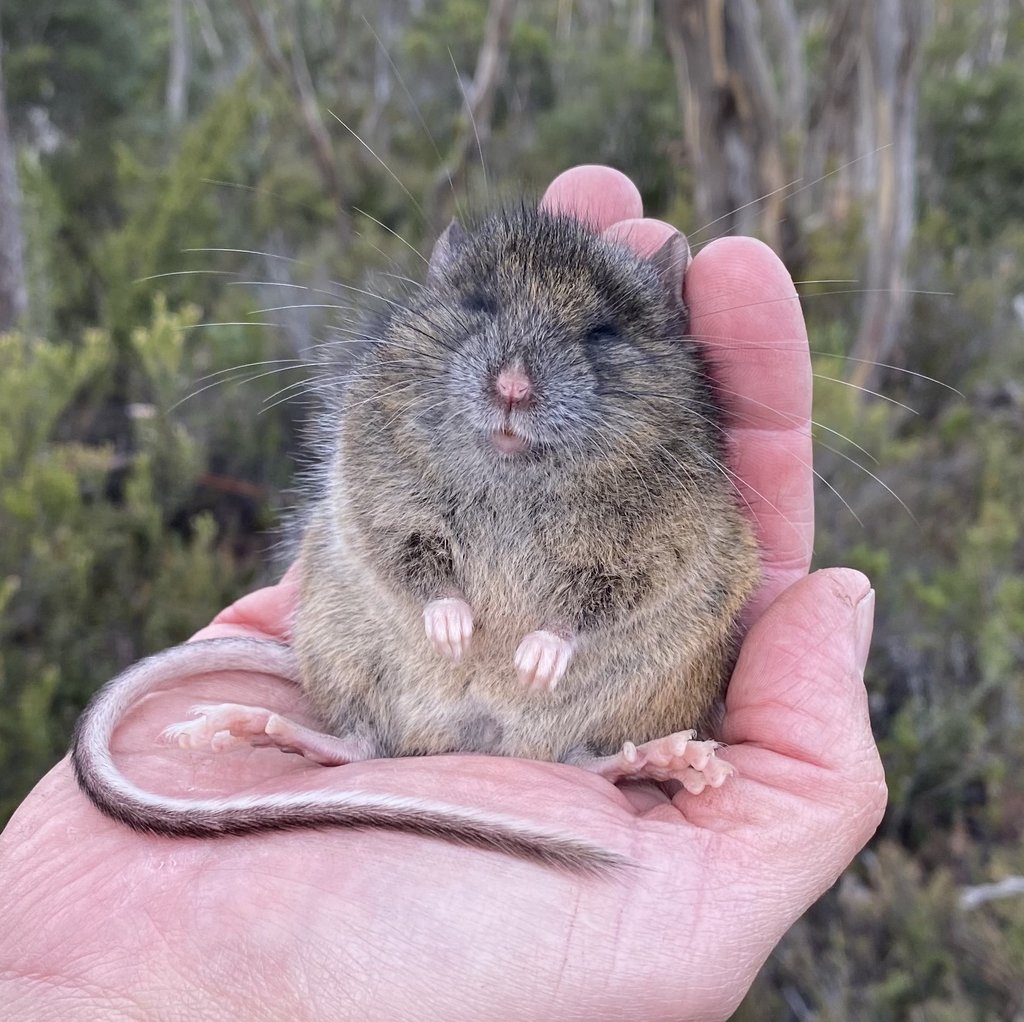
Long-tailed Mouse
Pseudomys higginsi
The long-tailed mouse (Pseudomys higginsi) is a native Australian mammal in the Order Rodentia and the Family Muridae. It is found only on the island of Tasmania. The long-tailed mouse is an omnivore that feeds on insects and a range of plants. It is found in forested areas, particularly in sub-alpine scree, and may live in burrows.
The species reaches a weight of about 70 grams. It is distinguished from other species by its two-tone tail, which is white on the underside and dark above. The tail is 1.3 times longer than the head and body combined. It is speculated that P.higginsi uses its tail for balance while leaping in habitat such as boulder screes.
From the article Long-tailed mouse on Wikipedia (CC BY-SA), quoted section by section
Range & habitat
The long-tailed mouse ranges from sea level to approximately 1,200 m. and seems to prefer habitats that offer high rainfall, such as wet forests. It is a habitat generalist which is resilient to environmental modifications. In a study of short-term responses of native rodents to various logging styles in old growth wet Eucalyptus forests, it was found that the long-tailed mouse was equally abundant across all forestry treatments and was positively correlated to reduced ground cover. Another study found that significantly greater numbers of long-tailed mouse were found in wet disturbed forests and that logging and harvesting did not effect the diversity of the local ecosystem. A conservational study conducted in 2012 was able to compare the historical range of the long-tailed mouse to its current range to determine if this helped predict the risk of extinction. Reduced geographic range size is often a strong predictor of species decline. It was shown that despite modern habitat loss, the long-tailed mouse is less threatened than would be expected from just the loss of its historical habitat ranges.
Wikipedia: “Distribution and habitat”
What it does
The long-tailed mouse is an opportunistic generalist omnivore whose diet is seasonal and varies with local availability. Using fecal analysis, it was found to consume a wide range of plant matter, such as grasses, grains, bamboo, fruits, ferns, and mosses. It was also found to consume fungi and insects of wide varieties.
Wikipedia: “Diet”
Listen
Looking for field recordings…
Where it lives
Recorded sightings
—
geo-referenced records in GBIF, from museums, herbaria and field observers.
Drag the globe to turn it. Dots are where records exist, not a range map; darker means more records.
In the stacks
Searching the stacks…
Every page naming Pseudomys higginsi in the Biodiversity Heritage Library →
This page is assembled live from iNaturalist, GBIF, Wikipedia, the Source Library and the Internet Archive. It is not yet part of the hand-edited codex. iNaturalist taxon 45216.