- Animals
- ›Chordates
- ›Vertebrates
- ›Mammals
- ›Therians
- ›Placental Mammals
- ›Primates, Rodents, and Allies
- ›Rodents
- ›Mice, Rats, and Hamsters
- ›Muroids
- ›Old World Mice and Rats
- ›Murines
- ›Typical Old World Rats
- ›Rattus
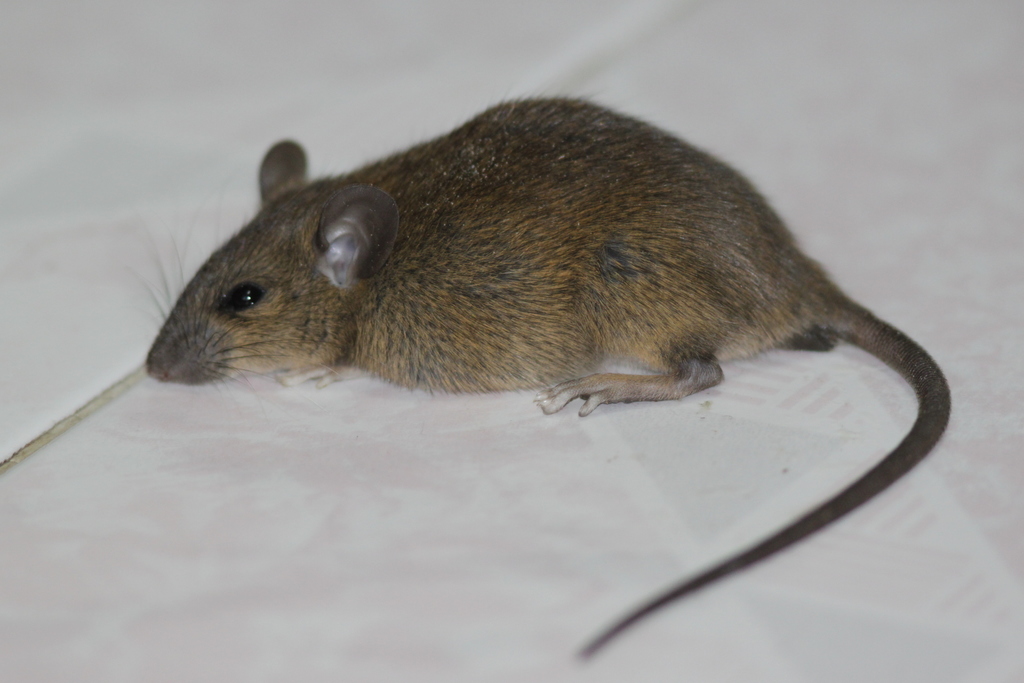
Polynesian Rat
Rattus exulans
The Polynesian rat, Pacific rat or little rat (Rattus exulans), or kiore, is the third most widespread species of rat in the world behind the brown rat and black rat. Contrary to its vernacular name, the Polynesian rat originated in Southeast Asia, and like its relatives has become widespread, migrating to most of Polynesia, including New Zealand, Easter Island, and Hawaii. It shares high adaptability with other rat species extending to many environments, from grasslands to forests. It is also closely associated with humans, who provide easy access to food. It has become a major pest in most areas of its distribution.
From the article Polynesian rat on Wikipedia (CC BY-SA), quoted section by section
Description
The Polynesian rat is similar in appearance to other rats, such as the black rat and the brown rat. It has large, round ears, a pointed snout, black/brown hair with a lighter belly, and comparatively small feet. It has a thin, long body, reaching up to 15 cm (5.9 in) in length from the nose to the base of the tail, making it slightly smaller than other human-associated rats. Where it exists on smaller islands, it tends to be smaller still – 11.5 cm (4.5 in). It is commonly distinguished by a dark upper edge of the hind foot near the ankle; the rest of its foot is pale.
Range & habitat
The Polynesian rat is widespread throughout the Pacific and Southeast Asia. Mitochondrial DNA analysis suggests that the species originated on the island of Flores. The IUCN Red List considers it native to Bangladesh, all of mainland Southeast Asia, and Indonesia, but introduced to all of its Pacific range (including the island of New Guinea), the Philippines, Brunei, and Singapore, and of uncertain origin in Taiwan. It cannot swim over long distances, so is considered to be a significant marker of the human migrations across the Pacific, as the Polynesians accidentally or deliberately introduced it to the islands they settled. The species has been implicated in many of the extinctions that occurred in the Pacific amongst the native birds and insects; these species had evolved in the absence of mammals and were unable to cope with the predation pressures posed by the rat. This rat also may have played a role in the complete deforestation of Easter Island by eating the nuts of the local palm tree Paschalococos, thus preventing regrowth of the forest. …
Wikipedia: “Distribution and habitat”
What it does
Polynesian rats are nocturnal like most rodents, and are adept climbers, often nesting in trees. In winter, when food is scarce, they commonly strip bark for consumption and satisfy themselves with plant stems. They have common rat characteristics regarding reproduction: they are polyestrous, with gestations of 21–24 days; their litter size is affected by food and other resources (6–11 pups); and weaning takes around another month at 28 days. They diverge only in that they do not breed year round, instead being restricted to spring and summer.
Diet. R. exulans is an omnivorous species, eating seeds, fruit, leaves, bark, insects, earthworms, spiders, lizards, and avian eggs and hatchlings. Polynesian rats have been observed to often take pieces of food back to a safe place to properly shell a seed or otherwise prepare certain foods. This not only protects them from predators, but also from rain and other rats. These "husking stations" are often found among trees, near the roots, in fissures of the trunk, and even in the top branches. In New Zealand, for instance, such stations are found under rock piles and fronds shed by nīkau palms.
Wikipedia: “Behaviour”
Listen
Looking for field recordings…
Where it lives
Recorded sightings
—
geo-referenced records in GBIF, from museums, herbaria and field observers.
Drag the globe to turn it. Dots are where records exist, not a range map; darker means more records.
In the stacks
Searching the stacks…
Every page naming Rattus exulans in the Biodiversity Heritage Library →
This page is assembled live from iNaturalist, GBIF, Wikipedia, the Source Library and the Internet Archive. It is not yet part of the hand-edited codex. iNaturalist taxon 44574.