- Animals
- ›Chordates
- ›Vertebrates
- ›Mammals
- ›Therians
- ›Placental Mammals
- ›Primates, Rodents, and Allies
- ›Rodents
- ›Squirrels, Dormice, and Mountain Beavers
- ›Squirrels
- ›Ground and African Tree Squirrels
- ›Holarctic Ground Squirrels
- ›Urocitellus
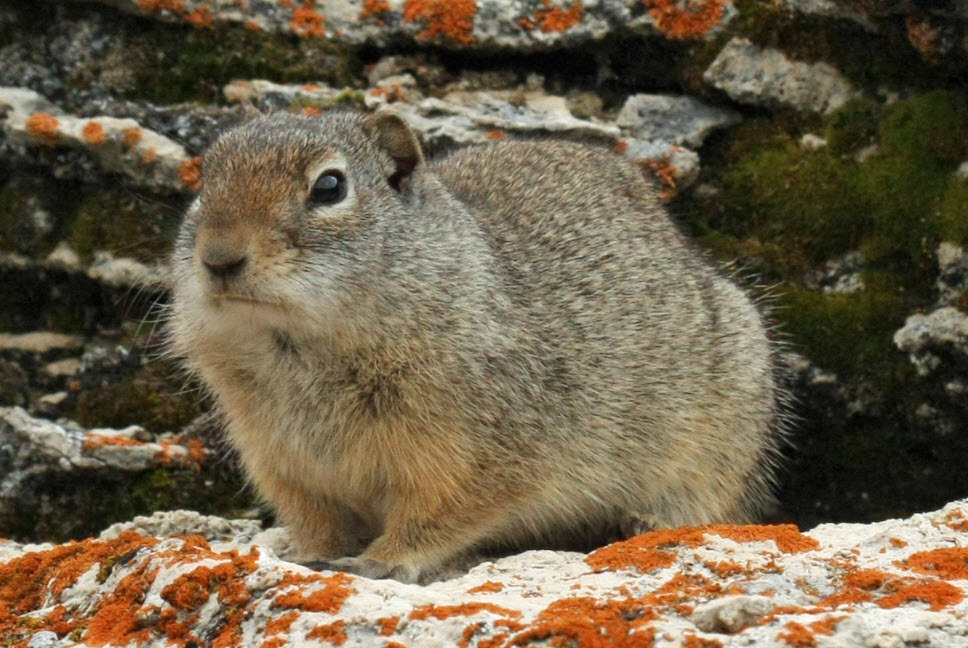
Uinta Ground Squirrel
Urocitellus armatus
The Uinta ground squirrel (Urocitellus armatus), commonly called a "chisler" and Potgut in northern Utah, is a species of rodent native to the western United States.
From the article Uinta ground squirrel on Wikipedia (CC BY-SA), quoted section by section
Description
The Uinta ground squirrel is a moderately sized ground squirrel, measuring 28 to 30 cm (11 to 12 in) in total length. They weigh about 210 g (7.4 oz) when they emerge from hibernation, a figure that steadily increases until they are ready to hibernate again in the fall. Their fur is brown to cinnamon in color, being paler on the underside and grey on the sides of the head and neck. The 6 to 8 cm (2.4 to 3.1 in) tail is buff with a grey underside, as distinct from the ochraceous or reddish color found in closely related species such as Belding's or Wyoming ground squirrels. Females have ten teats.
Range & habitat
First described from the Uinta Mountains, the squirrels are found in Wyoming west of the Green River, in southwestern Montana, eastern Idaho, and northern and central Utah. They inhabit open areas, such as meadows, pasture, and shrub-steppe habitats, at elevations between 1,220 and 2,440 m (4,000 and 8,010 ft). There are no recognised subspecies.
Wikipedia: “Distribution and habitat”
What it does
Uinta ground squirrels are primarily herbivorous, and mostly eat grass, seeds, and the leaves of forbs, along with a small amount of earthworms and discarded human food. The exact composition of the diet changes throughout the year. They have been observed to have a preference for common dandelions, Taraxacum officinale, in their feeding habits. Their most common predators are coyotes, badgers, weasels, and raptors. Although they often live in colonies, adults react aggressively towards one another outside of the breeding season, with females being more intolerant than males. Males mark their territories with scent glands in their cheeks, which they rub on the ground, but do not mark the entrances to their burrows. The squirrels greet one another by sniffing, escalating to threat postures and bristling the hair on their tails, and eventually to wrestling, boxing, and chasing if the intruder does not retreat. The squirrels make six distinct vocalisations: chirps, squeals, squawks, trills, growls, and teeth clattering. These are used primarily as a means of gaining attention, and all are used in aggressive interactions between individuals. …
Wikipedia: “Behavior”
Listen
Looking for field recordings…
Where it lives
Recorded sightings
—
geo-referenced records in GBIF, from museums, herbaria and field observers.
Drag the globe to turn it. Dots are where records exist, not a range map; darker means more records.
In the stacks
Searching the stacks…
Every page naming Urocitellus armatus in the Biodiversity Heritage Library →
This page is assembled live from iNaturalist, GBIF, Wikipedia, the Source Library and the Internet Archive. It is not yet part of the hand-edited codex. iNaturalist taxon 179994.