- Animals
- ›Chordates
- ›Vertebrates
- ›Mammals
- ›Therians
- ›Placental Mammals
- ›Primates, Rodents, and Allies
- ›Rodents
- ›Squirrels, Dormice, and Mountain Beavers
- ›Squirrels
- ›Beautiful and Palm Squirrels
- ›Beautiful Squirrels and Allies
- ›Callosciurus
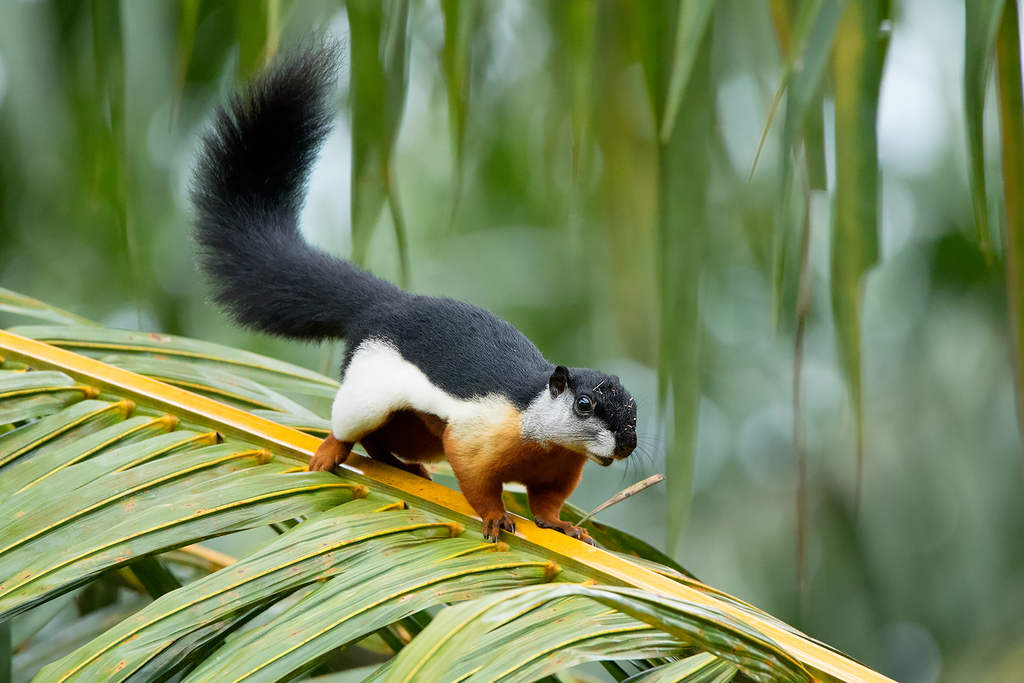
Prevost's Squirrel
Callosciurus prevostii
Prevost's squirrel or Asian tri-coloured squirrel (Callosciurus prevostii) is a colourful species of rodent in the family Sciuridae. It is found in forests in the Thai-Malay Peninsula, Sumatra, Borneo and nearby smaller islands, with an introduced population in northern Sulawesi. Although the Prevost's squirrel is declining in some regions because of habitat loss and hunting, the species is not considered threatened since it generally remains common and widespread. It can live in somewhat disturbed habitats and often visits plantations or gardens. It mostly feeds on plant material, especially fruits, but also takes insects.
From the article Prevost's squirrel on Wikipedia (CC BY-SA), quoted section by section
Description
The Prevost's squirrel is a medium-sized squirrel, but one of the larger species in its range, although clearly surpassed by the giant squirrels and giant flying squirrels of the region. The head-and-body of the Prevost's squirrel typically is 20–27 cm (8–11 in) long and the tail length is about the same; it weighs 250–500 g (9–18 oz). Individuals from small islands tend to be smaller in size than those from medium-small islands, but on large islands this pattern is reversed.
In general, the subspecies of the Prevost's squirrel have been described based on their colour patterns. While there are significant geographical variations, there are also some individual variations within each region. The underparts are always reddish-orange to rich rufous. The typical form, including the subspecies of the Thai-Malay Peninsula (C. p. prevostii and others), is among the most colourful mammals in the world with its black upperparts and tail, reddish-orange underparts, whitish thighs and flanks, and grey to grey-white cheeks. Some subspecies from elsewhere are quite similar, like the grey-cheeked C. p. rafflesii of southern Sumatra and black-cheeked C. p. melanops of eastern Sumatra, as well as those from southwestern Borneo. …
Wikipedia: “Appearance and taxonomy”
What it does
The Prevost's squirrel is active during the day and mostly stays in trees, only occasionally moving on the ground. The 1–3 young are born after a gestation that lasts around seven weeks. The nest is made of sticks, bark and grass.
Feeding. This squirrel eats fruits, nuts, seeds, buds, flowers, insects and bird eggs. They have been observed feeding on durians such as Durio graveolens. These squirrels carry the fruits far from the tree and drop the seeds when finished with their meal. This seed distribution away from the parent plant increases survival for the fruiting plant species.
== References ==
Wikipedia: “Behaviour”
Listen
Looking for field recordings…
Where it lives
Recorded sightings
—
geo-referenced records in GBIF, from museums, herbaria and field observers.
Drag the globe to turn it. Dots are where records exist, not a range map; darker means more records.
In the stacks
Searching the stacks…
Every page naming Callosciurus prevostii in the Biodiversity Heritage Library →
This page is assembled live from iNaturalist, GBIF, Wikipedia, the Source Library and the Internet Archive. It is not yet part of the hand-edited codex. iNaturalist taxon 45955.