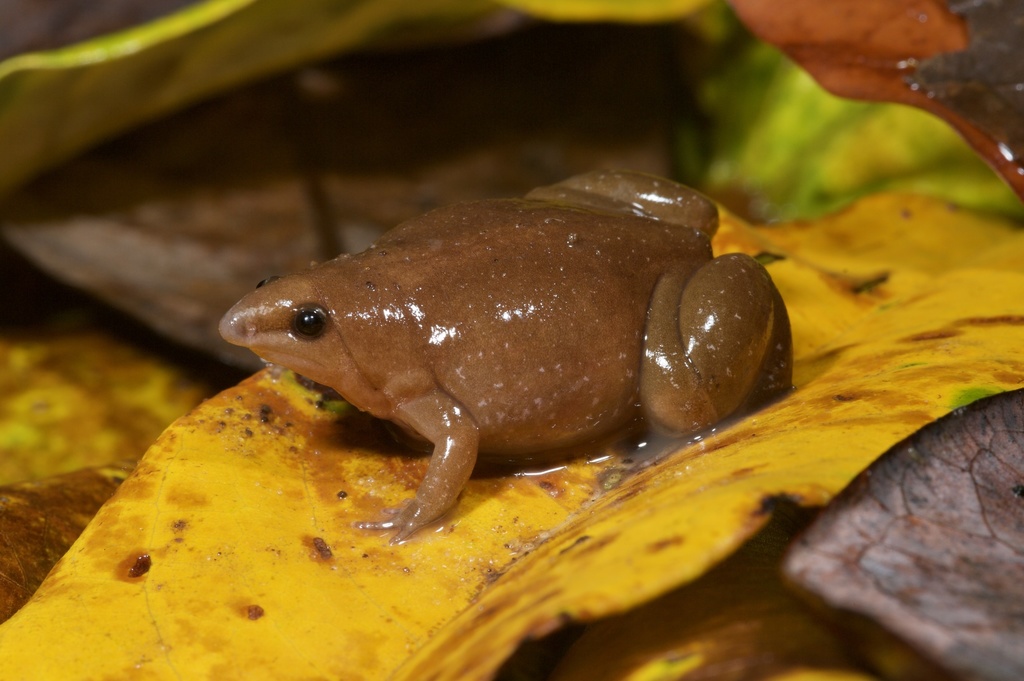
Synapturanus mesomorphus
Synapturanus mesomorphus Fouquet, Leblanc, Fabre, Rodrigues, Menin, Courtois, Dewynter, Hölting, Ernst, Peloso & Kok, 2021
Synapturanus is a genus of microhylid frogs. They are found in northern South America. The common name disc frogs has been coined for the genus. Because of their fossorial life style, their natural history is poorly known.
From Wikipedia (CC BY-SA), quoted section by section
Description
Females are larger than males. Breeding males have a glandular swelling on the wrist. Males and females are otherwise similar. The largest species is Synapturanus mirandaribeiroi, which reaches a snout–vent length of at least 37 mm (1.5 in).
What it does
Synapturanus are fossorial and mostly nocturnal tropical rainforest frogs found in the leaf litter and soft soils. Calling takes place usually during rain, which apparently triggers the calling. Eggs are deposited terrestrially in a small burrow below the soil surface. The tadpoles are endotrophic (developing without external food sources). Stomach contents have included nematodes and various arthropods (ants, termites, and spiders).
Where it has been recorded
Recorded sightings
—
geo-referenced records in GBIF, from museums, herbaria and field observers.
Drag the globe to turn it. Dots are where records exist, not a range map; darker means more records.
In the stacks
Searching the stacks…
Every page naming Synapturanus mesomorphus in the Biodiversity Heritage Library →
From the Catalogue of Life (catalogueoflife.org), compiled from its specialist databases; CC BY 4.0. This name in the Catalogue of Life.