- Animales
- ›Cordados
- ›Vertebrados
- ›Mamíferos
- ›Marsupiales y placentarios
- ›Placentarios
- ›Monos, roedores y parientes
- ›Roedores
- ›Ratones, ratas, hámsters, lemmings, topillos, jerbos, meteoritos y pericotes
- ›Muroidea
- ›Ratas y ratones del viejo mundo
- ›Múridos Murinos
- ›Hydromyini
- ›Pseudomys
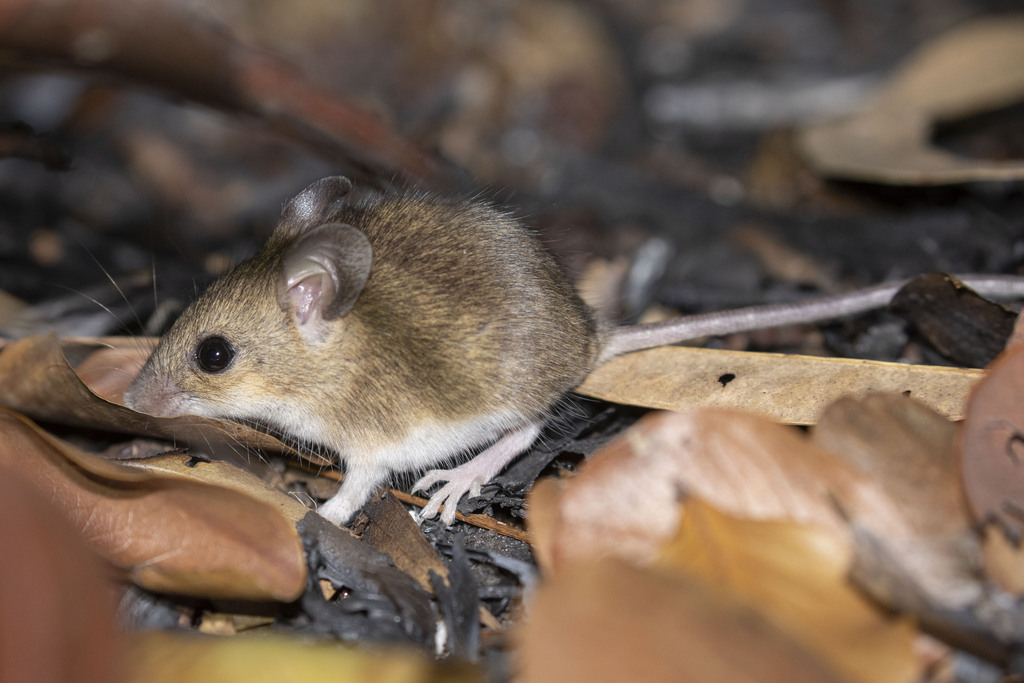
Pseudomys delicatulus
The little native mouse (Pseudomys delicatulus), also known as the delicate mouse, is a species of rodent in the family Muridae. The Kunwinjku people of western Arnhem Land call this little creature kijbuk.
It is found in Australia in Western Australia, the Northern Territory, Queensland, and New South Wales and in Papua New Guinea.
Del artículo Little native mouse de Wikipedia (CC BY-SA), citado sección por sección
Descripción
The little native mouse has fur that is yellow-brown to grey-brown above and white underneath. It is the smallest of all Australian native mice with a head and body length of 55–75 mm (2.2–3.0 in) with adults of both sexes being roughly the same in size, weight (6–15 g (0.21–0.53 oz)) and colour. In Arnhem Land, the only place the species has been studied at length, breeding takes place in July and August. Two to four young are born in a grass-lined nesting chamber after a gestation of 28–31 days. At birth the eyes are shut and the ears tightly folded back, they develop quickly and are independent of the mother around four weeks of age.
Wikipedia: «Description and behaviour»
Distribución y hábitat
The species is found in sandy, well drained, sparsely covered savanna. The animal lives in hollow logs, under pieces of bark, or in burrows, the design of which varies with local conditions: in hard granite sand ridges the burrow is shallow, intricately constructed retreats with many false passages and one main nesting chamber; in sandy conditions the burrows are deep simple structures around two metres long and with only one main chamber. It occasionally excavates burrows in termite mounds.
Wikipedia: «Habitat»
Escuchar
Buscando grabaciones de campo…
Dónde vive
Avistamientos registrados
—
registros georreferenciados en GBIF, de museos, herbarios y observadores de campo.
Arrastra el globo para girarlo. Los puntos marcan dónde hay registros, no un mapa de distribución; más oscuro significa más registros.
En los depósitos
Buscando en los depósitos…
Todas las páginas que nombran Pseudomys delicatulus en la Biodiversity Heritage Library →
Esta página se compone en directo a partir de iNaturalist, GBIF, Wikipedia, la Source Library y el Internet Archive. Aún no forma parte del códice editado a mano. Taxón 45215 de iNaturalist.