- Animales
- ›Cordados
- ›Vertebrados
- ›Mamíferos
- ›Marsupiales y placentarios
- ›Placentarios
- ›Monos, roedores y parientes
- ›Monos, simios y parientes
- ›Monos, Chimpancés y Tarseros
- ›Monos y Chimpancés
- ›simios y monos del Viejo Mundo
- ›Macacos, colobos y babuinos
- ›Cercopitecos, Macacos, Papiones, Mangabais y parientes
- ›Monos Africanos
- ›Erythrocebus
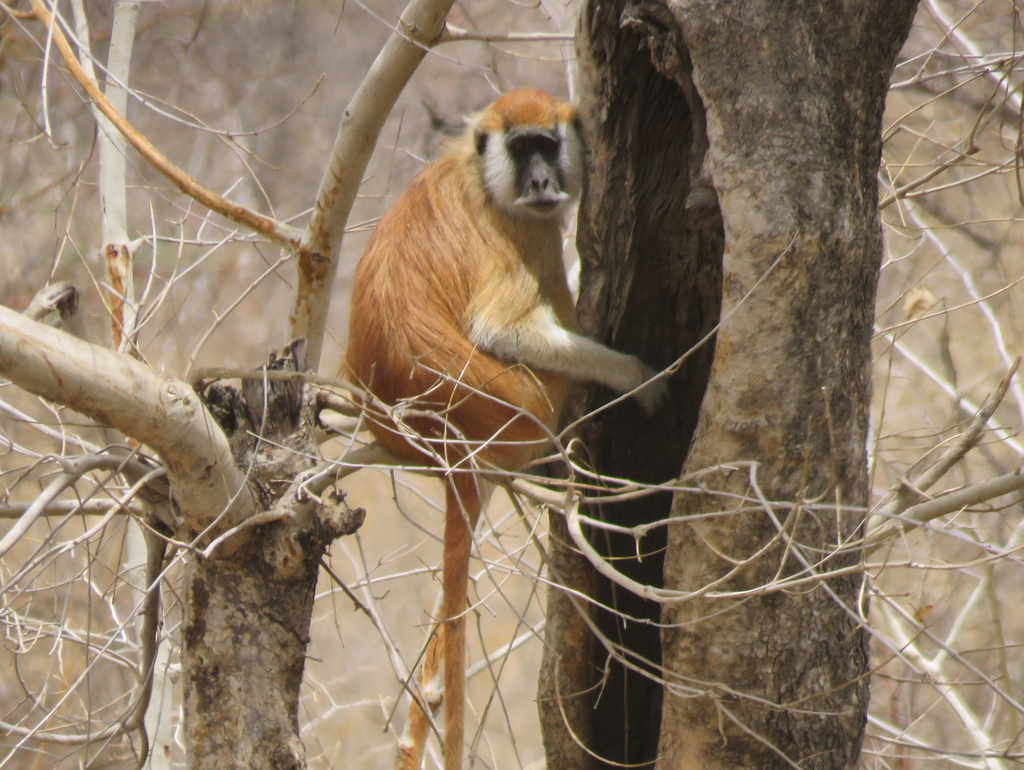
Mono Patas del Dinde
Erythrocebus poliophaeus
The Blue Nile patas monkey (Erythrocebus poliophaeus) or Heuglin's patas monkey is a species of Old World monkey found in Africa along the Blue Nile river valley in Ethiopia, Sudan, and potentially South Sudan. While first described in 1862, it was synonymized with the common patas monkey (E. patas) in 1927. A 2017 study reclassified it as a distinct species.
Del artículo Blue Nile patas monkey de Wikipedia (CC BY-SA), citado sección por sección
Descripción
This species has white hairs on upper lip hair which forms the shape of a handlebar moustache. This, when combined with the lack of the band between the ear and eye found in other members of Erythrocebus, distinguishes it from the rest of the genus.
Wikipedia: «Description»
Distribución y hábitat
This species is thought to be restricted to the area between the Nile and the western escarpment of the Great Rift Valley. It ranges from the vicinity of Metemma south to the Sudd. Although it is only known from Ethiopia and Sudan, it could potentially occur in South Sudan. In prehistoric times, this species may have had its range restricted to a montane refugium in western Ethiopia, through which it survived a period of aridification.
Wikipedia: «Distribution»
Escuchar
Buscando grabaciones de campo…
Dónde vive
Avistamientos registrados
—
registros georreferenciados en GBIF, de museos, herbarios y observadores de campo.
Arrastra el globo para girarlo. Los puntos marcan dónde hay registros, no un mapa de distribución; más oscuro significa más registros.
En los depósitos
Buscando en los depósitos…
Todas las páginas que nombran Erythrocebus poliophaeus en la Biodiversity Heritage Library →
Esta página se compone en directo a partir de iNaturalist, GBIF, Wikipedia, la Source Library y el Internet Archive. Aún no forma parte del códice editado a mano. Taxón 1369317 de iNaturalist.