- Animales
- ›Insectos, arácnidos y crustáceos
- ›Hexápodos
- ›Insectos
- ›Insectos alados
- ›Mariposas y polillas
- ›Mariposas diurnas
- ›Mariposas patas de cepillo
- ›mariposas carey, parche, ojos de venado y parientes
- ›mariposas parche, lunitas y parientes
- ›Euphydryas
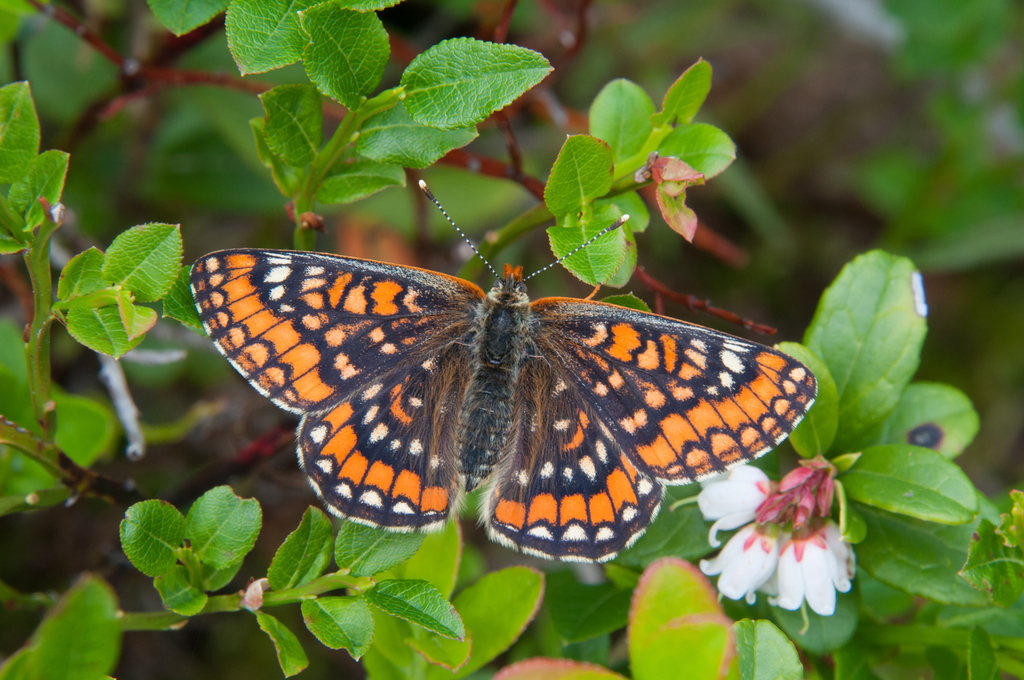
Euphydryas maturna
The scarce fritillary (Euphydryas maturna) is a species of butterfly in the family Nymphalidae. It is found in Austria, Bulgaria, Czech Republic, Finland, France, Germany, Greece, Hungary, Kazakhstan, Lithuania, Luxembourg, Poland, Romania, Russia, Serbia and Montenegro, and Sweden. and East across the Palearctic to Mongolia.
Del artículo Scarce fritillary de Wikipedia (CC BY-SA), citado sección por sección
Descripción
The scarce fritillary's wingspan ranges from 35 to 42 mm. The upper sides of the wings have a black-brown ground colour with a pattern of orange bands and a distinguished pattern of white spots. The veins and margins are black and brown. The pigmentation on the wing underside is orange and the details are blurred. The underside forewings exhibit a wide range of different shades of light and dark orange, the underside hindwings are orange with black-bordered white spots. Especially the pattern of the front wing undersides is washed out. The caterpillar larvae reach up to 30 mm in length when fully grown. They are dark colored with strikingly bright, yellow spots. They have a large amount of dark tubercules and hairs across its length. The pupae tend to be white with dark spots and yellow warts on the abdomen.
Wikipedia: «Description»
Distribución y hábitat
The butterfly scarce fritillary can be found in moist, light terrain which is overgrown by ash trees and ash bushes. Its population has decreased rapidly in Central Europe and in some areas they are no longer to be found.
Wikipedia: «Habitat»
Lo que hace
The females lay their striking red eggs on the undersides of ash leaves for which they often choose seedlings that are approximately 2 meters (6.5 feet) high. The entire hoard is laid in a layered cluster with a diameter of only 1 cm (0.39 inch). The choice of the right place for the eggs is very important as it has to fit certain criteria. Temperature, humidity and light conditions all have to be met exactly. This is why, occasionally, if it has been a strong year for the population of the scarce fritillary butterfly, several females can be seen laying their eggs on the same leaf. After hatching, the young caterpillars weave a cocoon around the entire leaf which they then all inhabit together. They eat only certain parts of the leaves, leaving a very distinct damage pattern of curled up leaves and their cocoons behind which makes the species easy to identify. From the end of June onwards the caterpillars, which until then have grown to an approximate size of 1 cm (0.39 inch) in length, leave their plant by letting themselves drop to the ground or by falling off with the dry leaves. Small groups then hide in piles of leaves to hibernate. They develop to lead a solitary life and are also starting to broaden their diet by including other plants only in the subsequent spring. …
Wikipedia: «Life cycle»
Toxicidad
The Fritillary butterfly is threatened by extinction and is one of Germany's most endangered species of butterflies. On the IUCN Red List they are marked as "critically endangered" whereas in Austria they are marked one rank below as "endangered". They are also marked in sections II and IV of the FHH guidelines (Habitats Directive; Lit. Fauna-Flora-Habitat-Guideline). The decline of the species is accounted to the loss of their habitats because of forestry, the draining of wetlands and the agricultural use of former biotopes. Another reason for their diminishing numbers are insecticides which were initially used against pine procession moths but which interfered with the shedding process of not only the moths but also scarce fritillary and many other kinds of butterflies as well.
== References ==
Wikipedia: «Endangerment and protection»
Escuchar
Buscando grabaciones de campo…
Dónde vive
Avistamientos registrados
—
registros georreferenciados en GBIF, de museos, herbarios y observadores de campo.
Arrastra el globo para girarlo. Los puntos marcan dónde hay registros, no un mapa de distribución; más oscuro significa más registros.
En los depósitos
Buscando en los depósitos…
Todas las páginas que nombran Euphydryas maturna en la Biodiversity Heritage Library →
Esta página se compone en directo a partir de iNaturalist, GBIF, Wikipedia, la Source Library y el Internet Archive. Aún no forma parte del códice editado a mano. Taxón 100743 de iNaturalist.