- Plantas
- ›Plantas vasculares
- ›Plantas con flores
- ›Magnolias, margaritas y parientes (dicotiledóneas)
- ›Magnolias, guanábanas y afines
- ›Cacao volador y parientes
- ›Myristica
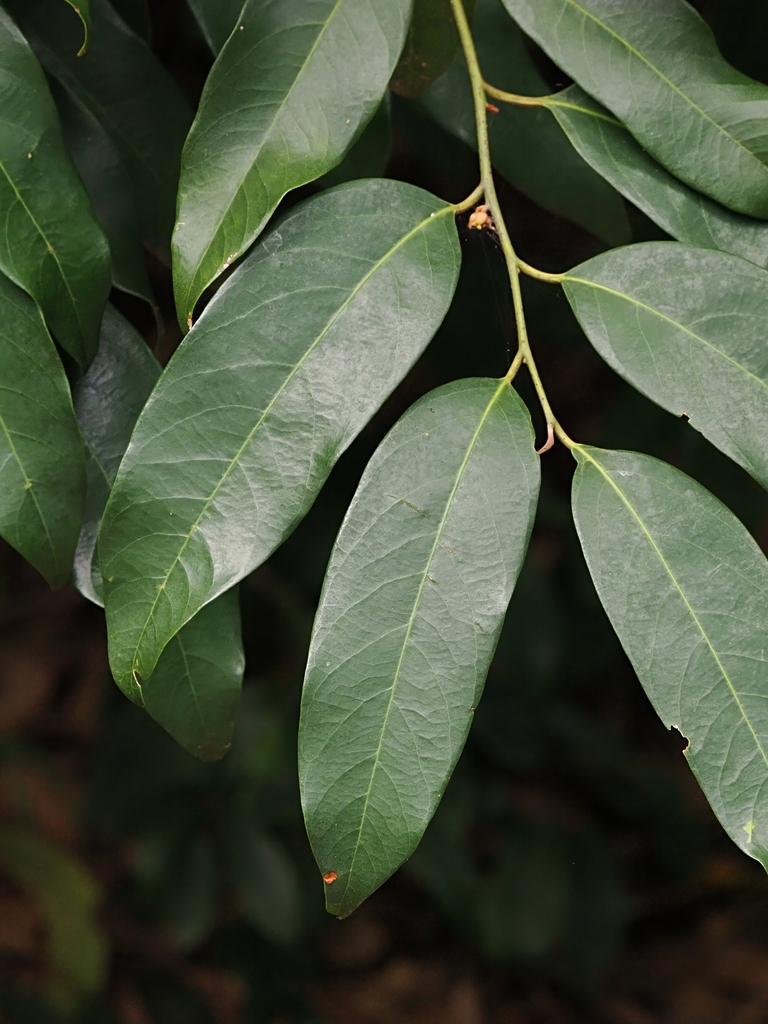
Myristica insipida
Myristica insipida, commonly known in Australia as Australian nutmeg, Queensland nutmeg or native nutmeg, is a small rainforest tree in the family Myristicaceae native to parts of Malesia, Papuasia and Australia. It is closely related to the commercially-important species of nutmeg, M. fragrans.
Del artículo Myristica insipida de Wikipedia (CC BY-SA), citado sección por sección
Descripción
Myristica insipida is a small, single-stemmed tree usually growing up to 16 m (52 ft) in height but it may reach 25 m (82 ft) in certain conditions. The trunk is cylindrical and straight, in mature trees it may exceed 30 cm (12 in) DBH. The bark is dark brown with numerous fine vertical fissures. As with other members of the family, this species displays the distinctive habit known as "myristicaceous branching", in which up to five primary branches are produced in a whorl from the trunk at regular intervals (see Gallery). The branches extend horizontally from the trunk and the twigs carrying the leaves are also held in a horizontal plane, creating a layered appearance. The exstipulate leaves are simple and alternate, dark green and glabrous (hairless) on the upper surface, much paler and glabrescent (almost glabrous) underneath, with 6 to 14 pairs of lateral or secondary veins. They are elliptic to ovate in shape, often with an acuminate tip (commonly called a "drip tip"). They are variable in size, from 2–7 cm (0.8–2.8 in) wide by 10–25 cm (3.9–9.8 in) long. The petiole, or leaf-stalk, measures between 5 and 15 mm (0.2 and 0.6 in) long and is channelled on the upper side. The lateral veins are evident on both sides of the leaf, while the reticulate (net-like) tertiary venation is only visible on the lower surface. …
Wikipedia: «Description»
Distribución y hábitat
Myristica insipida is native to the Moluccas, New Guinea, north-eastern Western Australia, northern parts of the Northern Territory, and north-eastern Queensland, where it grows in well-developed rainforest and monsoon forest at altitudes from sea level to 1,000 m (3,300 ft). M. i. var. insipida is the only variety found in Western Australia and the Northern Territory, but both are found in Queensland.
Wikipedia: «Distribution and habitat»
Lo que hace
The flowers of M. insipida, as with most plants in this family, are pollinated by a variety of species of small beetles. Fruits are eaten by cassowaries (Casuarius casuarius), musky rat-kangaroos (Hypsiprymnodon moschatus), Victoria's riflebirds (Lophorina victoriae) and various fruit doves (genus Ptilinopus). The tree produces a useful general-purpose timber with a specific gravity of 0.56.
Wikipedia: «Ecology»
En la cultura humana
The genus name Myristica was coined by Carl Linnaeus from the Ancient Greek word μυριστικός (muristikós) meaning "fragrant", and refers to the sweet-smelling oil found in some of the species. The species epithet derives from the Latin word insipidus meaning "tasteless", which is a reference to the poor quality of this species when used as a substitute for nutmeg spice.
Wikipedia: «Etymology»
Dónde vive
Avistamientos registrados
—
registros georreferenciados en GBIF, de museos, herbarios y observadores de campo.
Arrastra el globo para girarlo. Los puntos marcan dónde hay registros, no un mapa de distribución; más oscuro significa más registros.
En los depósitos
Buscando en los depósitos…
Todas las páginas que nombran Myristica insipida en la Biodiversity Heritage Library →
Esta página se compone en directo a partir de iNaturalist, GBIF, Wikipedia, la Source Library y el Internet Archive. Aún no forma parte del códice editado a mano. Taxón 201632 de iNaturalist.