- Animales
- ›Cordados
- ›Vertebrados
- ›Reptiles
- ›Lagartos y serpientes
- ›Lagartos, camaleones, iguanas y parientes
- ›Lagartos verdaderos, anfisbenias y parientes
- ›Lagartijas de pared
- ›Lagartos euroasiáticos
- ›Podarcis
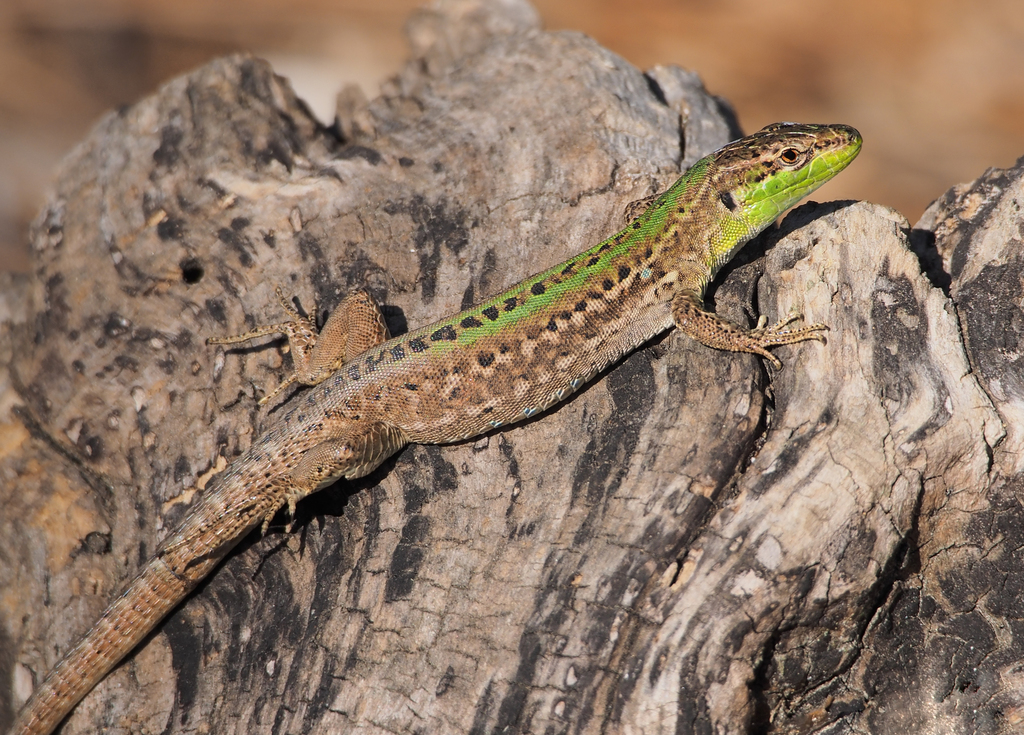
Lagartija Italiana
Podarcis siculus
The Italian wall lizard or ruin lizard (Podarcis siculus, from the Greek meaning foot and agile), is a species of lizard in the family Lacertidae. P. siculus is native to southern and southeastern Europe, but has also been introduced elsewhere in the continent, as well as North America, where it is a possible invasive species. P. siculus is a habitat generalist and can thrive in natural and human-modified environments. Similarly, P. siculus has a generalized diet as well, allowing it to have its large range.
P. siculus is notable for having many subspecies within its large range. Studies evidence how rapidly P. siculus subspecies can become distinguishable from larger populations given geographic isolation. A 2008 study detailed distinct morphological and behavioral changes in a P. siculus population indicative of "rapid evolution".
Del artículo Italian wall lizard de Wikipedia (CC BY-SA), citado sección por sección
Distribución y hábitat
True to its name, P. siculus is native to Italy and is one of the most common lizards there. Its range also includes Bosnia and Herzegovina, Croatia, France, Montenegro, Serbia, Slovenia, and Switzerland, but it has also been introduced to Spain, Turkey, the United States, and Canada.
As an introduced species. Populations of P. siculus in North America have been documented from Topeka, Kansas; Long Island, New York; Greenwich, Connecticut; Levittown, Pennsylvania; Joplin, Missouri; and the Cincinnati area of Ohio, Indiana and Kentucky where P. siculus and P. muralis can both be found in very high concentrations and have become so well established that the Ohio Department of Natural Resources now classifies them as a resident species rather than an invasive species because they are so successful and have been present for so long. Although illegal, it is not uncommon for people in the Cincinnati area to "trade" P. muralis lizards with people who live in areas with high population of P. siculus (often making trades by live shipment in mail) and then releasing significant numbers of the lizards in their own yards and rock walls. The species seems to be extending its range from an initial colonization event in western Long Island, presumably by using railroad tracks as dispersal corridors along the middle East Coast. …
Wikipedia: «Range»
Lo que hace
P. siculus is a habitat generalist and thrives in many natural and human-modified environments. Habitats of P. siculus include forests, grasslands, shrublands, rocky areas, and farmland. It is able to live in such open habitats due to biological characteristics, such as high thermophily, which is the ability to thrive in high temperatures.
Diet. P. siculus is a generalist predator. Its diet consists of a wide variety of invertebrates, mainly arthropods. P. siculus predates on small vertebrates as well. Plant matter comprises a much greater percentage of the diet of P. siculus than other related lizards. There is also a disparity in diet diversity between the sexes, with males having a more diverse diet than females. Contrary to common ecological thought, there is little relationship between habitat area and diet diversity for P. siculus. Different levels of taxonomic prey diversity does not seem to affect the diversity of diets in different P. siculus populations, but insular populations of P. siculus do consume a greater percentage of plant matter as a part of their diet.
Predation. Predators of P. siculus include snakes, birds, and feral cats.
Reproduction. P. siculus is oviparous. Females can lay 3 or 4 clutches of 4-7 eggs per year. The number of eggs laid per clutch does vary by population. …
Wikipedia: «Habitat and ecology»
Dónde vive
Avistamientos registrados
—
registros georreferenciados en GBIF, de museos, herbarios y observadores de campo.
Arrastra el globo para girarlo. Los puntos marcan dónde hay registros, no un mapa de distribución; más oscuro significa más registros.
En los depósitos
Buscando en los depósitos…
Todas las páginas que nombran Podarcis siculus en la Biodiversity Heritage Library →
Esta página se compone en directo a partir de iNaturalist, GBIF, Wikipedia, la Source Library y el Internet Archive. Aún no forma parte del códice editado a mano. Taxón 337045 de iNaturalist.