- Hongos
- ›Setas, royas y tizones
- ›Agaricomycotina
- ›Setas, bejines y parientes
- ›Agaricomycetidae
- ›Hongos con láminas
- ›Agaricineae
- ›Hymenogastraceae
- ›Gymnopilus
- ›Gymnopilus junonius
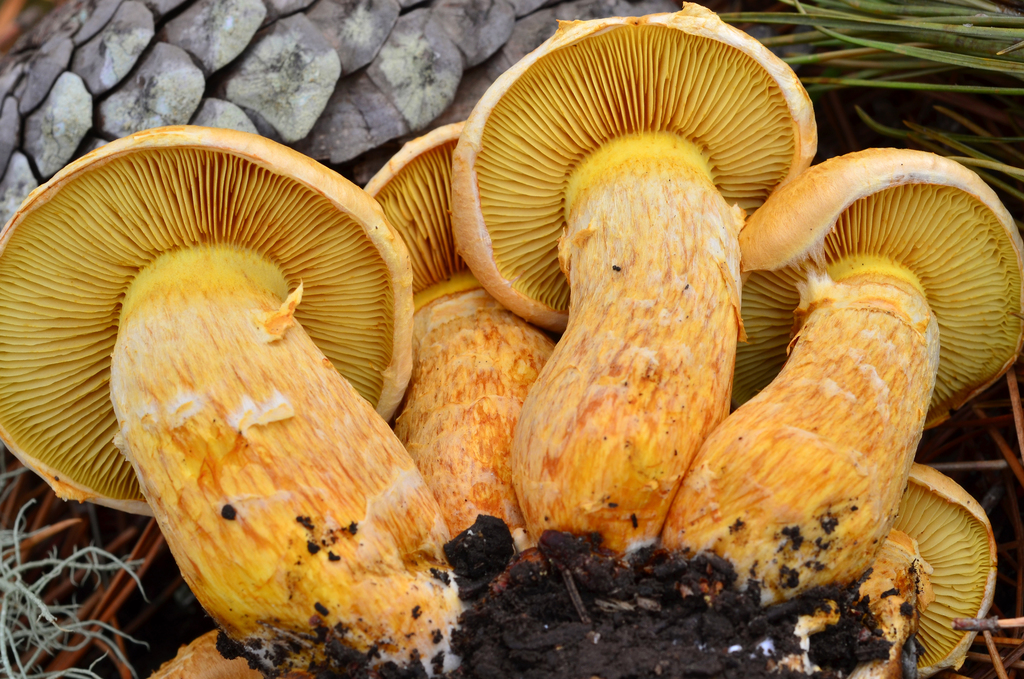
Gymnopilus ventricosus
Gymnopilus ventricosus, commonly known as the jumbo gym or western jumbo gym, is a species of mushroom in the family Hymenogastraceae. It was first described from the Stanford University campus by Franklin Sumner Earle as Pholiota ventricosa in 1902.
Del artículo Gymnopilus ventricosus de Wikipedia (CC BY-SA), citado sección por sección
Descripción
The cap is 5 to 30 cm (2 to 11+3⁄4 in) or larger in diameter, bright yellow-orange to rusty orange, covered with minute yellow hairs, sometimes becoming scaly. The flesh is thick, yellow and bitter. The gills are yellow to rusty orange, close, adnate to slightly decurrent. The stipe is 7-21 cm long, 1-4 cm thick, yellow-orange, streaked with brown fibrils, club-shaped or ventricose, usually narrowed at the base; partial veil yellowish, forming a superior membranous ring. White mycelium at the base of the stipe. Spores are ellipsoid or ovoid, warty, 7.5–9 x 4–5.5μm. The spore print is rusty brown to rusty orange. Clamp connections are present. This species contains no psilocybin, and is considered inedible; it is very bitter.
Wikipedia: «Description»
Distribución y hábitat
Gymnopilus ventricosus grows in groups or dense tufts on dead wood or living pines, also on conifers and hardwoods.
Wikipedia: «Habitat and ecology»
Dónde vive
Avistamientos registrados
—
registros georreferenciados en GBIF, de museos, herbarios y observadores de campo.
Arrastra el globo para girarlo. Los puntos marcan dónde hay registros, no un mapa de distribución; más oscuro significa más registros.
En los depósitos
Buscando en los depósitos…
Todas las páginas que nombran Gymnopilus ventricosus en la Biodiversity Heritage Library →
Esta página se compone en directo a partir de iNaturalist, GBIF, Wikipedia, la Source Library y el Internet Archive. Aún no forma parte del códice editado a mano. Taxón 348809 de iNaturalist.