- Animales
- ›Cordados
- ›Vertebrados
- ›Reptiles
- ›Lagartijas y Serpientes
- ›Lagartijas, camaleones, iguanas y parientes
- ›Agamas, iguanas, anolis y parientes
- ›Iguanas, anolis y otros lagartos del Nuevo Mundo
- ›Lagartijas espinosas, camaleones y parientes
- ›Lagartijas espinosas y parientes
- ›Petrosaurus
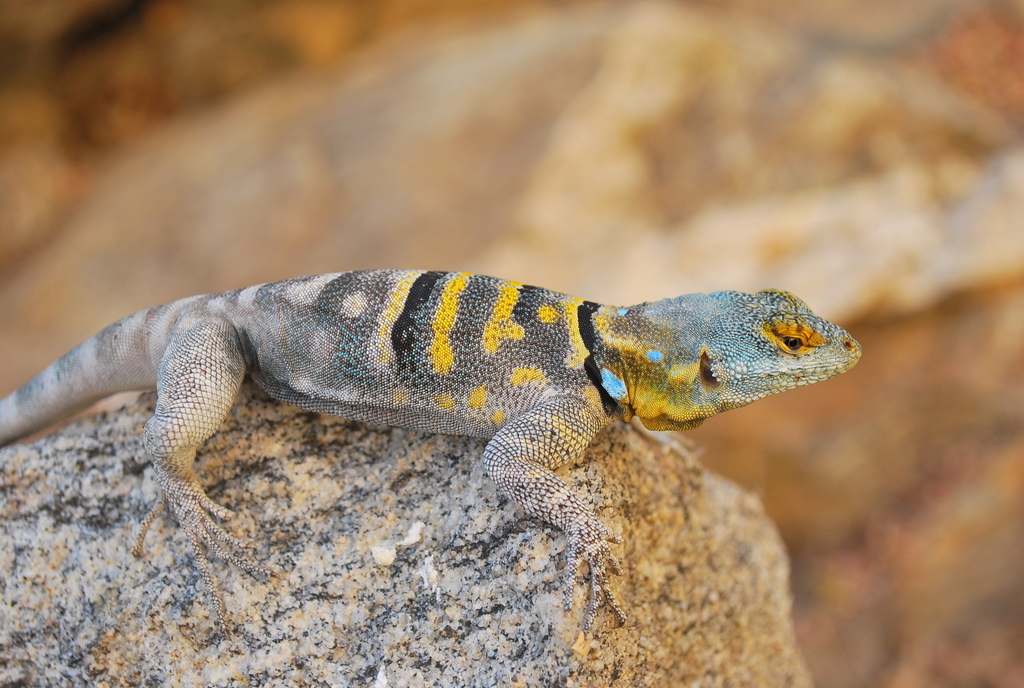
lagartija de piedra sudcaliforniana
Petrosaurus thalassinus
The Baja blue rock lizard (Petrosaurus thalassinus) is a species of large, diurnal phrynosomatid lizard.
Del artículo Baja blue rock lizard de Wikipedia (CC BY-SA), citado sección por sección
Descripción
It reaches up to 45 cm (18 in) long including the tail, and has a flattened body with small, smooth, granular scales and slightly keeled scales near the tail. The head is bluish with red to orange colors around the eyes, yellow neck with blue spots and streaks. The back of the tail is gray blue with darker cross bars. The coloration intensifies during the breeding season in both sexes.
Wikipedia: «Description»
Distribución y hábitat
Petrosaurus thalassinus is most often found in the immediate vicinity of rocky canyons, boulder-strewn hillsides and arroyo bottoms and sea-side cliffs. These lizards appear to be particularly common on rocks near large trees or other vegetation, and rarely seen in areas where vegetation is non-existent.
Wikipedia: «Habitat»
Lo que hace
It prefers temperatures in excess of 90 °F (32 °C) and basks in direct sunlight on desert rocks. A very wary species, its flattened body allows it to quickly retreat into rock crevices to escape predators as well as inclement weather conditions. When threatened, it can extend a skin flap along its throat. Like many lizards, it is able to drop its tail when caught.
Wikipedia: «Behavior»
En la cultura humana
Breeding takes place in the spring. 20 to 30 eggs are laid in late spring and summer, and hatchlings appear after 85 to 88 days in summer and early fall. Sexual maturity is reached after about 2 years with a life expectancy of 20 years.
Wikipedia: «Life history»
Dónde vive
Avistamientos registrados
—
registros georreferenciados en GBIF, de museos, herbarios y observadores de campo.
Arrastra el globo para girarlo. Los puntos marcan dónde hay registros, no un mapa de distribución; más oscuro significa más registros.
En los depósitos
Buscando en los depósitos…
Todas las páginas que nombran Petrosaurus thalassinus en la Biodiversity Heritage Library →
Esta página se compone en directo a partir de iNaturalist, GBIF, Wikipedia, la Source Library y el Internet Archive. Aún no forma parte del códice editado a mano. Taxón 36331 de iNaturalist.