- Plantas
- ›Plantas vasculares
- ›Plantas con flores
- ›pastos, palmeras y parientes (monocotiledóneas)
- ›Espárragos, orquídeas, cebollas y afines
- ›Orquídeas
- ›Epidendroideae
- ›Dendrobieae
- ›Dendrobium
- ›Dendrocoryne
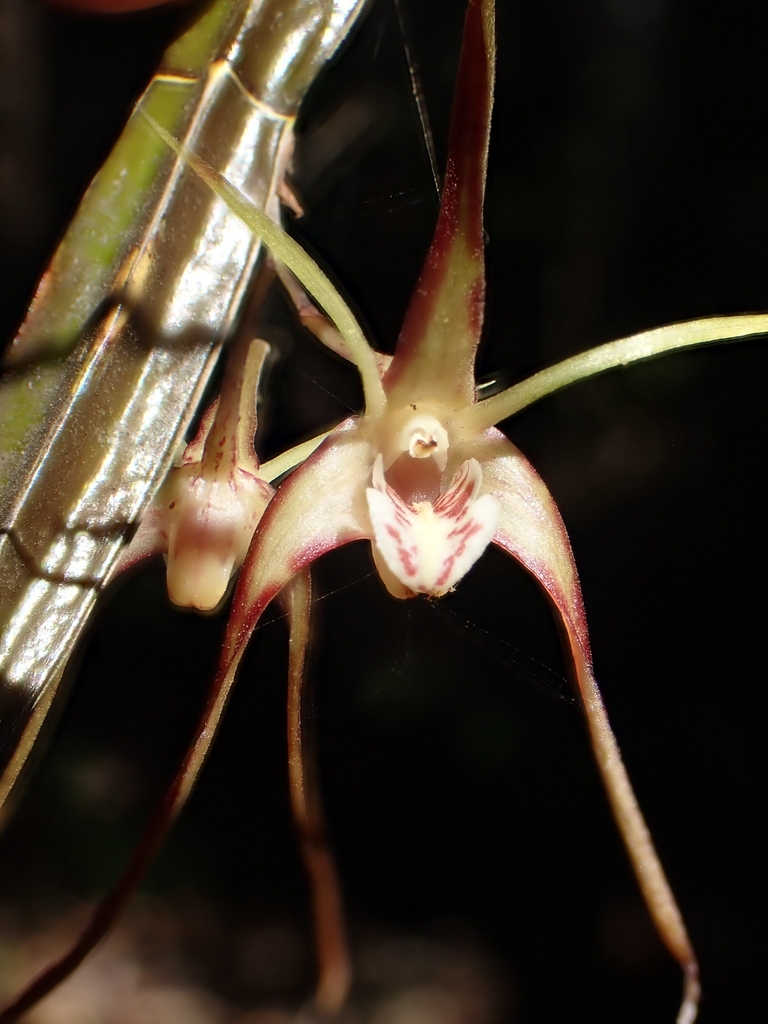
Dendrobium tetragonum
Dendrobium tetragonum, commonly known as the tree spider orchid, is a variable species of epiphytic or lithophytic orchid endemic to eastern Australia. Tree spider orchids are unusual in having pendulous pseudobulbs that are thin and wiry near the base then expand into a fleshy, four-sided upper section before tapering at the tip. There are only a few thin but leathery leaves at the end of the pseudobulbs and up to five flowers on relatively short flowering stems. To allow for the variations in the species there are five subspecies and a variety, some with a unique common name.
Del artículo Dendrobium tetragonum de Wikipedia (CC BY-SA), citado sección por sección
Descripción
Dendrobium tetragonium is an epiphytic or lithophytic herb with pendulous pseudobulbs 150–600 mm (6–20 in) long and 6–9 mm (0.2–0.4 in) wide. The pseudobulbs have a thin, wiry base but expand to a fleshy, four-sided upper section and a tapering tip with between two and five thin but leathery leaves. The leaves are 50–90 mm (2–4 in) long and 15–40 mm (0.6–2 in) wide. The flowering stems are 10–35 mm (0.4–1 in) long and bear up to eight flowers. The number, size and colour of the flowers depend on subspecies. Flower size ranges from 30 to 120 mm (1.2 to 4.7 in) long and 20 to 80 mm (0.79 to 3.1 in) wide. The flowers range in colour from green to pale yellow, sometimes with red blotches and a labellum that ranges in colour from white, to yellowish with red, brown or purplish markings. The sepals range in size from 20 to 70 mm (0.79 to 2.8 in) long and 2 to 5 mm (0.08 to 0.2 in) wide and the petals from 10 to 40 mm (0.39 to 1.6 in) long and 1 to 2 mm (0.04 to 0.08 in) wide. The labellum ranges from 8 to 15 mm (0.31 to 0.59 in) long and from 6 to 20 mm (0.24 to 0.79 in) wide. Flowering occurs between April and November.
Wikipedia: «Description»
Distribución y hábitat
Tree spider orchids are usually epiphytes which grow on trees in rainforest or shady places beside streams, but also sometimes on paperbark trees, especially Melaleuca styphelioides and occasionally on rocks. Different forms of the species occur in different areas of coastal or near-coastal New South Wales and Queensland.
Dendrobium tetragonum var. cacatua is found from the Mount Windsor Tableland near Cape Tribulation to the Eungella National Park in Queensland; Subspecies cataractarum is restricted to Connors Range west of the Cape Palmerston National Park in central eastern Queensland; Dendrobium tetragonum subsp. giganteum occurs between the Iron Range and Mackay in Queensland; Dendrobium tetragonum subsp. melaleucaphilum is found from the Blackdown Tableland National Park in Queensland to the Blue Mountains in New South Wales; Dendrobium tetragonum subsp. serpentis is restricted to the northern parts of the Blackdown Tableland; Dendrobium tetragonum subsp. tetragonum ranges from Fraser Island in Queensland to Tomerong in New South Wales.
Wikipedia: «Distribution and habitat»
Dónde vive
Avistamientos registrados
—
registros georreferenciados en GBIF, de museos, herbarios y observadores de campo.
Arrastra el globo para girarlo. Los puntos marcan dónde hay registros, no un mapa de distribución; más oscuro significa más registros.
En los depósitos
Buscando en los depósitos…
Todas las páginas que nombran Dendrobium tetragonum en la Biodiversity Heritage Library →
Esta página se compone en directo a partir de iNaturalist, GBIF, Wikipedia, la Source Library y el Internet Archive. Aún no forma parte del códice editado a mano. Taxón 369241 de iNaturalist.