- Plantas
- ›Plantas vasculares
- ›Plantas con flores
- ›Magnolias, margaritas y parientes (dicotiledóneas)
- ›Laureles, palo hediondo y afines
- ›Laureles, aguacate, canela y parientes
- ›Neolitsea
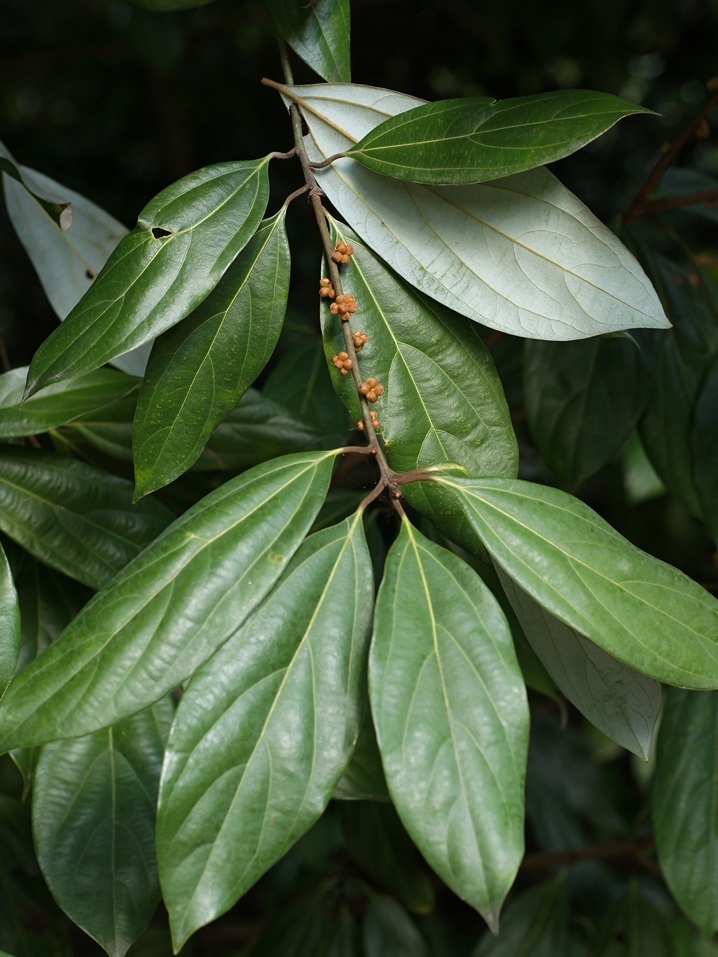
Neolitsea dealbata
Neolitsea dealbata, also known as white bolly gum, hairy-leaved bolly gum, or simply bolly gum (amongst others), is a shrub or small tree in the laurel family Lauraceae which is native to New South Wales and Queensland in Australia.
Del artículo Neolitsea dealbata de Wikipedia (CC BY-SA), citado sección por sección
Descripción
The bolly gum is an evergreen tree growing up to 15 m (49 ft) high, the trunk can reach 30 cm (12 in) diameter and may be buttressed. The twigs are densely covered in fine brown hairs on the younger parts and are terete (circular in cross-section). The leaves are generally elliptic but may be obovate or lanceolate, and new growth is also covered in brown hairs. They measure between 7 and 22 cm (2.8 and 8.7 in) long by 3 and 8 cm (1.2 and 3.1 in) wide. The upper surface is glossy green, the underside is whitish or glaucous. The inflorescence is an umbel produced in the leaf axils or directly from the twigs. There are up to five flowers per umbel, cream, yellow or pale brown in colour, and measuring from 2 to 8 cm (0.79 to 3.15 in) long. The female flowers are about half as long as male ones. The globose (roughly spherical) fruit is a drupe up to 11 mm (0.43 in) in diameter, green when immature and dark red to black when ripe, and they contain a single seed.
Wikipedia: «Description»
Distribución y hábitat
The bolly gum has a wide distribution on the coast and adjacent tablelands of eastern Australia, stretching from islands of the Torres Strait south to the Illawarra region south of Sydney. It is an understory species found in rainforest and wet sclerophyll forest on a variety of soil types, and at altitudes from sea level to 1,150 m (3,770 ft).
Wikipedia: «Distribution and habitat»
Lo que hace
This plant is a host species for larvae of the moths Acrocercops ordinatella and Gibbovalva quadrifasciata, as well as the blue triangle butterfly (Graphium sarpedon). Cassowaries (Casuarius casuarius) and fruit doves (genus Ptilinopus) are known to eat the fruit of these trees, and it's likely that many other frugivorous birds do so as well. The fungus Phyllachora queenslandica is found on Neolitsea dealbata.
Wikipedia: «Ecology»
En la cultura humana
The genus name Neolitsea is a combination of the Ancient Greek word néos (meaning "new") and the pre-existing genus name Litsea. The members of Neolitsea were mostly transferred from Litsea. The species epithet dealbata is Latin for "whitewashed", and refers to the white undersides of the leaves.
Wikipedia: «Etymology»
Dónde vive
Avistamientos registrados
—
registros georreferenciados en GBIF, de museos, herbarios y observadores de campo.
Arrastra el globo para girarlo. Los puntos marcan dónde hay registros, no un mapa de distribución; más oscuro significa más registros.
En los depósitos
Buscando en los depósitos…
Todas las páginas que nombran Neolitsea dealbata en la Biodiversity Heritage Library →
Esta página se compone en directo a partir de iNaturalist, GBIF, Wikipedia, la Source Library y el Internet Archive. Aún no forma parte del códice editado a mano. Taxón 369555 de iNaturalist.