- Animales
- ›Insectos, arácnidos y crustáceos
- ›Hexápodos
- ›Insectos
- ›Insectos alados
- ›Mariposas y polillas
- ›Polillas búho
- ›Polillas Búho
- ›Noctuinae
- ›Prodeniini
- ›Spodoptera
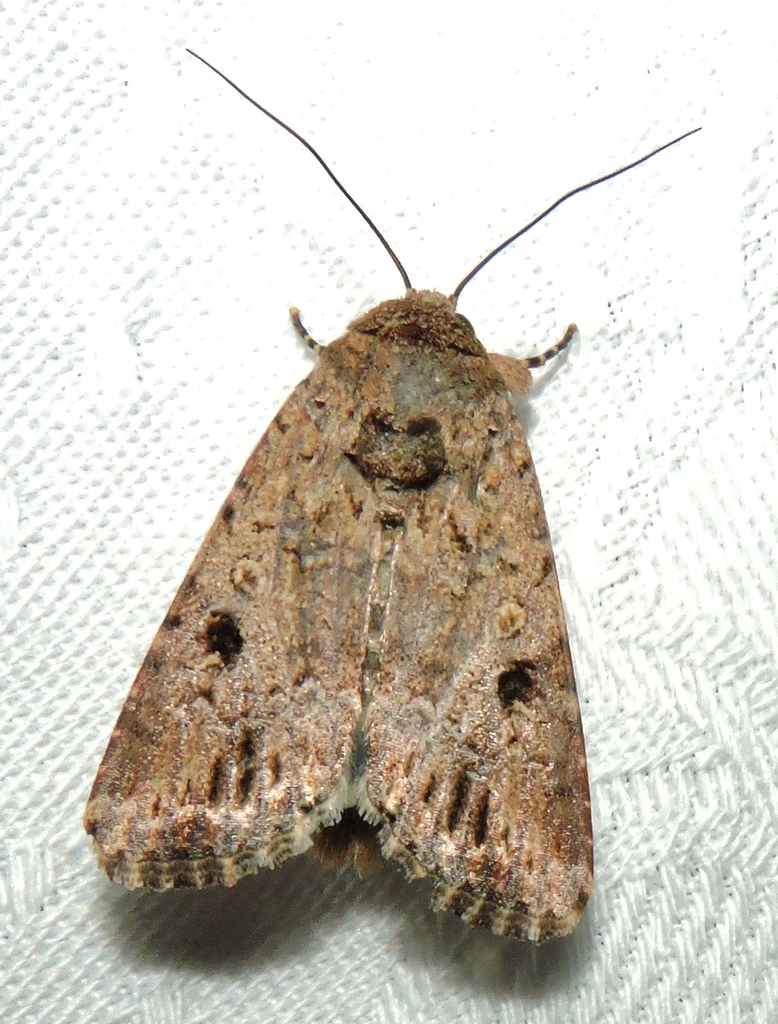
Spodoptera exempta
The African armyworm (Spodoptera exempta), also called okalombo, kommandowurm, or nutgrass armyworm, is a species of moth of the family Noctuidae. The larvae often exhibit marching behavior when traveling to feeding sites, leading to the common name "armyworm". The caterpillars exhibit density-dependent polyphenism where larvae raised in isolation are green, while those raised in groups are black. These phases are termed solitaria and gregaria, respectively. Gregaria caterpillars are considered very deleterious pests, capable of destroying entire crops in a matter of weeks. The larvae feed on all types of grasses, early stages of cereal crops (e.g., corn, rice, wheat, millet, sorghum), sugarcane, and occasionally on coconut. The solitaria caterpillars are less active and undergo much slower development. The species is commonly found in Africa, but can also be seen in Yemen, some Pacific islands, and parts of Australia. African armyworm outbreaks tend to be devastating for farmland and pasture in these areas, with the highest-density outbreaks occurring during the rainy season after periods of prolonged drought. During the long dry seasons ("off-season"), the population densities are very low and no outbreaks are seen.
Del artículo African armyworm de Wikipedia (CC BY-SA), citado sección por sección
Distribución y hábitat
The African armyworm is commonly found in the grasslands of Africa and Asia. Within Africa, it is mostly seen near the Sahara in the following countries: Tanzania, Kenya, Uganda, Ethiopia, Somalia, Malawi, Zimbabwe, Zambia, and South Africa. Outside of Africa, the species also inhabits southwest Saudi Arabia, Southeast Asia, Australia, and New Zealand.
Wikipedia: «Geographic range»
Lo que hace
S. exempta are a serious pest for crops, often thriving during the wet seasons and leading to outbreaks. There are two types of African armyworm outbreaks: primary and secondary. Primary outbreaks occur with relatively inconspicuous, low-density populations that can survive without frequent rainfall. Secondary outbreaks occur when the moths from the primary outbreak are carried downwind and the adults mate and lay eggs in same location due to wind patterns. During these secondary outbreaks, gregaria larvae emerge from the ground synchronously, and their density may exceed 1,000 larvae per m2. These larvae display highly active feeding behavior, leading to excessive consumption of the nearby vegetation, especially the leaves of cereal crops and grasses. If extremely hungry, the gregaria larvae may also consume the stem and flowers of the plants. The high-density gregaria larvae may then pupate and emerge as adults, leading to a large migration event of moths that travel downwind together. These moths will then develop their eggs together, resulting in more outbreaks. The intensity of outbreaks also increases during the start of the wet season after a drought, which allows moths to lay eggs in areas of dense vegetation which supports the larval stage growth.
Wikipedia: «Outbreak behavior»
En la mesa
S. exempta larvae feed almost exclusively on Poaceae, also called Gramineae. Poaceae is a family of flowering grasses which includes cereal grasses and the grasses of grasslands and pastures. The species targets most cereal crops, including maize, sorghum, rice, millet, and other grasses. Young caterpillars are also known to feed on wheat and oat seedlings. The larvae eat the upper and lower surfaces of the plant tissue first, preferring to feed on younger and recently germinated crops. Studies have shown that two larvae can completely consume a 10-day-old maize plant with 6–7 leaves, indicating the devastating potential of a high-density outbreak.
Wikipedia: «Food resources»
Escuchar
Buscando grabaciones de campo…
Dónde vive
Avistamientos registrados
—
registros georreferenciados en GBIF, de museos, herbarios y observadores de campo.
Arrastra el globo para girarlo. Los puntos marcan dónde hay registros, no un mapa de distribución; más oscuro significa más registros.
En los depósitos
Buscando en los depósitos…
Todas las páginas que nombran Spodoptera exempta en la Biodiversity Heritage Library →
Esta página se compone en directo a partir de iNaturalist, GBIF, Wikipedia, la Source Library y el Internet Archive. Aún no forma parte del códice editado a mano. Taxón 397396 de iNaturalist.