- Plantas
- ›Plantas vasculares
- ›Helechos y parientes
- ›Helechos y parientes
- ›Salviniales
- ›Oreja de ratón
- ›Azolla
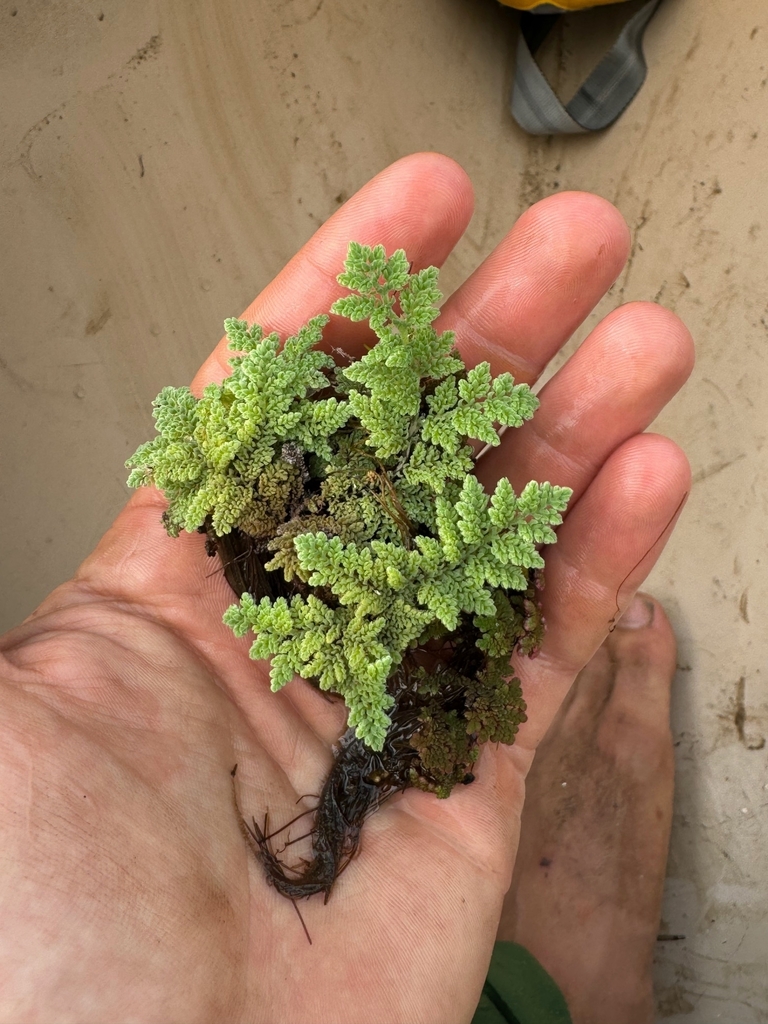
Azolla nilotica
Azolla nilotica is a medium-sized floating fern, that naturally occurs in the Nile and in eastern and central Africa. It is assigned to the family Salviniaceae.
Del artículo Azolla nilotica de Wikipedia (CC BY-SA), citado sección por sección
Descripción
Azolla nilotica is a floating water-bound fern of up to 32 cm (13 in) long, with a long, horizontal, branched, hairy rhizome of up to 2 mm (0.079 in) thick. Side branches are alternately set. The hairy roots spring in bundles from the nodes. Each leaf consists of an elliptic to broadly ovate green upper lobe of up to 2 mm (0.079 in) long, with a rounded or broadly pointed tip, with a nobbly middle and a broad translucent edge. The lower lobe lacks colour, is smaller, thinner and contains a cavity that holds the symbiont cyanophyte, that fixes aerial nitrogen making nitrate available to the plant. Azolla species have two types of spores (a state called heterosporous), small macrospores and minute microspores. The spore forming organs (called sporocarps) grow in the axils of the older leaves. In case of A. nilotica, the sporocarps occur in groups of four, and may consist of any combination of macrosporocarps and groups of microsporocarps (or massulae). A. nilotica differs from other Azolla species by its larger habit, whereas other species, particularly those of the subgenus Azolla break into cm size fragments. A. nilotica also has its roots in bundles while all other species have single roots. The upper lobe of the leaf is larger than the lower, in contrast to A. filiculoides where the lower leaf is larger in outline. …
Wikipedia: «Description»
Distribución y hábitat
The species can be found in the eastern half of Africa, from southern Sudan, and South-Sudan to the Democratic Republic of Congo, Gabon, Rwanda, Burundi, Uganda, Kenya, Tanzania, Malawi, Mozambique, Zambia, and Zimbabwe. Late Holocene fossil spores have been found in the Nile Delta, among Cyperus papyrus. It may have gone extinct with the demise of large areas of papyrus reeds, due to the reclaim of these swamps for agriculture.
Wikipedia: «Distribution»
Lo que hace
Azolla nilotica has a symbiotic relationship with cyanobacteria that fix gaseous nitrogen into nitrate, of a species that has variously been called Anabaena azollae, Nostoc azollae or Trichormus azollae. It occurs in stagnant or slowly streaming water, such as temporary pools, waterholes and lake edges, and can persist on drying mud. It occurs from sea level to an altitude of 1650 m. It is intolerant of temperatures below 10 °C (50 °F), so there is little risk that the species will become naturalised outside of the tropics.
Wikipedia: «Ecology and habitat»
En la cultura humana
The species name nilotica refers to the fact that it was collected from the river Nile.
Wikipedia: «Etymology»
Dónde vive
Avistamientos registrados
—
registros georreferenciados en GBIF, de museos, herbarios y observadores de campo.
Arrastra el globo para girarlo. Los puntos marcan dónde hay registros, no un mapa de distribución; más oscuro significa más registros.
En los depósitos
Buscando en los depósitos…
Todas las páginas que nombran Azolla nilotica en la Biodiversity Heritage Library →
Esta página se compone en directo a partir de iNaturalist, GBIF, Wikipedia, la Source Library y el Internet Archive. Aún no forma parte del códice editado a mano. Taxón 445201 de iNaturalist.