- Animales
- ›Insectos, arácnidos y crustáceos
- ›Hexápodos
- ›Insectos
- ›Insectos alados
- ›Mariposas y polillas
- ›Tortricoidea
- ›Enrolladores y parientes
- ›Enrolladores
- ›Archipini
- ›Archips
- ›Archips xylosteana
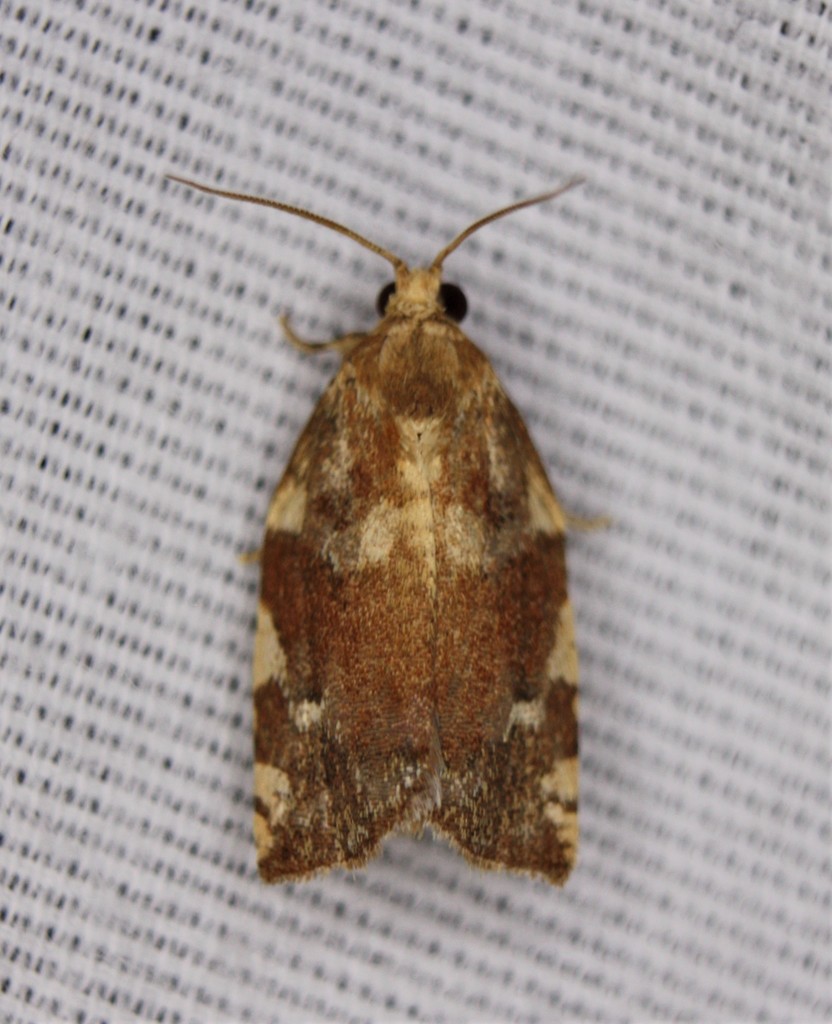
Archips semiferanus
Archips semiferanus (also known as Archips semiferana) is a species of moth in the family Tortricidae, and one of several species of moth commonly known as oak leafroller or oak leaf roller. The larvae feed on the leaves of oak trees in the eastern United States and southeastern Canada and are a major defoliator of oak trees, which can lead to tree mortality. In Pennsylvania in the late 1960s and early 1970s, oak leafrollers defoliated over 1,045,000 acres (423,000 ha).
Adult Archips semiferanus moths lay masses of 40 to 50 eggs on oak tree branches and rough bark in July; these overwinter and hatch the next spring. The larvae eat tree buds and young leaves, then roll leaves together with silk (hence the name). They nest and eat inside the rolled leaves, then pupate in the leaves or crevices in June. After a few weeks the adult moths emerge, mate and lay the next generation of eggs.
Del artículo Archips semiferanus de Wikipedia (CC BY-SA), citado sección por sección
Descripción
Oak leafroller moths lay their eggs in July each year, in groups of 40 to 50. The female covers the eggs with hairs from her body; they are deposited on "the base of large branches and rough bark patches on both tree trunks and limbs". The flat egg masses are white-gray in color and oval shaped, and are about 4.8 millimetres (0.19 in) across. The eggs overwinter and hatch in spring of the next year. The larvae (or caterpillars) emerge in April and initially eat the buds of oak trees and young leaves inside them. When fully grown, the larvae are between 25 and 29 millimetres (0.98 and 1.14 in) long with a body that can be yellow-green or darker shades of green. Other identifying characteristics in the larvae include pale legs and a head that is either black or has "a dark eye patch or a dark bar". The larvae feed and nest inside leaves which they have rolled or folded until they are ready to pupate in mid-June. The larvae pupate in cocoons which are found inside the rolled leaves or in "bark crevices". After a week or two in the pupal stage, the adult moths emerge in late June or early July. The moths are small with a wingspan of 18 to 22 millimetres (0.71 to 0.87 in); the wings have a characteristic bell shape. Wing color can vary considerably. Forewings are a mixture of "creamy brown and gray" with gray found at the wingtips. …
Wikipedia: «Description and life cycle»
Distribución y hábitat
Archips semiferanus is found in the eastern United States and adjoining portions of southeastern Canada. It has been found in US states including Connecticut, Massachusetts, New York, Pennsylvania, Texas, Virginia, and West Virginia. They may have been introduced to the United Kingdom. The oak leafrollers feed on all types of oak trees, but are especially prone to infestations in northern red oak, scarlet oak, and species found on mountain and ridge tops such as chestnut oak and white oak. In addition to oaks, Archips semiferanus have been known to feed on witchhazel and apple trees occasionally. In addition to the oak leafrollers, other pest species will often feed on the same oak trees, including Croesia semipurpurana and other oak leaftiers. The young larvae eat the buds and either destroy developing leaves, or cause leaves to develop with many holes in them. This can severely stress the tree's food reserves, and the older larvae can eat nearly all the remaining leaves, defoliating them. When trees are defoliated two or more years in a row, "extensive tree mortality" can result. Dead wood in affected trees is attacked by fungi such as the shoestring root fungus and wood borers like the twolined chestnut borer. Tiadaghton State Forest in north central Pennsylvania was especially hard hit. …
Wikipedia: «Distribution, habitat, and behavior»
Escuchar
Buscando grabaciones de campo…
Dónde vive
Avistamientos registrados
—
registros georreferenciados en GBIF, de museos, herbarios y observadores de campo.
Arrastra el globo para girarlo. Los puntos marcan dónde hay registros, no un mapa de distribución; más oscuro significa más registros.
En los depósitos
Buscando en los depósitos…
Todas las páginas que nombran Archips semiferanus en la Biodiversity Heritage Library →
Esta página se compone en directo a partir de iNaturalist, GBIF, Wikipedia, la Source Library y el Internet Archive. Aún no forma parte del códice editado a mano. Taxón 465083 de iNaturalist.