- Animales
- ›Insectos, arácnidos y crustáceos
- ›Hexápodos
- ›Insectos
- ›Insectos alados
- ›Escarabajos y parientes
- ›Adephaga
- ›Caraboidea
- ›Escarabajos tigre
- ›Cicindelini
- ›Cicindelina
- ›Cicindela
- ›Cicindela
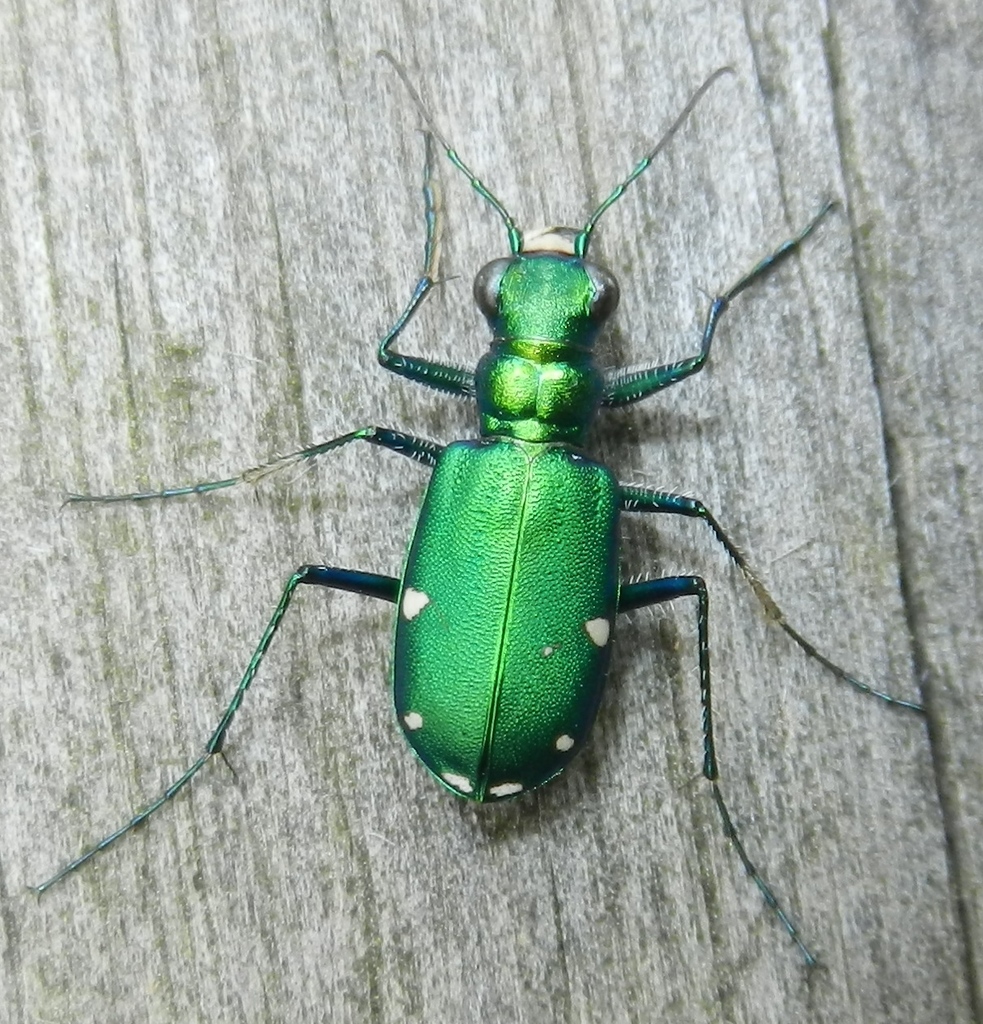
Cicindela sexguttata
The six-spotted tiger beetle, also known as the six-spotted green tiger beetle (Cicindela sexguttata), is a common North American species of tiger beetle in the Cicindelinae subfamily. It is common in many areas of the United States, and is well known. It is recognized for its bright green color and its flight pattern. The beetle is largely harmless to humans and may live as long as three years.
Del artículo Cicindela sexguttata de Wikipedia (CC BY-SA), citado sección por sección
Descripción
They are commonly found in deciduous forests in between Minnesota, southeastern Canada and south to eastern Texas, excluding the Florida Panhandle, and are easily recognizable by their large, white, overlapping mandibles. The adult is 12–14 mm (1/2-5/8") in length, and has fairly long legs. The mandibles give these attractive insects a ferocious appearance. While tiger beetles are voracious predators of small arthropods, they do not bite humans unless handled. Both the common name and the species name refer to the six small white spots on the beetle's metallic-green to metallic-blue-green elytra. This is not always the case, however, as some individuals may have more spots, fewer spots, or none at all, presumably due to genetic variation. This species is associated with wooded areas and they are often found in sunlit patches clear of undergrowth such as dirt paths and fallen logs where they hunt caterpillars, ants, spiders, and many other kinds of arthropods. Although tiger beetles are not gregarious, many beetles may sometimes be seen in one suitable hunting area. The female lays her eggs in sandy patches, and the larvae burrow into the ground after they hatch. Here they lie in wait until small arthropods pass by, at which time the larvae lunge out of their burrows at their prey. …
Wikipedia: «Description»
Escuchar
Buscando grabaciones de campo…
Dónde vive
Avistamientos registrados
—
registros georreferenciados en GBIF, de museos, herbarios y observadores de campo.
Arrastra el globo para girarlo. Los puntos marcan dónde hay registros, no un mapa de distribución; más oscuro significa más registros.
En los depósitos
Buscando en los depósitos…
Todas las páginas que nombran Cicindela sexguttata en la Biodiversity Heritage Library →
Esta página se compone en directo a partir de iNaturalist, GBIF, Wikipedia, la Source Library y el Internet Archive. Aún no forma parte del códice editado a mano. Taxón 49566 de iNaturalist.