- Animales
- ›Insectos, arácnidos y crustáceos
- ›Hexápodos
- ›Insectos
- ›Insectos alados
- ›Abejas, avispas, hormigas y parientes
- ›Avispas y abejas de cinturita
- ›Abejas, Hormigas y Avispas punzantes
- ›Abejas y parientes
- ›Abejas y abejorros
- ›Abejas del poliester
- ›Hylaeinae
- ›Hylaeus
- ›Macrohylaeus
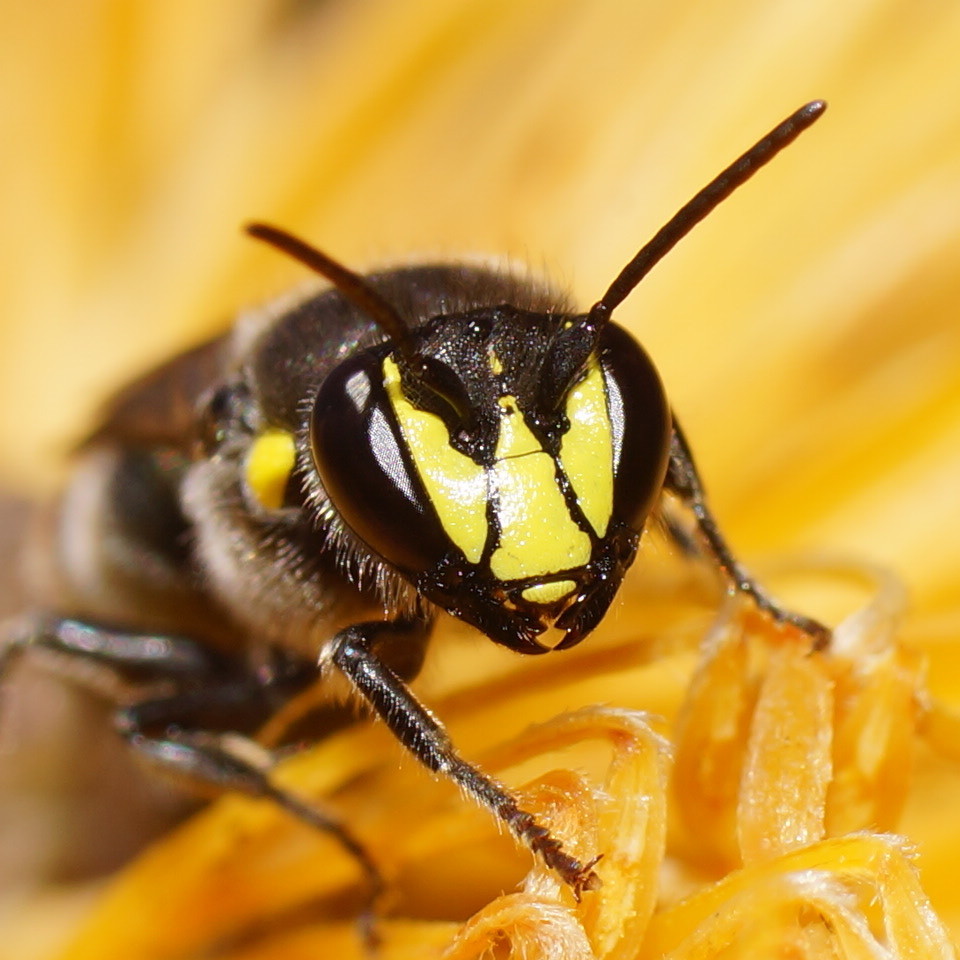
Hylaeus alcyoneus
Hylaeus alcyoneus, commonly known as the banksia bee, is a species of solitary bee in the family Colletidae. It is common in coastal regions of southern Australia. Both sexes are mostly black with a metallic blue abdomen. It is usually found on or near Banksia flowers, but it will visit other flowering species in eastern Australia. In areas with high honeybee densities, the banksia bee produces less nests due to competition for floral resources.
Del artículo Hylaeus alcyoneus de Wikipedia (CC BY-SA), citado sección por sección
Descripción
This is a relatively large and robustly-built species of bee, measuring 8.5-12mm in length. On average, males are significantly larger than females, which is unusual amongst hymenopterans. Both sexes have a black head and thorax, black legs and a metallic blue abdomen. Females have three vertical yellow marks on the face, while in males the face is more extensively yellow. The tubercle next to each wing socket is yellow, and males have a yellow stripe across the front of the thorax (just behind the head). There is a sparse covering of moderately long hair over most of the body and legs. The hair is dark on top of the head, top of the thorax and end of the abdomen, but white everywhere else. Males tend to have denser and more conspicuous hair. Large males have hairier abdomens than smaller males – an example of allometry. Large males have a pair of spines on the underside of the abdomen. These spines are reduced or absent in smaller males, and absent in females. The antennae are black on the upper side and brownish on the underside. In males the first antennal segments (scapes) are slightly expanded and they bear epidermal glands. The mandibles have three teeth in females, two in males.
Wikipedia: «Description»
Distribución y hábitat
The banksia bee is endemic to Australia, with records from Western Australia, South Australia (including Kangaroo Island), Victoria, Tasmania, New South Wales and Queensland. It prefers a temperate climate, but also extends into subtropical zones. It is common in coastal heaths.
Wikipedia: «Distribution and habitat»
Lo que hace
Male banksia bees have evolved resource-defence strategies to maximise their chances of mating. Large males perch on Banksia inflorescences, preferring the flower spikes that are partly opened and high on the tree or shrub. Each individual will typically position itself at or near the top of a spike, looking outwards alertly. Periodically, the wings are beaten rapidly for several seconds. At the same time, the abdomen is extended and frequently groomed with the hind legs. This is believed to be a way of dispersing pheromones produced by glands in the abdomen. The rapid wing-beating display is often triggered by the approach of other insects, and researchers have even triggered it by throwing small bits of dark wood. If a rival male attempts to land on an occupied Banksia flower spike, violent fights can occur, which involve chasing, biting, grappling and thumping with the abdomen. Grappling pairs commonly tumble from the spike before one male returns alone to claim it. Larger males have a more strongly developed pair of spines on the underside of the abdomen, and they almost always win these battles. Small males are forced to perch on flower spikes that are closer to the ground, or to non-aggressively patrol circuits that take them from one flower spike to another in search of unmated females. …
Wikipedia: «Male behaviour»
Escuchar
Buscando grabaciones de campo…
Dónde vive
Avistamientos registrados
—
registros georreferenciados en GBIF, de museos, herbarios y observadores de campo.
Arrastra el globo para girarlo. Los puntos marcan dónde hay registros, no un mapa de distribución; más oscuro significa más registros.
En los depósitos
Buscando en los depósitos…
Todas las páginas que nombran Hylaeus alcyoneus en la Biodiversity Heritage Library →
Esta página se compone en directo a partir de iNaturalist, GBIF, Wikipedia, la Source Library y el Internet Archive. Aún no forma parte del códice editado a mano. Taxón 511366 de iNaturalist.