- Plantas
- ›Plantas vasculares
- ›Plantas con flores
- ›pastos, palmeras y parientes (monocotiledóneas)
- ›Espárragos, orquídeas, cebollas y afines
- ›irises, gladiolas y parientes
- ›Iridoideae
- ›Irideae
- ›Iris
- ›Longipetalae
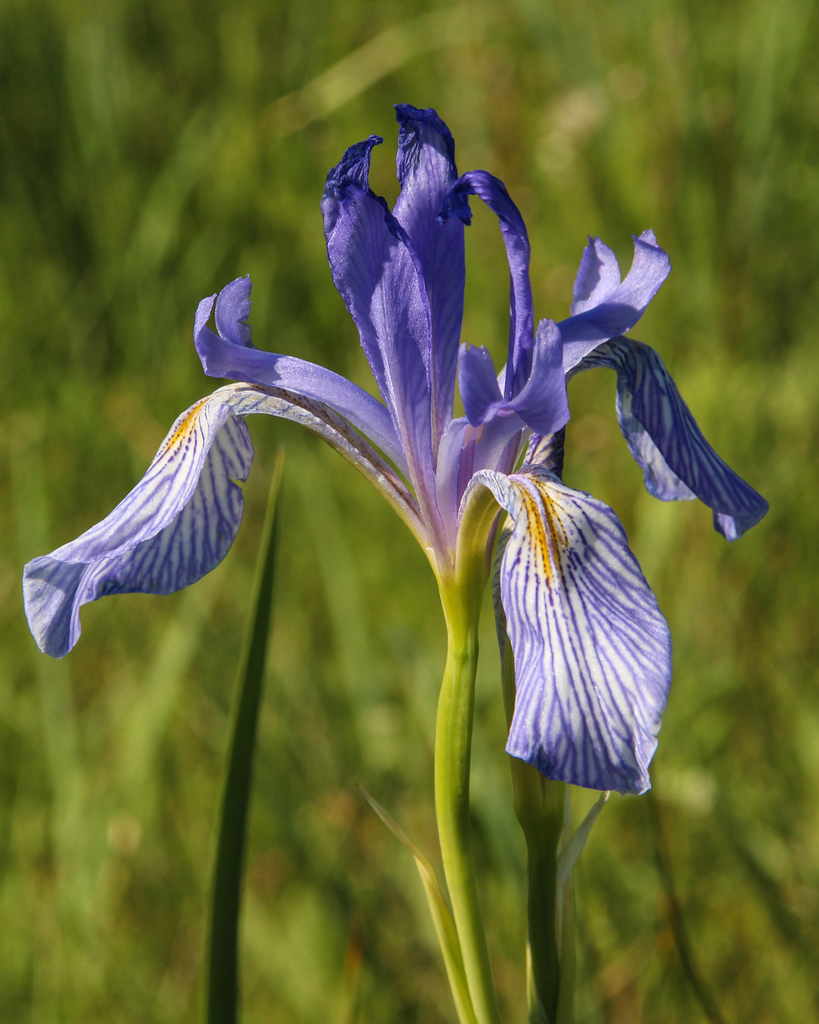
Iris missouriensis
Iris missouriensis (syn. I. montana) is a hardy flowering rhizomatous species of the genus Iris, in the family Iridaceae. Its common names include western blue flag, Rocky Mountain iris, and Missouri flag.
It is native to western North America. Its distribution is varied; it grows at high elevations in mountains and alpine meadows and all the way down to sea level in coastal hills.
Del artículo Iris missouriensis de Wikipedia (CC BY-SA), citado sección por sección
Descripción
Iris missouriensis is an erect herbaceous rhizomatous perennial, 20 to 40 centimetres (7+7⁄8 to 15+3⁄4 in) high, with leafless unbranched scapes (flowering stems) and linear basal leaves, 5 to 10 mm wide, similar in height to the scapes. The inflorescence usually consists of one or two flowers, exceptionally three or four. Each flower has three light to dark blue, spreading or reflexed sepals lined with purple and three smaller upright blue petals. They produce a large fruit capsule. The plant populations often spread outwards from the older plants, leaving a dead opening in the center of a growing ring.
Wikipedia: «Description»
En la mesa
Some Native American tribes made cordage from the plant's stems and leaves. Some Plateau Indian tribes used the roots to treat toothache. The Navajo used a decoction of the plant as an emetic. Plains Indians are said to have extracted the toxin irisin (also known as iridin and irisine) from the plant to use as arrow poison. The Zuni apply a poultice of chewed root to increase the strength of newborns and infants. This iris is listed as a weed in some areas, particularly in agricultural California. It is bitter and distasteful to livestock and heavy growths of the plant are a nuisance in pasture land. Heavy grazing in an area promotes the growth of this hardy iris. The plant is widely cultivated in temperate regions.
Wikipedia: «Uses»
Toxicidad
The plant is toxic, particularly the rootstalks, which contain the potentially lethal iridin.
Wikipedia: «Toxicity»
Dónde vive
Avistamientos registrados
—
registros georreferenciados en GBIF, de museos, herbarios y observadores de campo.
Arrastra el globo para girarlo. Los puntos marcan dónde hay registros, no un mapa de distribución; más oscuro significa más registros.
En los depósitos
Buscando en los depósitos…
Todas las páginas que nombran Iris missouriensis en la Biodiversity Heritage Library →
Esta página se compone en directo a partir de iNaturalist, GBIF, Wikipedia, la Source Library y el Internet Archive. Aún no forma parte del códice editado a mano. Taxón 57730 de iNaturalist.