- Plantas
- ›Plantas vasculares
- ›Plantas con flores
- ›Magnolias, margaritas y parientes (dicotiledóneas)
- ›Leguminosas, hierbas lecheras y afines
- ›Leguminosas
- ›Huizaches, sensitivas, plumerillos y parientes
- ›Acacia
- ›Plurinerves
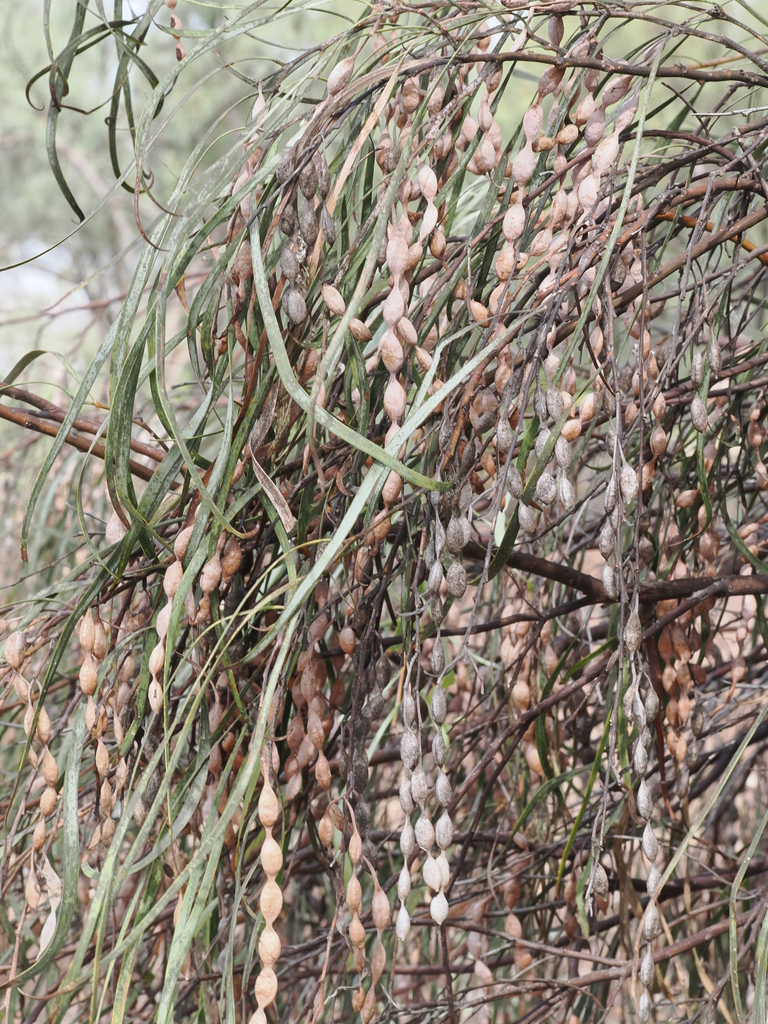
Acacia de agujetas
Acacia stenophylla
Acacia stenophylla, commonly referred to as the shoestring acacia, is an evergreen tree in the family Fabaceae and native to Australia. It is not considered rare or endangered.
Del artículo Acacia stenophylla de Wikipedia (CC BY-SA), citado sección por sección
Descripción
Acacia stenophylla varies in characteristic and size from a rounded, multi-stemmed shrub to a spreading tree. A. stenophylla grows from 4–20 m (13–66 ft) tall, often stemming into branches at the trunk from about 1 m (3.3 ft). Bark is dark-grey to blackish and rough, branchlets are smooth to sericeous and sometimes angular. The phyllodes are strap-like, 15–40 cm (5.9–15.7 in) long, 2–10 mm (0.08–0.4 in) wide, straight to slightly curved, slightly rough, free from hair or very finely puberulous, acute to acuminate, apex is often strongly curved. Veins are copious and closely parallel. The racemes are 3– to 5-headed, with stems 2–15 mm (0.08–0.6 in) long, which are slightly rough or with appressed minute hairs. The peduncles are 6–13 mm (0.2–0.5 in) long. The flower heads are creamy-white to pale yellow in colour, spherical and 6–9 mm (0.2–0.4 in) in diameter. Flowers are pentamerous, with sepals three-quarters united. The pods are moniliform, up to 26 cm (10 in) long, 8–12 mm (0.3–0.5 in) wide, woody-leathery textured, smooth except micro-puberulous between seeds. The seeds are longitudinal, elliptic, 7–9 mm (0.3–0.4 in) long, dark brown, lacking an aril, funicle enlarged, are folded at the seed apex. Flowering time is often irregular, although mainly occurring in autumn. A. stenophylla is highly salt tolerant and moderately frost and drought tolerant. …
Wikipedia: «Description»
Distribución y hábitat
Acacia stenophylla is predominantly distributed in central and eastern Australia. A. stenophylla is found from the Murray River in South Australia and Victoria through western New South Wales, Northern Territory, and Queensland, with a small population also occurring in Western Australia. It mainly occurs from latitude 23° to 33° S with a range from 17° to 36°S. In altitude, it mainly occurs between 50 and 325 m ASL with a range from near sea level to 625 m.
Wikipedia: «Distribution»
Lo que hace
Acacia stenophylla normally flowers from March to August, although it can flower irregularly throughout the year. Seed pods turn woody as they mature from October to December and produce approximately 6–12 viable seeds/g. A. stenophylla seeds germinate prolifically. After major floods, seedlings can often be present along the flood-line, but only a very small proportion of these persist.
Wikipedia: «Reproduction and dispersal»
En la mesa
Acacia stenophylla is rarely utilised by cattle, but it is palatable to sheep. Seeds and pods of A. stenophylla were roasted and used by Indigenous Australians as a food source. The plant is said to contain medicinal alkaloids. A. stenophylla is widely planted as a drought tolerant and decumbent ornamental tree. It is cultivated by plant nurseries, and used in modernist gardens and in public landscapes in the Southwestern United States and California.
Wikipedia: «Utilisation and uses»
En la cultura humana
The specific epithet is derived from the Greek stenos (narrow) and phyllon (leaf), meaning 'with narrow leaves'.
Wikipedia: «Etymology»
Dónde vive
Avistamientos registrados
—
registros georreferenciados en GBIF, de museos, herbarios y observadores de campo.
Arrastra el globo para girarlo. Los puntos marcan dónde hay registros, no un mapa de distribución; más oscuro significa más registros.
En los depósitos
Buscando en los depósitos…
Todas las páginas que nombran Acacia stenophylla en la Biodiversity Heritage Library →
Esta página se compone en directo a partir de iNaturalist, GBIF, Wikipedia, la Source Library y el Internet Archive. Aún no forma parte del códice editado a mano. Taxón 61361 de iNaturalist.