- Plantas
- ›Plantas vasculares
- ›Plantas con flores
- ›Magnolias, margaritas y parientes (dicotiledóneas)
- ›Nochebuena, nanche, lino y afines
- ›Achiotillos
- ›Hypericeae
- ›Hypericum
- ›Taeniocarpium
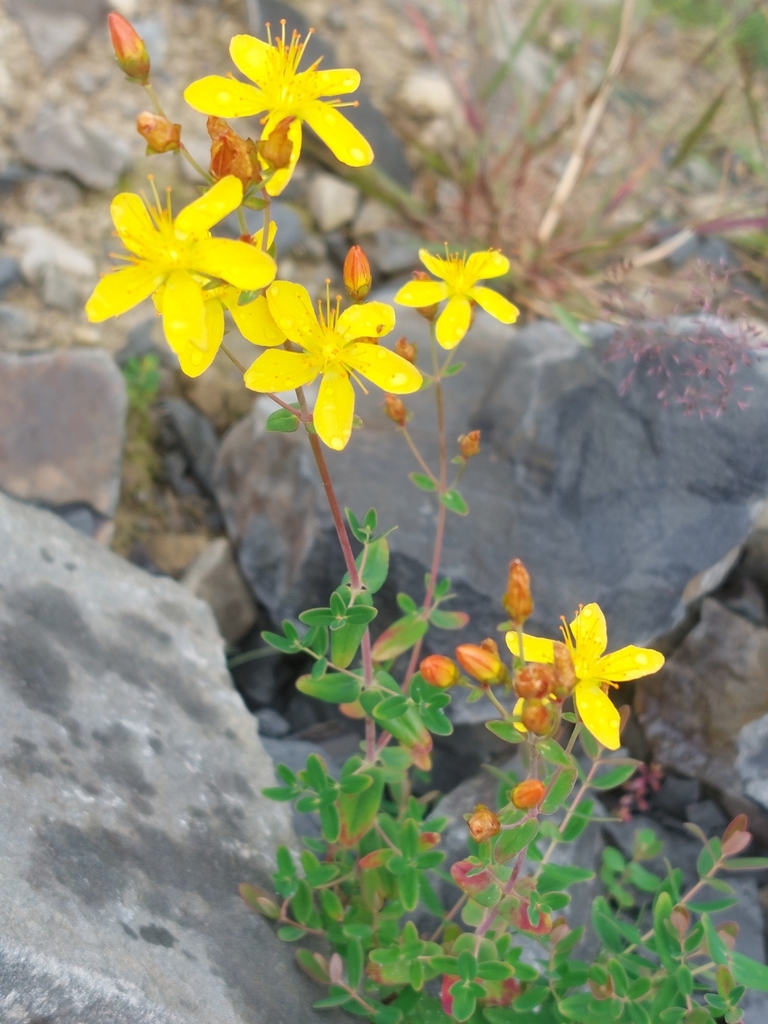
Hypericum pulchrum
Hypericum pulchrum is a flowering plant in the family Hypericaceae, commonly known as slender St John's-wort. It is native to Western Europe.
Del artículo Hypericum pulchrum de Wikipedia (CC BY-SA), citado sección por sección
Descripción
Hypericum pulchrum is a dainty, rhizomatous perennial plant growing 9–18 in (23–46 cm) high. It has erect smooth stems without ridges or wings. It has a few opposite pairs of untoothed, heart-shaped leaves that half clasp the stem. They are dotted with transparent spots and often have inrolled margins. The terminal inflorescence has rich yellow flowers. Each of these has five small, broad, blunt sepals with black dots on the margins. The five petals are red beneath and have red and black dots on the margins. There are three styles and many stamens with orange anthers in three bundles. The fruit is a dehiscent capsule.
Wikipedia: «Description»
Distribución y hábitat
Hypericum pulchrum is a calcifuge, found in heathy places, dry moorlands, among rocks in upland regions and on road verges on non-calcareous soils.
Wikipedia: «Habitat»
Dónde vive
Avistamientos registrados
—
registros georreferenciados en GBIF, de museos, herbarios y observadores de campo.
Arrastra el globo para girarlo. Los puntos marcan dónde hay registros, no un mapa de distribución; más oscuro significa más registros.
En los viejos herbarios y bestiarios

On the Names of Plants
Hieronymus Bock (Tragus) · 1552 · p.146

Herbarium Portatile, Oder Behendes Kräuter- und Gewächs-Buch: Darinn nicht allein 1363. so wol Einheimische als Außländndische Kräuter mit Lateinisch und Deutscher Benennung abgebildet, sondern auch die meisten, so in der Medicin gebräuchlich, kürtzlich erkläret werden
Panckow, Thomas · 1656 · p.116
En los depósitos
Buscando en los depósitos…
Todas las páginas que nombran Hypericum pulchrum en la Biodiversity Heritage Library →
Esta página se compone en directo a partir de iNaturalist, GBIF, Wikipedia, la Source Library y el Internet Archive. Aún no forma parte del códice editado a mano. Taxón 62018 de iNaturalist.