- Animales
- ›Insectos, arácnidos y crustáceos
- ›Quelicerados
- ›Arañas, alacranes, ácaros y parientes
- ›Arañas
- ›Arañas verdaderas
- ›Entelegynae
- ›Salticoidea
- ›Arañas saltarinas
- ›Arañas saltarinas típicas
- ›Plexippini
- ›Plexippina
- ›Evarcha
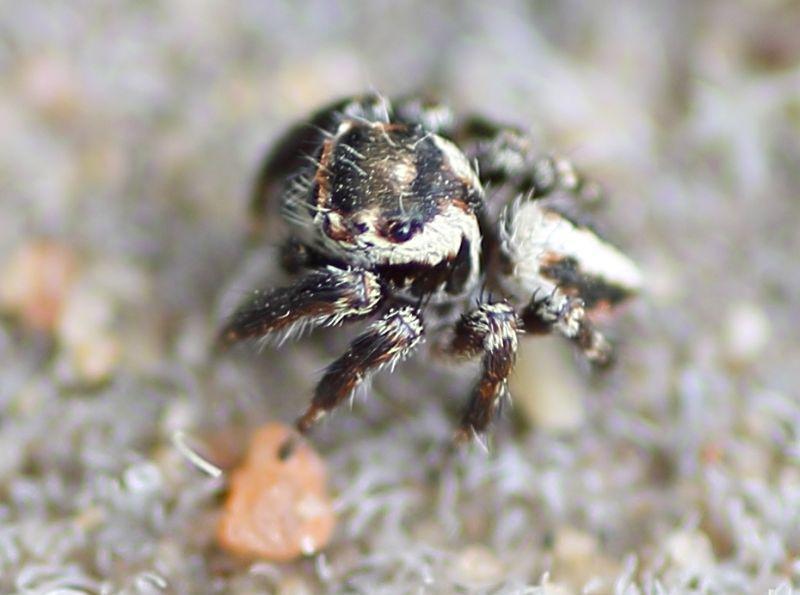
Evarcha denticulata
Evarcha denticulata, the Paterson Evarcha Jumping Spider, is a species of jumping spider that is endemic to South Africa. A member of the genus Evarcha, it is ground-dwelling spider, thriving in the fynbos found in the Eastern and Western Capes. The spider is small, with a rounded forward section, or cephalothorax, that is usually between 2.1 and 2.5 mm (0.08 and 0.10 in) long and, behind that, an ovoid abdomen that is between 1.8 and 3.4 mm (0.07 and 0.13 in) long. The female has a larger abdomen than the male. It is also lighter, with a pattern of grey patches visible on its yellow background. The male is generally blackish-brown. Both have three lines of white hairs on the spider's cheeks. The male Evarcha denticulata has a distinctive tooth on the spike, or apophysis, that emanates from its palpal tibia, part of its copulatory organs, which is recalled in the specific name. The species was first described in 2013 by Wanda Wesołowska and Charles Hadded.
Del artículo Evarcha denticulata de Wikipedia (CC BY-SA), citado sección por sección
Descripción
Evarcha denticulata is a small spider. The spider's body is divided into two main parts: a rather rounded almost rectangular cephalothorax and more pointed and ovoid abdomen. The male has cephalothorax that is typically 2.1 mm (0.08 in) long and 1.5 mm (0.06 in) wide. The spider's carapace, the hard upper part of the cephalothorax, is high and generally male is with a lighter brown flat patch in the middle. The eye field is separated from the thorax by a line of white hairs that extends onto the carapace. There are long brown bristles on the eye field and fawn and white scales near the eyes themselves. The underside of the cephalothorax, or sternum, is dark brown. The clypeus have a few long white bristles on it and the spider's cheeks are marked with white hairs forming three lines. The spider's mouthparts, including the chelicerae, are dark brown. The male spider's abdomen is typically 1.8 mm (0.07 in) long and 1.2 mm (0.05 in) wide. It is also blackish-brown on top with a pattern of white hairs forming a streak along the front edge and a band across the middle broken up by large spots to the rear. The underside is dark and has a marking of pale dots making up four lines grey. The spinnerets are also dark. …
Wikipedia: «Description»
Distribución y hábitat
Evarcha spiders live across the world, although those found in North America may be migrants accidental carried as part of shipments transported across the ocean. They are particularly common in Africa and East Asia. Evarcha denticulata is endemic to South Africa. The male holotype was discovered on a grassy tussock 10 km (6.2 mi) from Paterson in the Eastern Cape in 2011. Other examples have been found in urban areas like Cape Town in the Western Cape and at high altitudes in the Amathole Mountains, typically at a height of 1,270 m (4,170 ft) above sea level. The first female specimen to be identified was found in Fisherhaven in 2004 and they were subsequently observed in areas like Jeffrey's Bay as well as the Amathole Mountains. The spider is ground-dwelling and is seen in the leaf litter and grasslands that is found in fynbos. It is often seen living underneath overhanging vegetation.
Wikipedia: «Distribution and habitat»
Dónde vive
Avistamientos registrados
—
registros georreferenciados en GBIF, de museos, herbarios y observadores de campo.
Arrastra el globo para girarlo. Los puntos marcan dónde hay registros, no un mapa de distribución; más oscuro significa más registros.
En los depósitos
Buscando en los depósitos…
Todas las páginas que nombran Evarcha denticulata en la Biodiversity Heritage Library →
Esta página se compone en directo a partir de iNaturalist, GBIF, Wikipedia, la Source Library y el Internet Archive. Aún no forma parte del códice editado a mano. Taxón 666100 de iNaturalist.