- Hongos
- ›Setas, royas y tizones
- ›Agaricomycotina
- ›Setas, bejines y parientes
- ›Phallomycetidae
- ›hongos falo y afines
- ›Clathraceae
- ›Clathrus
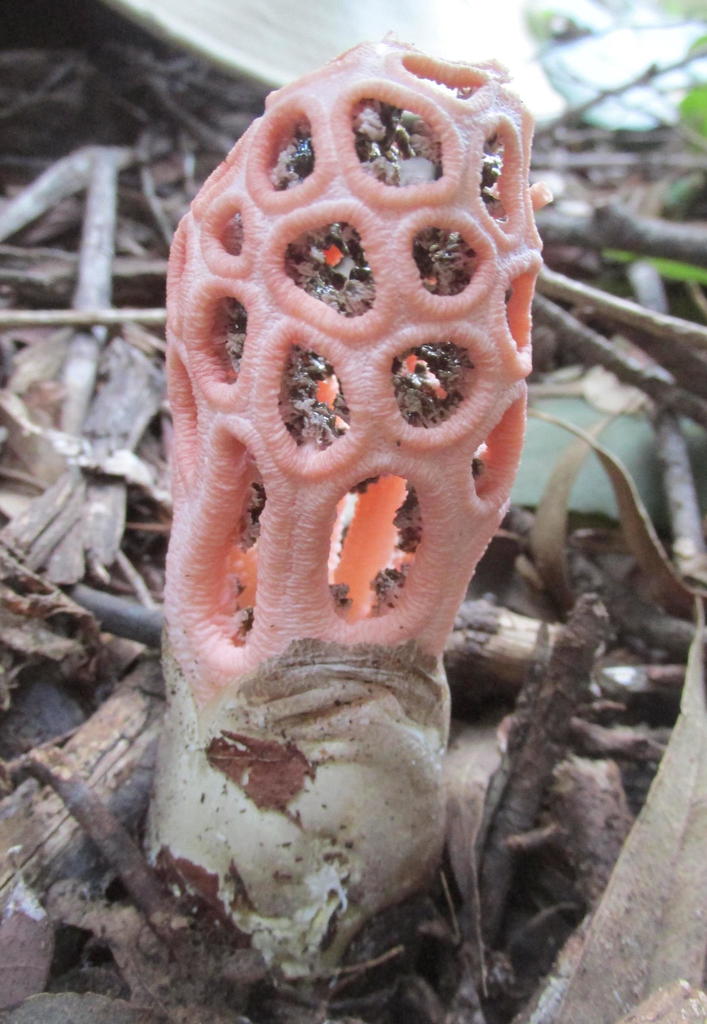
Clathrus transvaalensis
Clathrus transvaalensis is a species of fungus in the stinkhorn family. It is found in South Africa. It was described as new to science in 1990 by mycologists Albert Eicker and Derek Reid. The fruit body forms a hollow, pale yellow to pinkish lattice structure.
Del artículo Clathrus transvaalensis de Wikipedia (CC BY-SA), citado sección por sección
Descripción
Fruitbodies of Clathrus transvaalensis originate from a smooth, whitish, egg-shaped structure measuring up to 4.5 cm (1.8 in) in diameter. The egg is attached to the ground by one or more thick mycelial strands. As the receptacle emerges, it causes an irregular tearing of the tissue at the top of the egg, and the peridium ultimately forms a loose volva at the base of the receptacle. The broadly egg-shaped receptacles reach a size of 8 cm (3.1 in) tall by 5 cm (2.0 in) wide. The lattice structure of the receptacle typically contains about 21 meshes. One mesh is situated at the top, encircled by 5 meshes, followed by a circle of 7 meshes and then 8 vertically elongated meshes in the lower half. The tubular "arms" of the receptacles are pale yellow near the base, gradually changing to pinkish in the upper third. They are 3.5–11 mm (0.14–0.43 in) wide, with a rounded triangular shape when viewed in cross-section. The outer surface of the arms is flat with rounded edges, and features transverse wrinkles; the inner surface is even more strongly wrinkled. The context, or tissue, of the arms comprises roughly 11 regularly arranged, non-interconnecting tubes. Gleba is secreted by glebiferous organs that are mostly located at intersection of the arms. These organs resemble a cushion-like swelling that is itself meshed. The gleba is slimy, and coloured dark olive-green to brown. …
Wikipedia: «Description»
Distribución y hábitat
Clathrus transvaalensis is a saprophytic fungus that fruits in clumps on the ground in grass. It is one of six Clathrus species known to occur in South Africa.
Wikipedia: «Habitat and distribution»
Dónde vive
Avistamientos registrados
—
registros georreferenciados en GBIF, de museos, herbarios y observadores de campo.
Arrastra el globo para girarlo. Los puntos marcan dónde hay registros, no un mapa de distribución; más oscuro significa más registros.
En los depósitos
Buscando en los depósitos…
Todas las páginas que nombran Clathrus transvaalensis en la Biodiversity Heritage Library →
Esta página se compone en directo a partir de iNaturalist, GBIF, Wikipedia, la Source Library y el Internet Archive. Aún no forma parte del códice editado a mano. Taxón 700613 de iNaturalist.