- Animales
- ›Cordados
- ›Vertebrados
- ›Reptiles
- ›Tortugas
- ›Tortugas sabaneras
- ›Galápagos del Viejo Mundo
- ›Vijayachelys
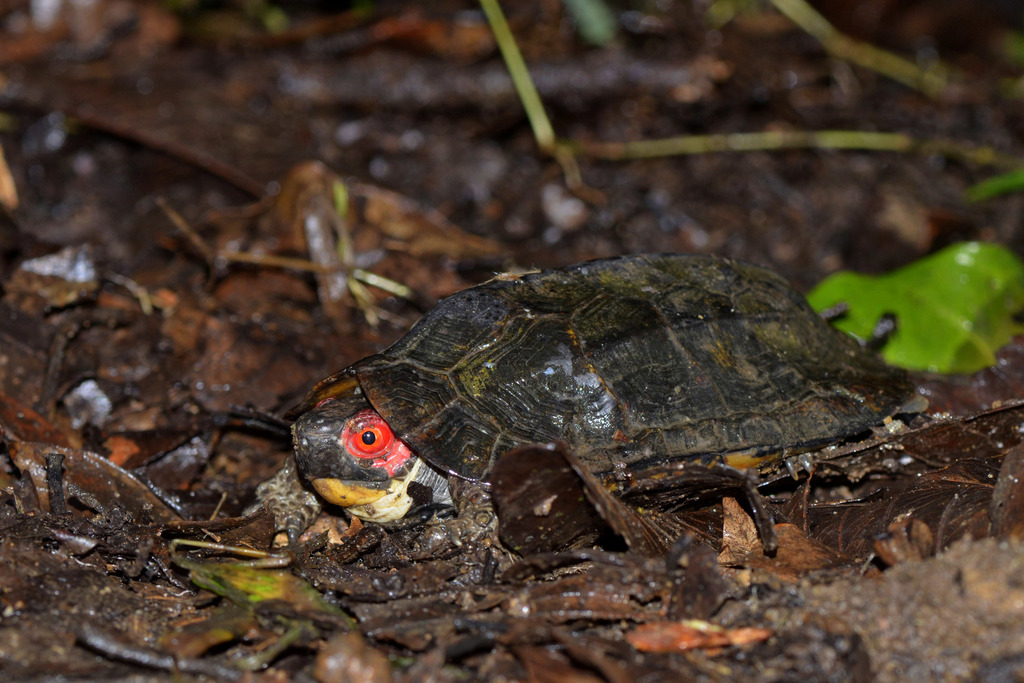
Vijayachelys silvatica
The Cochin forest cane turtle (Vijayachelys silvatica), also known as Kavalai forest turtle, forest cane turtle or simply cane turtle, is a rare turtle from the Western Ghats of India. Described in 1912, its type locality is given as "Near Kavalai in the Cochin State Forests, inhabiting dense forest, at an elevation of about 1500 feet above sea level". Only two specimens were found at that time, and no scientist saw this turtle for the next 70 years. It was rediscovered in 1982, and since then a number of specimens have been found and some studies have been conducted about its phylogeny and ecology.
Del artículo Cane turtle de Wikipedia (CC BY-SA), citado sección por sección
Descripción
The carapace is considerably depressed, with a prominent mid-line keel, as well as one less pronounced lateral keel on each side. Its posterior margin is feebly reverted and not or only indistinctly serrated. The nuchal scute is small. The first vertebral scute is broader in front than behind and larger than the second, third and fourth vertebral shields. These are considerably broader than long, as broad as the costal scutes. The plastron is sizeable, being nearly as large as the shell opening; it is connected to the carapace by ligaments and particularly in females there is little ossification between the shields of the shell. The plastron is angled at the sides and openly emarginate at the forward and aft opening. The width of the plastron bridge is less than the length of the hind lobe; the longest median suture is between the abdominal scute, the shortest between the gular scute. The axillary and inguinal scutes are very small; one of the latter is even absent.
Its head is rather large, with a truncated snout as long as the sizeable orbit; the upper jaw is hooked, with small premaxillae. The mandibular symphysis is very long, exceeding the maximum diameter of the orbit in width. On the hind part of the head, the skin is divided into moderately large shields. The skull lacks a temporal arch and has the frontal bone extended to form a considerable part of the orbit. …
Wikipedia: «Description»
Lo que hace
This turtle inhabits dense evergreen forest, presumably at lower elevations. According to the natives from whom Henderson obtained the type, the species inhabits short burrows underground and is indifferent about having water nearby (unlike some of its relatives, which are decidedly aquatic). The type as well as another younger specimen were kept in captivity for six months, and Henderson remarks that they did not show any special partiality for water and when handled did not emit the offensive odour known from the related Indian black turtle (Melanochelys trijuga). The first captive specimens lived entirely upon vegetable food, but subsequently it has turned out that this turtle is omnivorous, eating any suitably sized plant and animal food.
Wikipedia: «Ecology»
Dónde vive
Avistamientos registrados
—
registros georreferenciados en GBIF, de museos, herbarios y observadores de campo.
Arrastra el globo para girarlo. Los puntos marcan dónde hay registros, no un mapa de distribución; más oscuro significa más registros.
En los depósitos
Buscando en los depósitos…
Todas las páginas que nombran Vijayachelys silvatica en la Biodiversity Heritage Library →
Esta página se compone en directo a partir de iNaturalist, GBIF, Wikipedia, la Source Library y el Internet Archive. Aún no forma parte del códice editado a mano. Taxón 73993 de iNaturalist.