- Plantas
- ›Plantas vasculares
- ›Plantas con flores
- ›Magnolias, margaritas y parientes (dicotiledóneas)
- ›Menta, acantos, verbenas y afines
- ›jopos, chupamieles, eufrasias y parientes
- ›chupamieles, garañonas y parientes
- ›Chloropyron
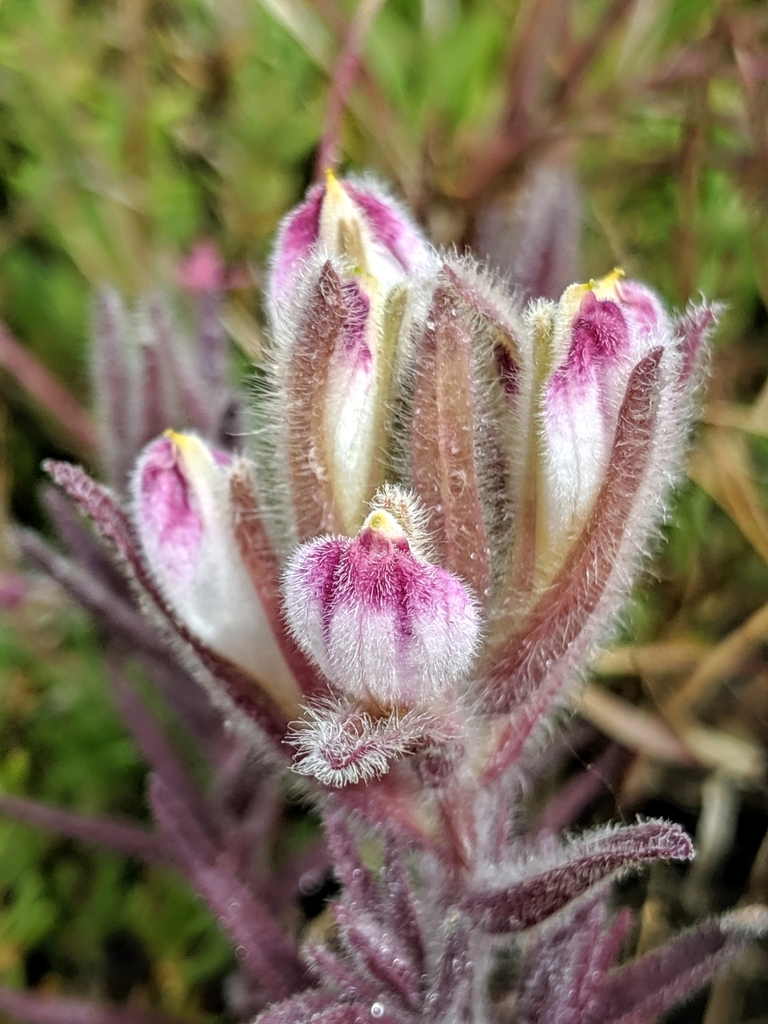
Chloropyron maritimum
Chloropyron maritimum is a rare species of flowering plant in the family Orobanchaceae native to western North America. It is known by the common names saltmarsh bird's beak and Point Reyes bird's beak, depending on the specific subspecies.
Del artículo Chloropyron maritimum de Wikipedia (CC BY-SA), citado sección por sección
Descripción
This plant grows in low clumps and has small, thick, gray-green hairy leaves often tinted with purple. It concentrates and excretes salts, giving its foliage a grainy crust. It erects an inflorescence several centimeters high which has many fuzz-covered white or cream club-shaped flowers with yellow or purplish tips. The fruit is a capsule containing many brown net-textured (reticulate) seeds.
Wikipedia: «Description»
Distribución y hábitat
It is native to the Western and Southwestern United States and northern Mexico, from southern Oregon to Baja California. This is a halophyte which grows in areas of high salt concentrations, including coastal salt marshes and the inland salt flats of the Great Basin. It is hemiparasitic, such that it is greenish and has chlorophyll but also parasitizes other plants by inserting haustoria into their roots to tap nutrients.
Wikipedia: «Distribution and habitat»
Dónde vive
Avistamientos registrados
—
registros georreferenciados en GBIF, de museos, herbarios y observadores de campo.
Arrastra el globo para girarlo. Los puntos marcan dónde hay registros, no un mapa de distribución; más oscuro significa más registros.
En los depósitos
Buscando en los depósitos…
Todas las páginas que nombran Chloropyron maritimum en la Biodiversity Heritage Library →
Esta página se compone en directo a partir de iNaturalist, GBIF, Wikipedia, la Source Library y el Internet Archive. Aún no forma parte del códice editado a mano. Taxón 76296 de iNaturalist.