- Plantas
- ›Plantas vasculares
- ›Plantas con flores
- ›Magnolias, margaritas y parientes (dicotiledóneas)
- ›Calabazas, begonias y parientes
- ›Calabazas, pepinos, sandías y parientes
- ›chayotillos, estropajos y parientes
- ›Marah
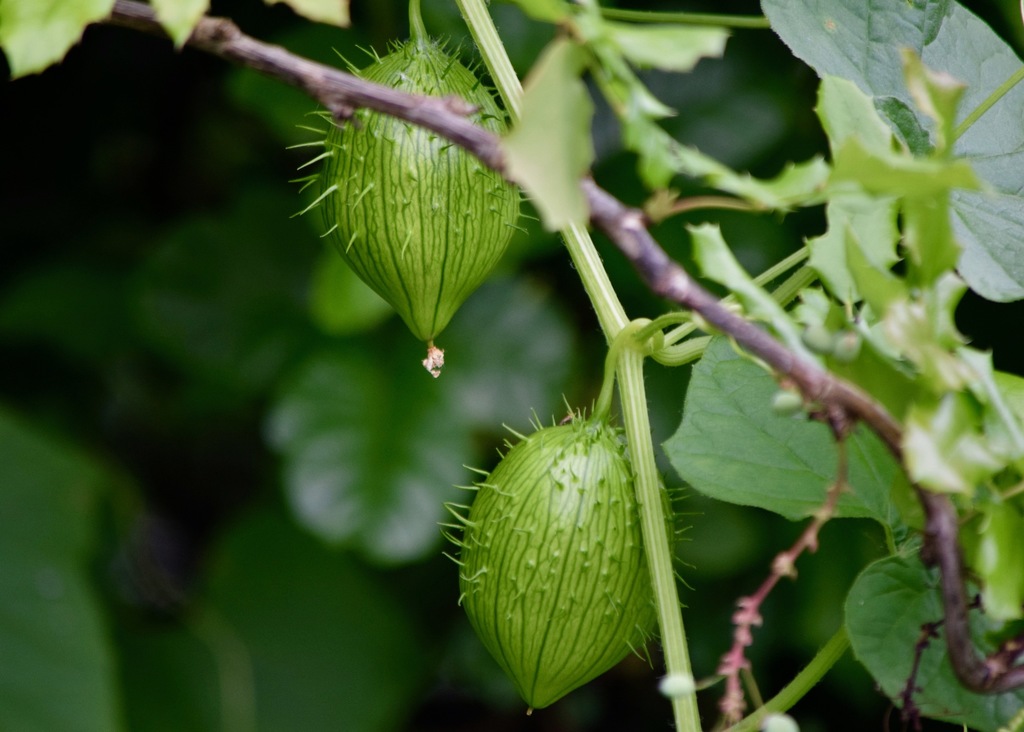
Marah oregana
Marah oregana, the Oregon manroot, coastal manroot or western wild-cucumber, is a common manroot of the northwest coast of the United States. It ranges from California north to Vancouver Island in southwestern Canada.
Del artículo Marah oregana de Wikipedia (CC BY-SA), citado sección por sección
Distribución y hábitat
Coastal manroot grows most vigorously by streams or in washes but can also be successful in dryer areas, at elevations up to 1600 metres. It will tolerate a variety of soil types and acidities, but it requires at least seasonally moist soil. Vines can grow in full-sun to heavily shaded conditions. In mild areas of its range where year-round moisture is available, vines are perennial. In cold winter areas, vines die back in fall. In areas with seasonal wetness, vines emerge at the beginning of the wet season and die back completely in the dry season.
Wikipedia: «Habitats»
En la mesa
All parts of the plant have a bitter taste (this is the meaning of the genus name Marah, which comes from Hebrew). The fruit is inedible. Some Native Americans may have consumed the seeds to commit suicide. The large tuber of the manroot can be processed for a soap-like extract.
Medicinal uses. Marah oregana was used by the Native Americans for various health problems. The Chinook made a poultice from the gourd. The Squaxin mashed the upper stalk in water to dip aching hands. The Chehalis people burned the root and mixed the resulting powder with bear grease to apply to scrofula sores. The Coast Salish made a decoction to treat venereal disease, kidney trouble and scrofula sores.
Wikipedia: «Uses»
Toxicidad
The leaves and fruit contain high concentrations of tetracyclic triterpenoid compounds known as cucurbitacins. They impart a bitter flavor which serve as a natural pest deterrent. When ingested they can lead to various degrees of gastrointestinal upset and dehydration. Although data for this specific variety of wild cucumber is limited, case reports of ingestion of other species within the Cucurbitaceae family have been found to induce severe illness requiring intensive care support to treat dehydration from the profound gastrointestinal distress. There is no specific antidote. These compounds have also been reported to induce delayed alopecia although the mechanism is unknown.
Wikipedia: «Toxicity»
Dónde vive
Avistamientos registrados
—
registros georreferenciados en GBIF, de museos, herbarios y observadores de campo.
Arrastra el globo para girarlo. Los puntos marcan dónde hay registros, no un mapa de distribución; más oscuro significa más registros.
En los depósitos
Buscando en los depósitos…
Todas las páginas que nombran Marah oregana en la Biodiversity Heritage Library →
Esta página se compone en directo a partir de iNaturalist, GBIF, Wikipedia, la Source Library y el Internet Archive. Aún no forma parte del códice editado a mano. Taxón 77960 de iNaturalist.