- Animales
- ›Insectos, arácnidos y crustáceos
- ›Hexápodos
- ›Insectos
- ›Insectos alados
- ›Mariposas y polillas
- ›Mariposas diurnas
- ›Mariposas Cometa
- ›Mariposas Cometa
- ›Cometa, colas de espada, Azulejos
- ›Eurytides
- ›Mimoides
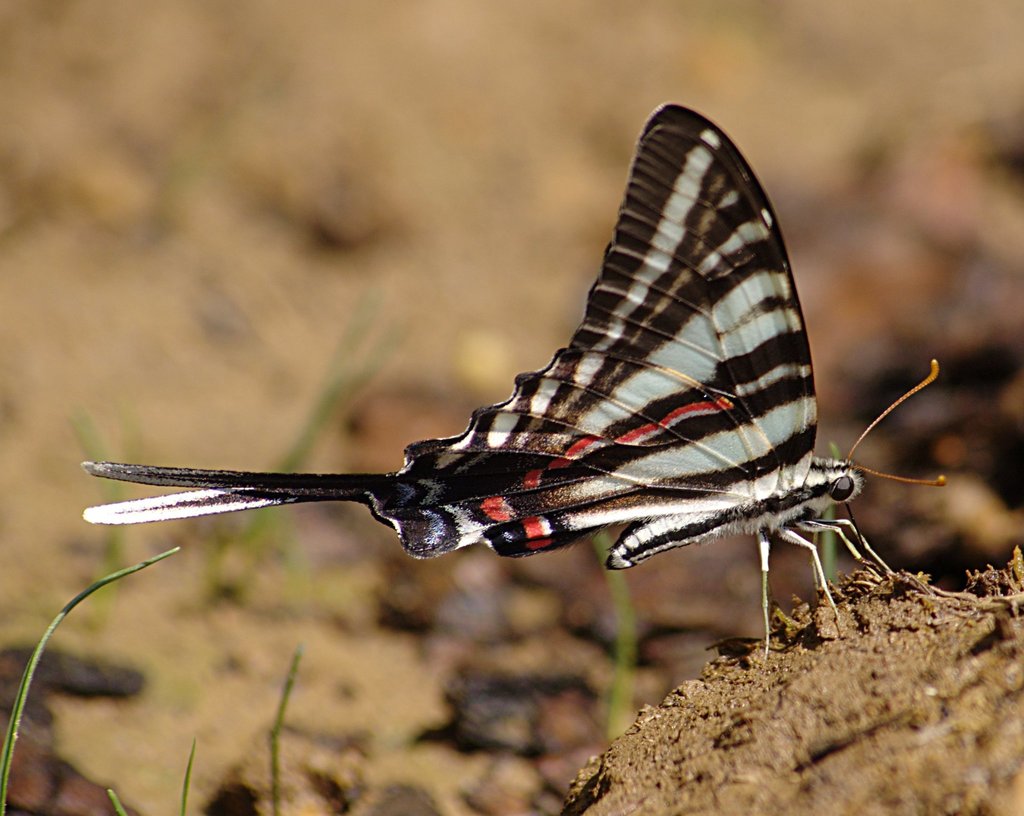
Mariposa cometa cebra
Eurytides marcellus
Eurytides marcellus, the zebra swallowtail (formerly listed under genera Protographium, Iphiclides, Graphium and Papilio by some authorities), is a swallowtail butterfly native to the eastern United States and south-eastern Canada. It is the state butterfly of Tennessee. Its distinctive wing shape and long tails make it easy to identify, and its black-and-white-striped pattern is reminiscent of a zebra. The butterflies are closely associated with pawpaws, and are rarely found far from these trees. The green or black caterpillars feed on the leaves of various pawpaw species, while the adults feed on flower nectar and minerals from damp soil.
Del artículo Eurytides marcellus de Wikipedia (CC BY-SA), citado sección por sección
Descripción
The zebra swallowtail has a wingspan of 6.4 to 10.4 cm (2.5 to 4.1 in). The triangular wings are white to greenish white with black longitudinal stripes. A pair of swordlike tails extend from the hindwings. The inner margin of the hindwing has two blue spots on the corner and a red spot near the body. A red stripe runs along the middle of the ventral hindwing. P. marcellus has two seasonal forms, one occurring in the spring and the other in the summer. Spring forms are smaller, more white, and have short, black tails with white tips. Summer forms are larger, have broader black stripes, and longer, black tails with white edges.
Wikipedia: «Description»
Lo que hace
Males will patrol near host plants in search of females, flying swiftly and directly. They usually fly 0.5 to 1.8 meters (1.6 to 5.9 ft) above the ground. Females will fly slowly when searching for suitable host plants. Both males and females avidly visit flowers, including species from the families Apocynaceae, Brassicaceae, Fabaceae, Lythraceae, Polemoniaceae, and Rosaceae. Males participate in a behavior known as puddling, in which individuals congregate on sand, gravel, or moist soil to obtain salts and amino acids. These nutrients aid the male in reproduction. Other food sources include rotting fruit and urine.
Wikipedia: «Behavior»
Escuchar
Buscando grabaciones de campo…
Dónde vive
Avistamientos registrados
—
registros georreferenciados en GBIF, de museos, herbarios y observadores de campo.
Arrastra el globo para girarlo. Los puntos marcan dónde hay registros, no un mapa de distribución; más oscuro significa más registros.
En los depósitos
Buscando en los depósitos…
Todas las páginas que nombran Eurytides marcellus en la Biodiversity Heritage Library →
Esta página se compone en directo a partir de iNaturalist, GBIF, Wikipedia, la Source Library y el Internet Archive. Aún no forma parte del códice editado a mano. Taxón 83086 de iNaturalist.