- Animales
- ›Cordados
- ›Vertebrados
- ›Reptiles
- ›Lagartijas y Serpientes
- ›Serpientes y culebras
- ›Culebras y parientes
- ›Culebras típicas
- ›Chironius
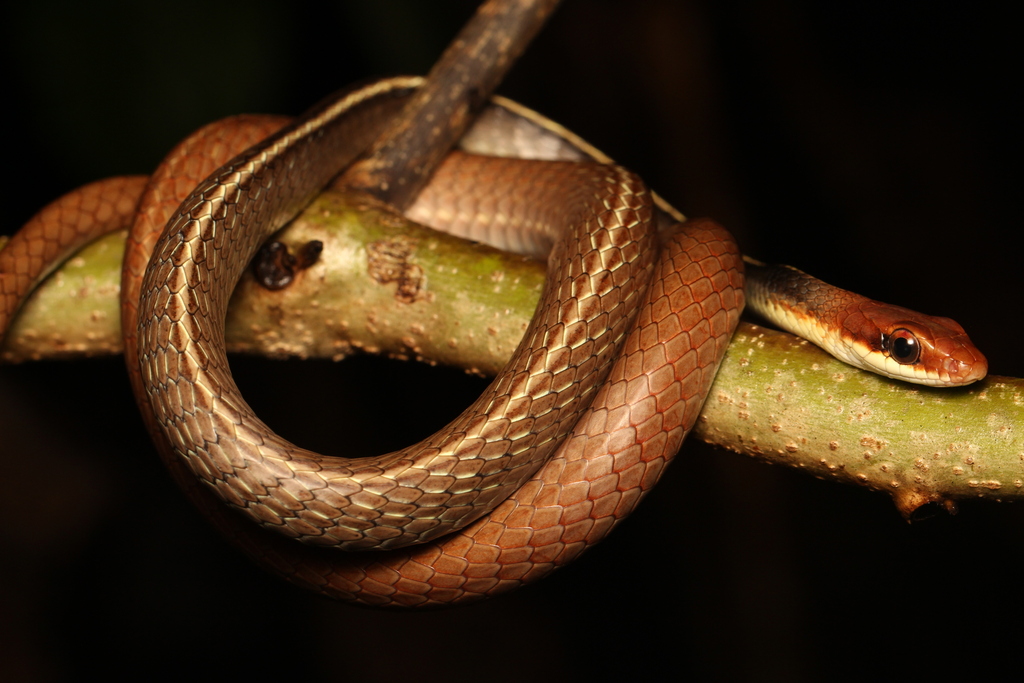
Chironius flavolineatus
Chironius flavolineatus, also known as Boettger's sipo, is a vine snake species in the family Colubridae, endemic to savannas and semiarboreal biomes in Brazil, and much of South America. It is listed as least concern on the IUCN Red List since 2014. It is a member of the Genus Chironius which is composed of twenty-two other described snake species. It is nonvenomous, using camouflage or burrowing as a form of defense.
Del artículo Chironius flavolineatus de Wikipedia (CC BY-SA), citado sección por sección
Descripción
The Chironius flavolineatus's distinguishing trait is a yellow or cream white vertebral stripe that extends for nearly the entire length of the snake's body. On either side of the stripe, black sides that begin after the first row of scales lie anteriorly. The back of the Chironius flavolineatus's head ranges in color from tan to brown and is distinct from the superior third of the body, which is black or dark gray. The Chironius flavolineatus usually has a single posterior temporalis muscle, a divided cloacal shield, and white, unpigmented ventral and subcaudal scales. Chironinus flavolineatus also features 0-4 rows of keeled dorsal scales in its midbody and a static color pattern throughout its lifetime Studies indicate that Chironius flavolineatus is sexually dimorphic. Adult females tend to be larger than males, with an average weight around 81 g (2.9 oz) and an approximate total length of about 1.16 m (3 ft 10 in). Adult males weigh approximately 60 g (2.1 oz) and reach a total length of around 1.10 m (3 ft 7 in). Males tend to have long tails and larger eyes than their female counterparts, while no dimorphism is seen in the head size of the sexes. The smaller size of males indicates that there is limited male to male combat for mating. …
Wikipedia: «Description»
Distribución y hábitat
Chironius flavolineatus has no specific locality and has been reported in São Paulo, Amazonas, Rio Grande do Sul, Pernambuco, Rio Grande do Norte and many other regions in South America. It is found predominantly in Brazil, but is also found in Paraguay, Bolivia and Peru. Chironius flavolineatus is commonly found in areas that are between 100 and 400 meters above sea level in biomes such as semiarboreal forests and grass steppes.
Wikipedia: «Distribution & habitat»
Lo que hace
Chironius flavolineatus has various defense mechanisms that prevent itself from being killed or harmed by predators and utilizes camouflage. The main defensive behaviours that these snakes use are cryptic coloration, camouflage, and mimicry. For example, this species will submerge themselves in a pile of decaying foliage matter where it is not able to be detected until the threat or predator can no longer be observed. Chironius flavolineatus have been found to rest in said decaying matter roughly 2 meters above ground during nighttime, indicating a preference for arboreal resting spaces, contrasting its active ground-foraging behavior during the day.Another unique escape tactic the snake uses rarely is diving; there are several semi-aquatic snakes that regularly use the water as a defense however C. flavolineatus, an arboreal species normally would not. But when foraging near a river, it dived in as an attempt to escape.
Diet. The diet of C. flavolineatus like other snakes in the Chironius genus consists fairly exclusively on frogs. The specific frog family preferred by these snakes is Hylidae which consists of a wide range of tree frogs. C. flavolineatus also have a taste for various small prey that they may find around their environment. These snakes are very active foragers as they roam the ground or arboreal substrates to acquire most of their diet. …
Wikipedia: «Behavior and ecology»
Dónde vive
Avistamientos registrados
—
registros georreferenciados en GBIF, de museos, herbarios y observadores de campo.
Arrastra el globo para girarlo. Los puntos marcan dónde hay registros, no un mapa de distribución; más oscuro significa más registros.
En los depósitos
Buscando en los depósitos…
Todas las páginas que nombran Chironius flavolineatus en la Biodiversity Heritage Library →
Esta página se compone en directo a partir de iNaturalist, GBIF, Wikipedia, la Source Library y el Internet Archive. Aún no forma parte del códice editado a mano. Taxón 97537 de iNaturalist.