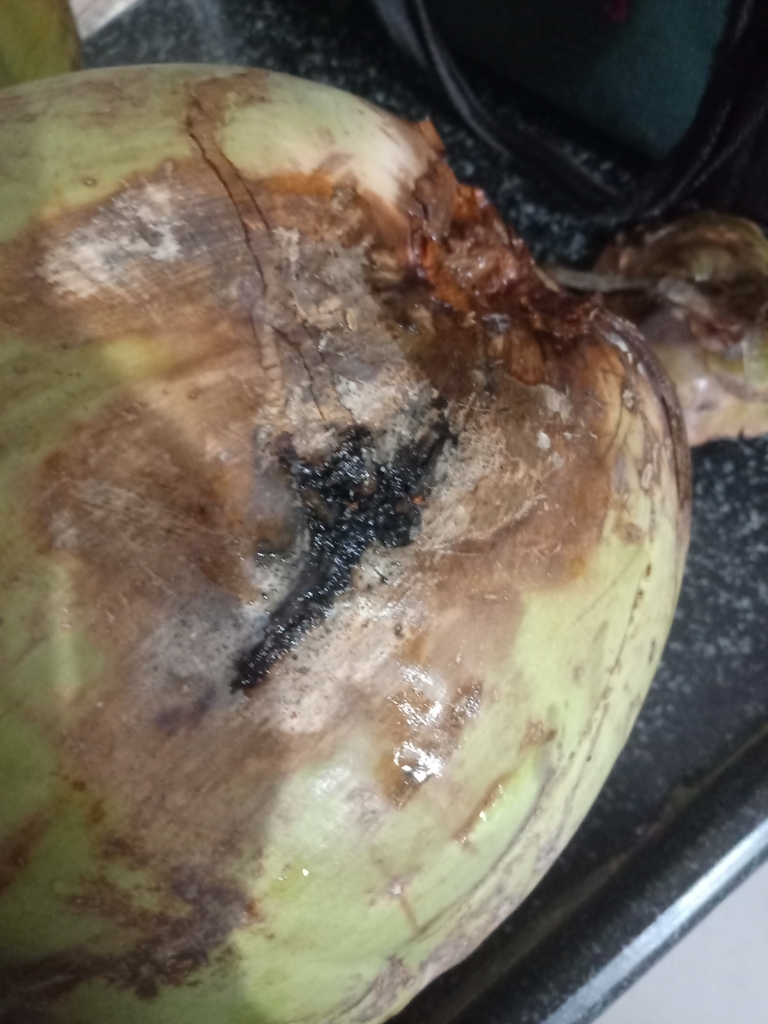
Pudrición del cogollo de la palma
Phytophthora palmivora
Phytophthora palmivora is an oomycete that causes bud-rot of palms, fruit rot or kole-roga of coconut and areca nut. These are among the most serious diseases caused by fungi and moulds in South India. Outbreaks occur almost every year in Malnad, Mysore, North & South Kanara, Malabar and other areas. Similar diseases of palms are also known to occur in Sri Lanka, Mauritius, and Sumatra. The causative organism was first identified as P. palmivora by Edwin John Butler in 1917.
Del artículo Phytophthora palmivora de Wikipedia (CC BY-SA), citado sección por sección
Lo que hace
Phytophthora palmivora produces abundant sporangia on V8 agar under continuous fluorescent light. However, light is not required for sporangia production on infected papaya fruit. Sporangia are usually produced in clusters sympodially. Sporangia are papillate and ovoid with the widest part close to the base. They are easily washed off and each detached sporangium contains a short pedicel. The average size of the sporangia is 50×33 μm with a length of about 1.6 times longer than it is wide. Sporangia germinate directly in a nutrient medium by producing germ tubes that develop into mycelial masses. In water, however, zoospores are released from germinating sporangia. Zoospores aggregate and form distinct patterns at 16 °C (61 °F) in water. Chlamydospores produced in infected papaya fruit and pure papaya juice are thick-walled. However, chlamydospores produced in papaya juice at lower concentrations or in other kinds of fruit juice are mostly thin-walled. In the presence of nutrients, chlamydospores germinate by producing germ tubes that continue to grow and form mycelial masses. In water, chlamydospores germinate by producing short germ tubes, each with a sporangium at the tip. Sexual reproduction requires the presence of opposite mating types known as A1 and A2. Both A1 and A2 isolates can produce zoospores by selfing when stimulated by sex hormones produced by A2 and A1. …
Wikipedia: «Reproduction»
Dónde vive
Avistamientos registrados
—
registros georreferenciados en GBIF, de museos, herbarios y observadores de campo.
Arrastra el globo para girarlo. Los puntos marcan dónde hay registros, no un mapa de distribución; más oscuro significa más registros.
En los depósitos
Buscando en los depósitos…
Todas las páginas que nombran Phytophthora palmivora en la Biodiversity Heritage Library →
Esta página se compone en directo a partir de iNaturalist, GBIF, Wikipedia, la Source Library y el Internet Archive. Aún no forma parte del códice editado a mano. Taxón 976262 de iNaturalist.