- Animales
- ›Insectos, arácnidos y crustáceos
- ›Hexápodos
- ›Insectos
- ›Insectos alados
- ›Escarabajos y parientes
- ›Polyphaga
- ›gorgojos, catarinas y parientes
- ›Chrysomeloidea
- ›Escarabajos de las hojas
- ›Galerucinae
- ›Escarabajos pulga
- ›Alticina
- ›Altica
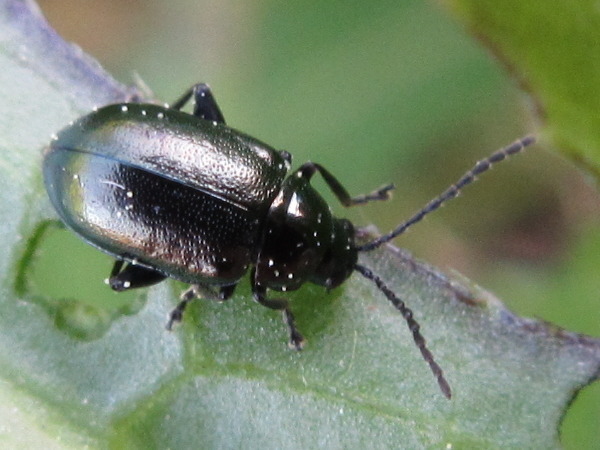
Altica cirsicola
Altica cirsicola is a species of flea beetle from the genus Altica, which belongs to the family Chrysomelidae (commonly known as leaf beetles). A. cirsicola is found throughout East Asia. Adults feed exclusively on plants from the genus Cirsium. This food resource provides the species with the opportunity to create holes in the leaves of the plant, which helps to provide the beetles with camouflage and protection from predators.
Both male and female A. cirsicola make multiple matings throughout their lives. A. cirsicola males have been discovered to exhibit mate choice, using cuticular hydrocarbons (CHCs) as one of several signals to help them identify potential mates.
Del artículo Altica cirsicola de Wikipedia (CC BY-SA), citado sección por sección
Distribución y hábitat
Although beetles of the genus Altica are widely distributed throughout the world, A. cirsicola is primarily distributed throughout East Asia. The species is native to the countries of Japan and China. More recent reports have also found the species in other regions, with a 2024 publication reporting the first documented presence of the species in Russia. A. cirsicola also has had a reported presence in both North and South Korea, and there is a particular recording of the species in Mt. Hallasan National Park. Although A. cirsicola is nearly identical morphologically to Altica carduorum, A. carduorum is instead native to Europe.
Wikipedia: «Geographic range»
Lo que hace
A. cirsicola, along with some other leaf beetle species, create uniform holes while they feed on the leaves of their host plant food resources. These holes help to camouflage the species by changing the background environment of which the beetle interacts. This camouflage is effective against humans. The difficulty in identifying the beetles increases when there were more holes present in the leaves and when the size of the holes were similar to the size of the beetles. The species may also optimize their feeding to allow for hole sizes and quantities that increase the efficacy of its camouflage. The primary predators that have led to the hole-feeding camouflage behavior are likely birds. Because birds primarily use visual cues to find the insects, it is believed that the hole-feeding camouflage greatly helps the beetles avoid such predators.
Wikipedia: «Hole-feeding camouflage»
En la mesa
Like many other leaf beetle species, A. cirsicola is an herbivore that feeds on the leaves of plants. A. cirsicola only eats plants that are from the genus Cirsium. In particular, the species is known to feed on Cirsium setosum. When A. cirsicola feeds on C. setosum, the beetle makes specialized holes in the leaves of the plant. The holes that are created in the plant are typically about half of the size of the insect's body and are usually uniform. The anatomy of A. cirsicola, particularly the volume of its foregut and the restricted range of motion in the head-prothorax region, limits the size of the hole that the beetle creates while feeding. The presence of these holes also makes it more difficult to visually recognize the beetles, so they serve as a form of camouflage.
Wikipedia: «Food resources»
En la cultura humana
Like other species of beetles, A. cirsicola develops through a metamorphosis process.
Eggs. The eggs of beetles from the Altica genus are oval in shape and have a length of about 1 to 2 mm. Females lay clutches of 1 to 15 eggs on the top or the bottom surface of the leaves.
Larvae. Eggs develop into larvae in about 5 to 8 days, which have a dark brown to black color. The larvae from the Altica genus typically have a length of about 5.2 mm. The body structure of the larvae in this genus is composed of 10 distinct segments. The larvae live and feed on the leaves where they are oviposited. There are three instars during the larval stage where the smaller larvae typically live at the bottom of the host leaves and the larger larvae live at the top and feed on the leaves of the host plants.
Pupae. Larvae of the Altica genus leave the host plant and pupate into the ground or leaf litter. The larvae form a case for themselves to live through the pupation and overwinter, which is made of mucus from the maxillary glands.
Adult. Pupation ends in the spring following birth, and adult beetles emerge from the case. Adults feed on the leaves of the host plant, which is from the Cirsium genus. Adult females generally have a larger body size than adult males. The location of Altica beetles can influence the number of generations that are produced per year. …
Wikipedia: «Life history»
Escuchar
Buscando grabaciones de campo…
Dónde vive
Avistamientos registrados
—
registros georreferenciados en GBIF, de museos, herbarios y observadores de campo.
Arrastra el globo para girarlo. Los puntos marcan dónde hay registros, no un mapa de distribución; más oscuro significa más registros.
En los depósitos
Buscando en los depósitos…
Todas las páginas que nombran Altica cirsicola en la Biodiversity Heritage Library →
Esta página se compone en directo a partir de iNaturalist, GBIF, Wikipedia, la Source Library y el Internet Archive. Aún no forma parte del códice editado a mano. Taxón 984615 de iNaturalist.