On eBird ↗
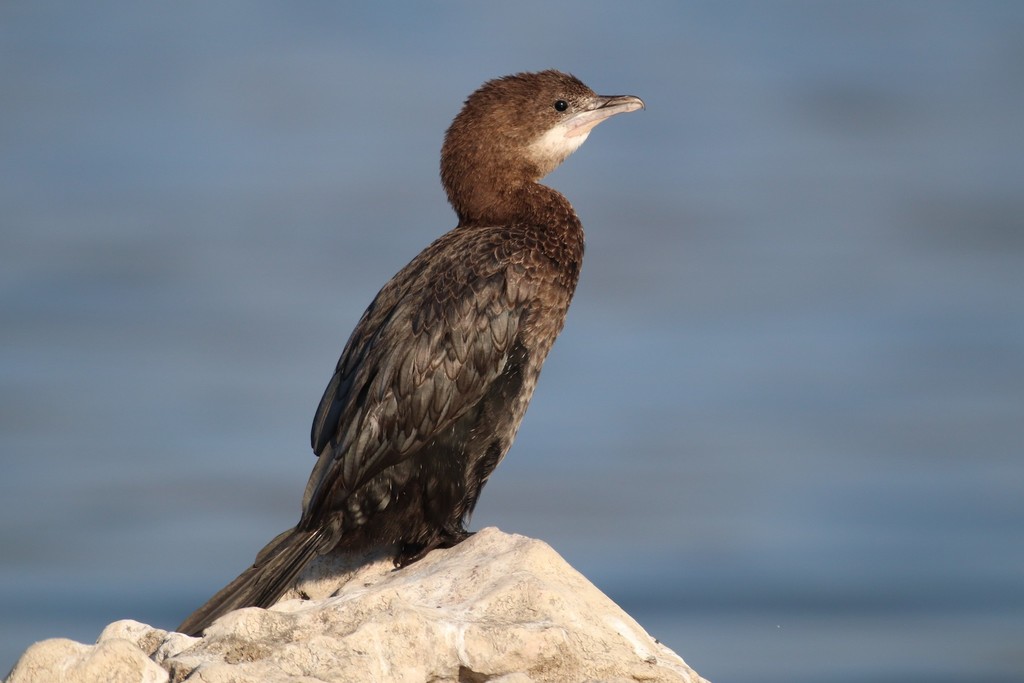
Pygmy Cormorant
Live sightings near you, the range map, bar charts of when it is seen, and Macaulay Library photos and recordings.
Pygmy Cormorant
Microcarbo pygmaeus
The pygmy cormorant (Microcarbo pygmaeus) is a member of the Phalacrocoracidae (cormorant) family of seabirds. It breeds in south-eastern Europe and south-western Asia. It is partially migratory, with northern populations wintering further south, mostly within its breeding range. It is a rare migrant to western Europe.
From the article Pygmy cormorant on Wikipedia (CC BY-SA), quoted section by section
Range & habitat
The pygmy cormorant occupies an area from the south-east of Europe (east of Italy) and the south-west of temperate Asia, east to Kazakhstan, Tajikistan, Turkmenistan, and Uzbekistan. The largest distribution is in south-east Europe, Albania, Greece, Bulgaria, Romania, the Balkan countries, Turkey, Cyprus, Iran, Iraq (namely the Tigris–Euphrates river system), Azerbaijan, Israel, Syria. In Romania, according to studies of Czech ornithologist Robert Ritter von Dombrowski, at the end of the 19th century, the pygmy cormorant was present in large colonies in the Danube Delta, Brăila and Ialomița Pond, on Vederoasa Lake (Constanța County), on certain pools and ponds with reeds and willows in Muntenia. The number of pygmy cormorant pairs was 10,000 without taking in account the breeding population of the Danube Delta. Populations of pygmy cormorant in Romania have dramatically declined, especially in 1960 when, due to the communist agricultural policies, the Great Brăila Island and important parts of Ialomiţa Pond were drained in order to practice agriculture, so the habitats of a great number of aquatic birds were destroyed. …
Wikipedia: “Distribution”
What it does
Pygmy cormorants like pools with plenty of vegetation, lakes and river deltas. They avoid mountainous and cold and dry areas. They love rice fields or other flooded areas where trees and shrubs can be found. During winter they also go to waters with higher salinity, in estuaries or on barrier lakes. These are birds who can live alone or in groups and they have adapted to human presence. They build nests from sticks and reeds in dense vegetation, in trees, shrubs, willows but occasionally in reeds on small floating islets. At the end of May, beginning of June, both parents incubate for 27–30 days, and nestlings become independent after 70 days. The young are fed by their parents with small fish and other aquatic animals. This bird frequently shares the same type of habitat with egrets, herons and spoonbills.
Wikipedia: “Habitat and ecology”
Listen
Looking for field recordings…
Where it lives
Recorded sightings
—
geo-referenced records in GBIF, from museums, herbaria and field observers.
Drag the globe to turn it. Dots are where records exist, not a range map; darker means more records.
In the stacks
Searching the stacks…
Every page naming Microcarbo pygmaeus in the Biodiversity Heritage Library →
This page is assembled live from iNaturalist, GBIF, Wikipedia, the Source Library and the Internet Archive. It is not yet part of the hand-edited codex. iNaturalist taxon 979813.