On eBird ↗
Oriental Magpie
Live sightings near you, the range map, bar charts of when it is seen, and Macaulay Library photos and recordings.
Oriental Magpie
Pica serica
The Oriental magpie or Korean magpie (Pica sericea), known as "kkachi" (까치) in Korean, is a species of magpie found in China and northern Indochina. It is a common symbol of the Korean identity, and has been adopted as the "official bird" of numerous South Korean cities, counties and provinces. Its distribution is not limited to the Korean Peninsula and if considered a valid species its range may extend almost to the Himalayas. Consequently, other vernacular
From the article Oriental magpie on Wikipedia (CC BY-SA), quoted section by section
Description
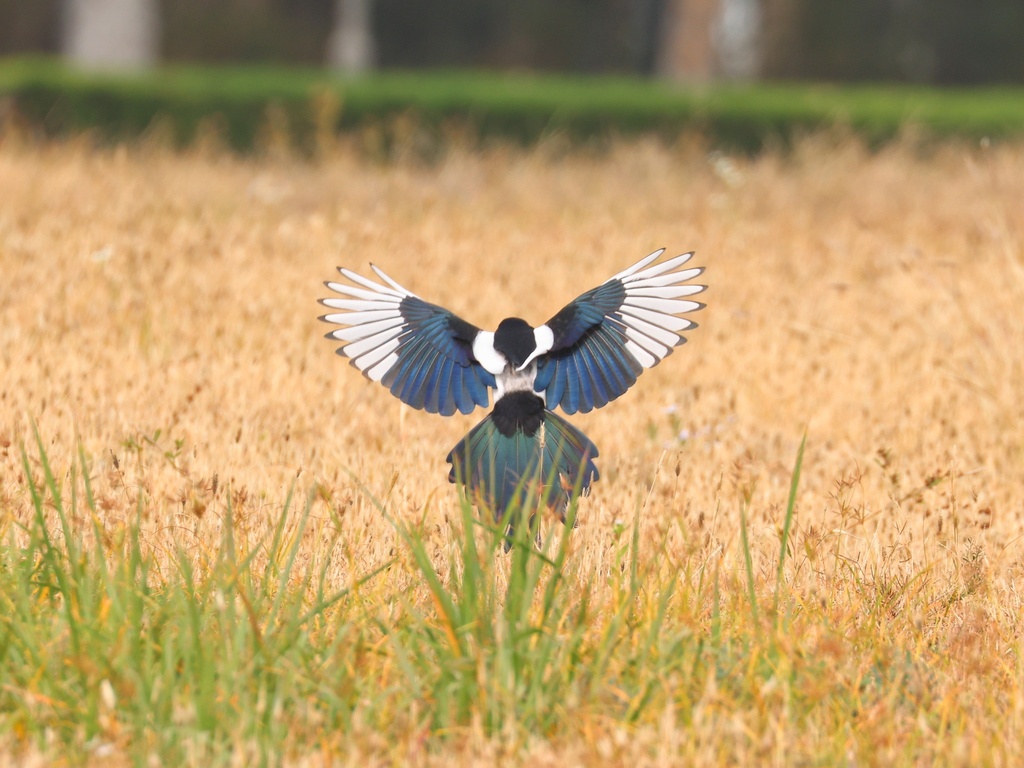
It is 45 cm long. Compared to the Eurasian magpie, it is slightly smaller, with a proportionally shorter tail and longer bill and tarsi (lower legs), and darker with less white in the plumage. The back, tail, and particularly the remiges show (according to source) either bluer, less green iridescence compared to Eurasian magpie, or conversely, more green. The rump plumage is mostly black, with narrow, often greyish-white band, which connects the white shoulder patches as in its relatives. The Oriental magpie has the same call as the Eurasian magpie, though somewhat softer.
In human culture
In China, magpies are seen as an omen of good fortune. This is reflected in the Chinese word for magpie, simplified Chinese: 喜鹊; traditional Chinese: 喜鵲; pinyin: xǐquè, in which the first character means "happiness". It was the official ‘bird of joy’ for the Qing dynasty. Qixi Festival, a holiday in China celebrating lovers, is based on the folktale The Cowherd and the Weaver Girl, in which a bridge of magpies reunite the lovers every year on the seventh day of the seventh lunar month. In Korea, the magpie (까치, "kkachi") is celebrated as "a bird of great good fortune, of sturdy spirit and a provider of prosperity and development". In the same vein of bringing fortune and luck, Korean children were also taught that when you lose a tooth, to throw it on the roof singing a song for the magpie (까치야 까치야 헌 이 줄게). The bird will hear your song and bring you a new tooth. It is also a common symbol of the Korean identity, and has been adopted as the "official bird" of numerous South Korean cities, counties and provinces. According to a Korean folktale, magpies formed a bridge to help two star-crossed lovers reunite. The Oriental magpie is the national bird of the Democratic People’s Republic of Korea, replacing the Eurasian goshawk in 2023. In Japan, the Oriental magpie is a naturalised species, first introduced to northwestern Kyushu about 400 years ago by Korean immigrants. …
Wikipedia: “Significance in East Asian culture”
Listen
Looking for field recordings…
Where it lives
Recorded sightings
—
geo-referenced records in GBIF, from museums, herbaria and field observers.
Drag the globe to turn it. Dots are where records exist, not a range map; darker means more records.
In the stacks
Searching the stacks…
Every page naming Pica serica in the Biodiversity Heritage Library →
This page is assembled live from iNaturalist, GBIF, Wikipedia, the Source Library and the Internet Archive. It is not yet part of the hand-edited codex. iNaturalist taxon 827401.