- Animals
- ›Chordates
- ›Vertebrates
- ›Ray-finned Fishes
- ›Carps, Characins, Catfishes and Allies
- ›Characins
- ›Characoidei
- ›American tetras
- ›Acestrorhamphinae
- ›Astyanax
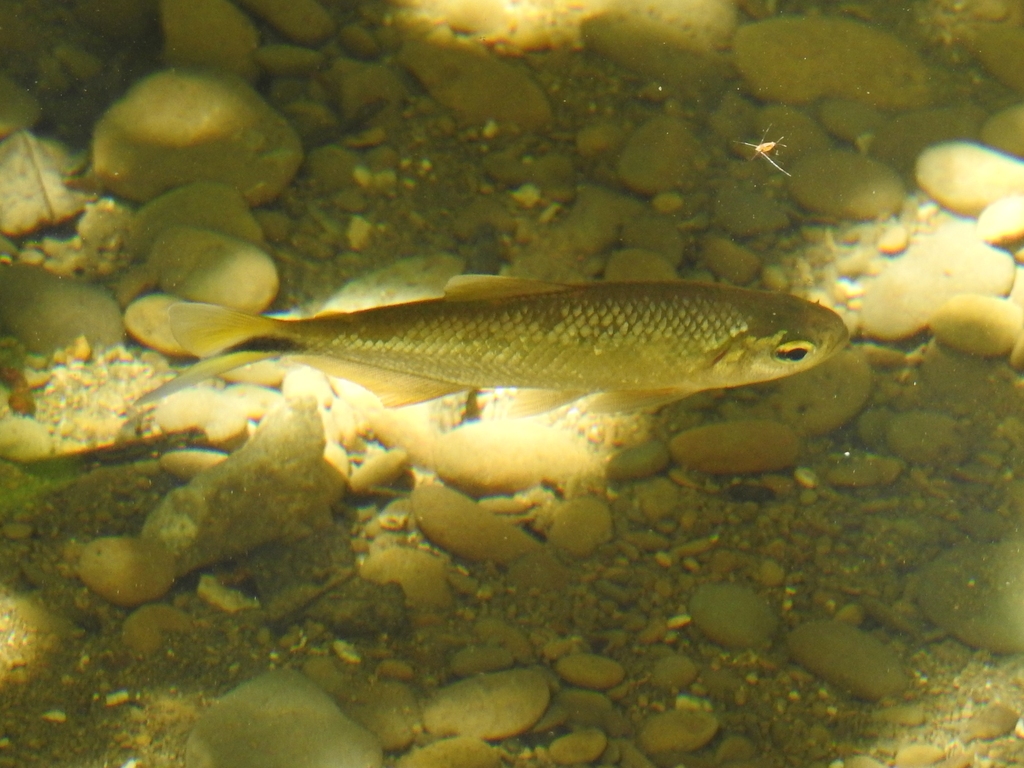
Sixaola River Astyanax
Astyanax anai
Astyanax anai is a species of freshwater ray-finned fish belonging to the family Acestrorhamphidae, the American characins. This fish is found in Central America. It has a restricted range, inhabiting a handful of Atlantic drainages in Costa Rica and Panama, and is known from locales only up to 100 meters elevation. As an endangered species, A. anai is a point of interest for conservation biologists studying the region. It can be found living sympatrically with other species of Astyanax, but is less common than its relatives.
Specimens of A. anai were frequently mistaken for specimens of Astyanax orthodus before it was recognized as its own species; physically and genetically, the two are very similar. A. anai sports several features not uncommon in the genus, such as silver scales, a humeral spot, and fins in a mixture of yellows and oranges. It also has a distinctive, elongated blotch of pigment on the caudal peduncle that often stretches forwards far enough to reach over the back end of the anal fin.
From the article Astyanax anai on Wikipedia (CC BY-SA), quoted section by section
Description
Astyanax anai reaches a maximum length of 11.3 cm (4.4 in) SL (standard length, without the tail fin included). The body is deep and robust, with its deepest point just before the origin of the dorsal fin. The scales are cycloid and somewhat large, and there is a lateral line that has between 35 and 39 scales, most often 36 or 38. There are usually 12 rays in the pectoral fin, rarely 11, and there are consistently 7 rays in the ventral fin. The dorsal fin is also consistent, with 9 rays. The anal-fin rays vary more, ranging from 25 to 30, but 27 rays is the most common. (The first ray of the anal fin may be difficult to pick out, as it is quite small.) The two lobes of the caudal fin are usually the same size, though the lower is occasionally larger; there are usually 17 caudal-fin rays in total, but there may be 16 or 18. In life, there are brown or greenish-brown scales on the back and silver or silver-white scales on the belly. There is an indistinct silver-blue or silver-green stripe down each side. The area surrounding the eye and on the operculum - the gill cover - has scattered black chromatophores (pigment cells). The eye itself sports a dark blotch or stripe in the middle of its back half, which often extends out onto the cheek and onto the upper portion of the operculum. The dorsal, caudal, and adipose fins are yellow to yellow-brown. …
Range & habitat
Astyanax anai has a relatively restricted range, present only in a few coastal drainages in Panama and Costa Rica that are a part of the Sixaola river basin. It is a lowland species, collected from waters at 0 to 100 meters in elevation; the holotype of A. anai - the original specimen upon which the description was based - was collected at 60 m. In terms of a more specific biotope, it has a noted preference for pools and backwaters, where it takes shelter in caves under the riverbank or in plant roots. However, it is adaptable to various conditions and can withstand various current speeds, as well as temperatures ranging from 21 °C (70 °F) to 32 °C (90 °F). It will sometimes share its environment with congener Astyanax nicaraguensis, but is less common in flowing waters; in still areas, it may be more abundant. Astyanax anai is omnivorous. It mainly eats seeds, but a substantial part of its diet is made up of insects, both terrestrial and aquatic.
Wikipedia: “Distribution and ecology”
In human culture
The genus name Astyanax originates in the Iliad, a Greek epic poem wherein Astyanax was a prince and a warrior. While not made clear in the nominal text, this allusion is likely because the large, silvery scales of type species A. argentatus could be compared to armor or a shield. The specific epithet anai serves as a reference to two entities of importance in local aquatic research: firstly, to the ecological organization Asociación ANAI, which the authors wished to recognize for its contributions to the conservation of the native range of A. anai; secondly, to the collection manager of the fishes collection of the Universidad de Costa Rica, Ana R. Ramírez Coghi.
Wikipedia: “Etymology”
Where it lives
Recorded sightings
—
geo-referenced records in GBIF, from museums, herbaria and field observers.
Drag the globe to turn it. Dots are where records exist, not a range map; darker means more records.
In the stacks
Searching the stacks…
Every page naming Astyanax anai in the Biodiversity Heritage Library →
This page is assembled live from iNaturalist, GBIF, Wikipedia, the Source Library and the Internet Archive. It is not yet part of the hand-edited codex. iNaturalist taxon 1314285.