On eBird ↗
Greater Antillean Bullfinch
Live sightings near you, the range map, bar charts of when it is seen, and Macaulay Library photos and recordings.
Greater Antillean Bullfinch
Melopyrrha violacea
The Greater Antillean bullfinch (Loxigilla violacea) is a species of bird in the family Thraupidae. It is found in the Bahamas, the Dominican Republic, Haiti, Jamaica (endemic sub-species L. v. ruficollis), and the Turks and Caicos Islands. Its natural habitats are subtropical or tropical dry forest, subtropical or tropical moist lowland forest, subtropical or tropical moist montane forest, subtropical or tropical dry shrubland, and heavily degraded former forest.
From the article Greater Antillean bullfinch on Wikipedia (CC BY-SA), quoted section by section
Description
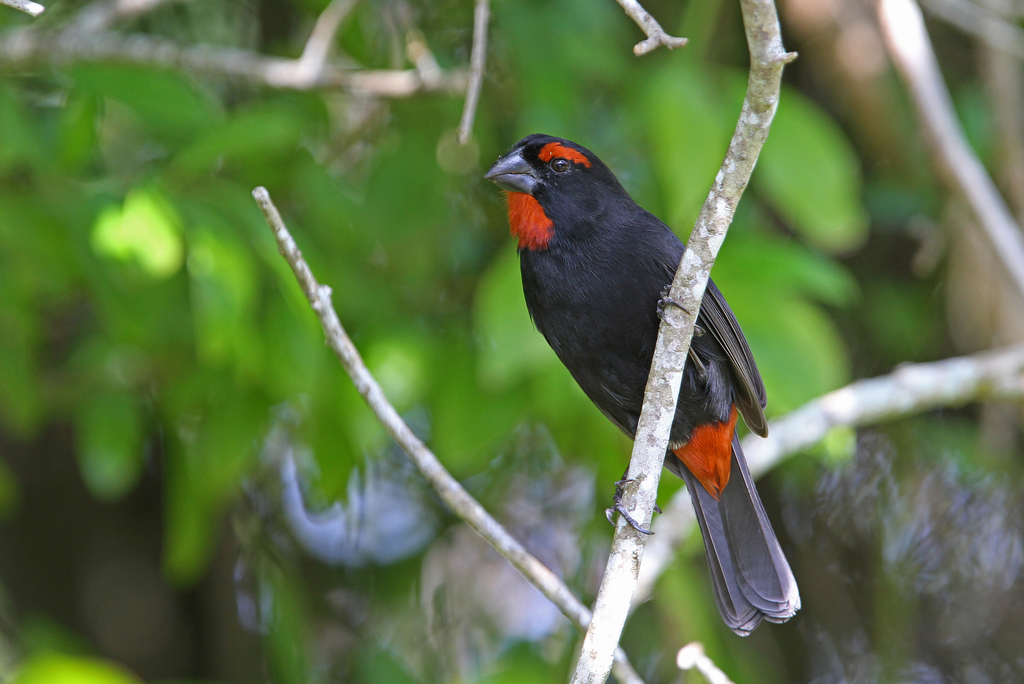
The Greater Antillean bullfinch is 13.2 to 17.5 cm (5.2 to 6.9 in) long and weighs 18 to 32.4 g (0.63 to 1.1 oz). The species is sexually dimorphic though not dramatically so. Adult males of the nominate M. v. violacea are black except for a short red-orange supercilium and red-orange throat and undertail coverts. Adult females are a duller, more slaty black than males, especially on their upperparts. The other subspecies of the Greater Antillean bullfinch differ little from the nominate. M. v. affinis is smaller and glossier and M. v. maurella is larger than affinis and glossier than the nominate. Subspecies M. v. ruficollis differs the most; it is larger, grayer, and duller than the nominate with a paler supercilium and throat. M. v. ofella is the smallest subspecies but otherwise like the nominate. M. v. parishi is described as smaller than the nominate "but this is not confirmed by any measurements of topotypes". Both sexes of all subspecies have a dark iris, a short, thick dark gray bill, and dusky legs and feet.
Range & habitat
Even when they agree on the subspecies of the Greater Antillean bullfinch, sources differ on some of their ranges:
M. v. violacea: when ofella is treated separately, the northern and central Bahamas; when ofella is included, the Bahamas and Caicos Islands M. v. ofella: central and eastern Caicos Islands in the southern Bahamas M. v. maurella: Tortue; Tortue and Gonâve Islands of Haiti and Saona Island of the Dominican Republic M. v. affinis: with parishi, Hispaniola and small islands off its south coast; without parishi, Hispaniola and Catalina Island of the Dominican Republic M. v. parishi: Île-à-Vache of Haiti and Beata Island of the Dominican Republic M. v. ruficollis: Jamaica The Greater Antillean bullfinch inhabits "[d]ense thickets and undergrowth at all elevations from dry coastal scrub to wet mountain forests, including gardens". Other sources say its elevational ceiling is 2,000 m (6,600 ft).
Wikipedia: “Distribution and habitat”
What it does
The Greater Antillean bullfinch feeds primarily on fruits and seeds but also includes flowers and snails in its diet. It usually feeds in dense vegetation and probably on or near the ground.
Wikipedia: “Feeding”
Listen
Looking for field recordings…
Where it lives
Recorded sightings
—
geo-referenced records in GBIF, from museums, herbaria and field observers.
Drag the globe to turn it. Dots are where records exist, not a range map; darker means more records.
In the stacks
Searching the stacks…
Every page naming Melopyrrha violacea in the Biodiversity Heritage Library →
This page is assembled live from iNaturalist, GBIF, Wikipedia, the Source Library and the Internet Archive. It is not yet part of the hand-edited codex. iNaturalist taxon 793274.