- Animals
- ›Chordates
- ›Vertebrates
- ›Birds
- ›Swifts and Hummingbirds
- ›Hummingbirds
- ›Bee Hummingbirds, Emeralds, Mountain-gems, and Allies
- ›Emerald Hummingbirds and Allies
- ›Riccordia
On eBird ↗
Hispaniolan Emerald
Live sightings near you, the range map, bar charts of when it is seen, and Macaulay Library photos and recordings.
Hispaniolan Emerald
Riccordia swainsonii
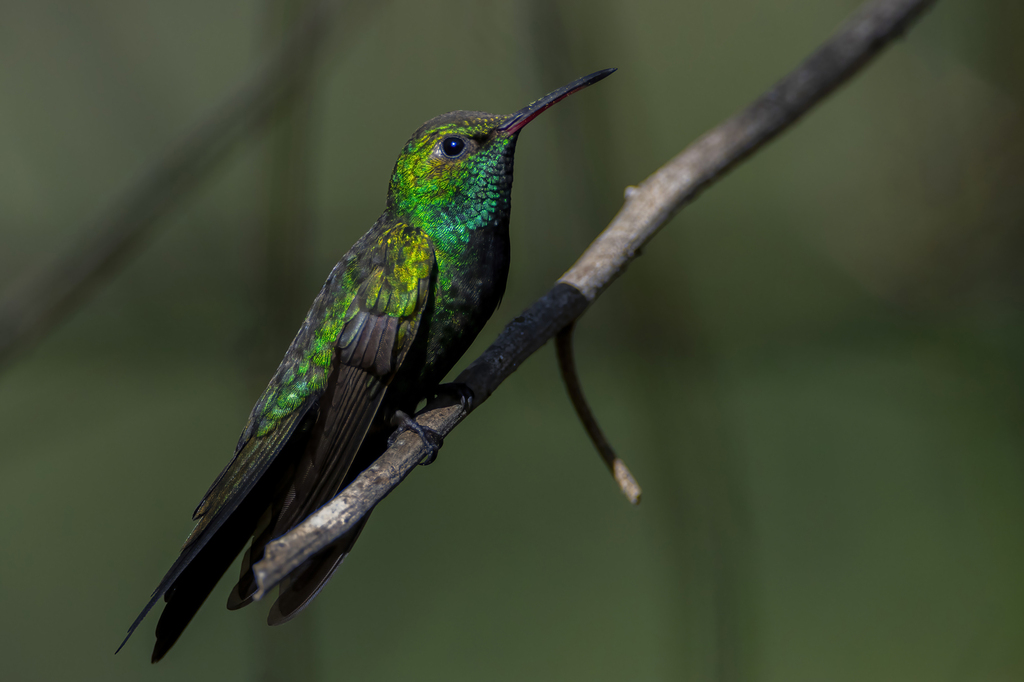
The Hispaniolan emerald (Riccordia swainsonii) is a species of hummingbird in the "emeralds", tribe Trochilini of subfamily Trochilinae. It is endemic to the island of Hispaniola, which is shared by the Dominican Republic and Haiti.
From the article Hispaniolan emerald on Wikipedia (CC BY-SA), quoted section by section
Description
Male Hispaniolan emeralds are 9.5 to 10.5 cm (3.7 to 4.1 in) long and females 8.5 to 9.5 cm (3.3 to 3.7 in). The species weighs between 2.5 and 5 g (0.088 and 0.18 oz). Both sexes have a small white spot behind the eye. Males have a bill whose mandible is red and the maxilla black, and that is slightly decurved at the outer end. Its forehead, crown, and cheeks are dull dark brown; the rest of its upperparts and flanks are dark green with a bronze tinge and the uppertail coverts are dark green. Its throat is iridescent green with a large black patch below it. The rest of its underparts are a darker green than the upperparts with dark green undertail coverts. The tail is deeply forked and dark brown. The female's bill is more deeply decurved than the male's. Its head and upperparts are like the male's. Its underparts are gray that is darker on the belly and undertail coverts. The outermost pair of tail feathers have a gray base, a wide dark brown band near the end, and a white tip. The next pair inward is mostly dark grass green becoming black at the end. The inner three pairs are green.
Range & habitat
The Hispaniolan emerald is found in both countries of its namesake island, the Dominican Republic and Haiti. It inhabits the interior and edges of dense montane rainforest, scrublands, and coffee plantations. In elevation it mostly ranges between 300 and 2,500 m (980 and 8,200 ft) but is found as low as sea level and occasionally higher than 3,000 m (9,800 ft).
Wikipedia: “Distribution and habitat”
What it does
The Hispaniolan emerald forages for nectar by trap-lining, visiting a circuit of flowering plants. It feeds anywhere from 3 to 18 m (10 to 60 ft) above the ground. In addition to nectar, it feeds on insects captured by hawking from a perch.
Wikipedia: “Feeding”
Listen
Looking for field recordings…
Where it lives
Recorded sightings
—
geo-referenced records in GBIF, from museums, herbaria and field observers.
Drag the globe to turn it. Dots are where records exist, not a range map; darker means more records.
In the stacks
Searching the stacks…
Every page naming Riccordia swainsonii in the Biodiversity Heritage Library →
This page is assembled live from iNaturalist, GBIF, Wikipedia, the Source Library and the Internet Archive. It is not yet part of the hand-edited codex. iNaturalist taxon 1289680.