On eBird ↗
Puerto Rican Bullfinch
Live sightings near you, the range map, bar charts of when it is seen, and Macaulay Library photos and recordings.
Puerto Rican Bullfinch
Melopyrrha portoricensis
The Puerto Rican bullfinch (Melopyrrha portoricensis) is a small bullfinch tanager endemic to the archipelago of Puerto Rico. The species can be commonly found in heavy forests throughout Puerto Rico, except on the easternmost tip of the island. It consumes seeds, fruits, insects, and spiders. The nest is spherical, with an entrance on the side. Typically three light green eggs are laid.
From the article Puerto Rican bullfinch on Wikipedia (CC BY-SA), quoted section by section
Description
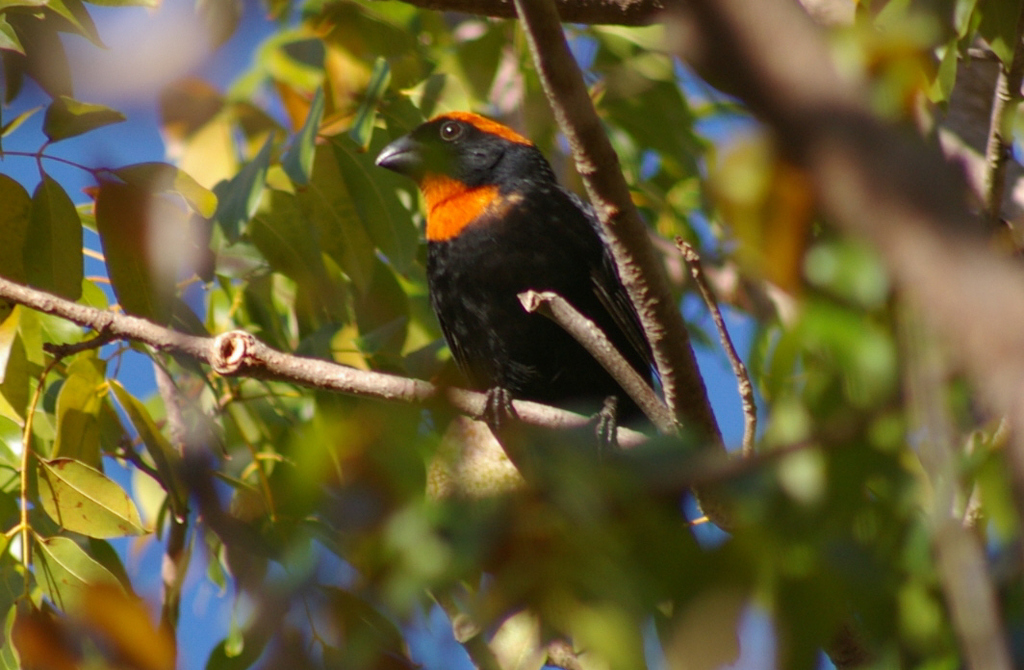
The Puerto Rican bullfinch has black feathers with orange areas above the eyes, around its throat, and underneath the tail's base. The species measures from 17 to 19 cm (6.7 to 7.5 in) and weighs approximately 32 grams (1.1 oz).
Range & habitat
Bullfinches are believed to be most common in dense mountain forests but can also be found in lower forests with dense undergrowth, coffee plantations, thick brushy areas, dry coastal thickets, and rarely in mangroves. They have also been described as edge or open-canopy species. Even though it has a widespread distribution over the island, it is suspected that there has been a reduction in range and overall population.
Wikipedia: “Distribution and habitat”
What it does
Bullfinches are considered to be mainly frugivorous (and appear to prefer fruit when available) but they also consume other plant and animal material. Even though the diet of the nestling bullfinches is unknown, most frugivorous bird species feed large quantities of animal matter to their young, especially during the early portion of the nestling stage. In later stages of development, it is likely that the chicks are also fed fruit and insects. Because of their behavioral flexibility when it comes to food consumption, foraging methods, and foraging site preferences, they are considered a generalist species.
Wikipedia: “Diet”
Listen
Looking for field recordings…
Where it lives
Recorded sightings
—
geo-referenced records in GBIF, from museums, herbaria and field observers.
Drag the globe to turn it. Dots are where records exist, not a range map; darker means more records.
In the stacks
Searching the stacks…
Every page naming Melopyrrha portoricensis in the Biodiversity Heritage Library →
This page is assembled live from iNaturalist, GBIF, Wikipedia, the Source Library and the Internet Archive. It is not yet part of the hand-edited codex. iNaturalist taxon 793273.