- Animals
- ›Chordates
- ›Vertebrates
- ›Ray-finned Fishes
- ›Spiny-rayed fishes
- ›Jacks, Flounders, Barracudas, and Allies
- ›Jacks, Remoras, and Allies
- ›Jacks
- ›Caranginae
- ›Atropus
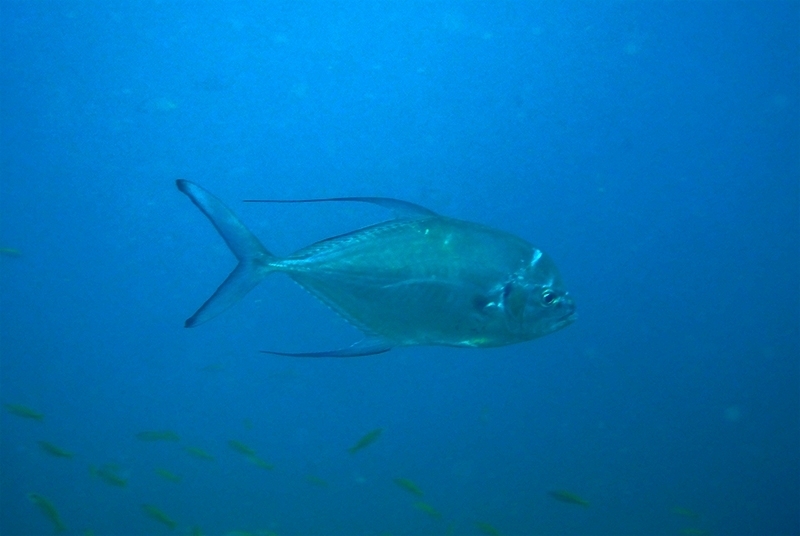
Longfin Trevally
Atropus armatus
The longfin trevally (Atropus armatus), also known as the longfin kingfish, longfin cavalla or armed trevally, is a species of inshore marine fish in the jack family, Carangidae. The species is common in tropical to subtropical waters of the Indo-Pacific, ranging from South Africa in the west to Japan in the east, typically inhabiting inshore reefs and bays. The species is easily distinguished by its elongate dorsal and anal fin lobes and filamentous dorsal rays, as well as its scaleless breast. Longfin trevally are pelagic predators, taking a variety of small fish, cephalopods and crustaceans, and reach sexual maturity at around 21 cm. The species has a maximum known length of 57 cm and weight of 3.5 kg. The longfin trevally has a very complex taxonomic history which is closely intertwined with another currently valid species, Carangoides ciliarius, which may yet prove to be synonymous. Longfin trevally are of minor importance to fisheries throughout their range and are considered good table fish, and are occasionally taken by anglers.
From the article Longfin trevally on Wikipedia (CC BY-SA), quoted section by section
Description
The longfin trevally has a similar body profile to most other jacks, having a deep, strongly compressed body. It is a medium-sized fish, growing to a maximum known length of 57 cm, and at least 3.5 kg in weight. The profile of the head is very steep from the mouth to the nape, especially in adults. There is a weak adipose eyelid covering the eye, which is about equal to or smaller than the snout length. Both jaws are lined with villiform teeth, although larger specimens have small conical teeth in bands. The gill rakers are one of the diagnostic features of the species, having 30 to 37 rakers on the first arch. The dorsal fin is in two parts, the first consisting of 13 spines and the second of 1 spine followed by 19 to 22 soft rays. The second dorsal fin is sexually dimorphic, with mature males longer than 21 cm having 3 to 12 of the central soft rays extended into thin filaments of varying lengths. The anal fin has 2 anteriorly detached spines followed by a single spine connected to 16 to 18 soft rays. The lobes of both the anal and dorsal fin are highly extended, giving the species its name. The anal fins also show extension into filaments to a lesser degree. The pectoral fins are falcate to subfalcate with 18–20 rays, while the caudal fin is deeply forked with bilateral, paired caudal keels. …
Range & habitat
The longfin trevally inhabits tropical to subtropical waters of the Indian and west Pacific Oceans. It is distributed from East London, South Africa in the west, north to Madagascar, eastern Africa, India, Thailand, Hong Kong, Taiwan and to Japan in the east. The species is also common in the Red Sea and the Gulf of Oman. The species inhabits inshore coastal waters rarely venturing offshore, and is pelagic, inhabiting both the upper and lower sections of the water column. Longfin trevally are commonly found on rocky and coral coastlines, often inhabiting reef complexes, with solitary individuals or groups of larger fish patrolling the edges of reefs. They are also found in shallow, sandy bays and lagoons, with juveniles known to enter and use estuaries as nursery areas.
Wikipedia: “Distribution and habitat”
Where it lives
Recorded sightings
—
geo-referenced records in GBIF, from museums, herbaria and field observers.
Drag the globe to turn it. Dots are where records exist, not a range map; darker means more records.
In the stacks
Searching the stacks…
Every page naming Atropus armatus in the Biodiversity Heritage Library →
This page is assembled live from iNaturalist, GBIF, Wikipedia, the Source Library and the Internet Archive. It is not yet part of the hand-edited codex. iNaturalist taxon 1360078.