- Animals
- ›Chordates
- ›Vertebrates
- ›Ray-finned Fishes
- ›Spiny-rayed fishes
- ›Jacks, Flounders, Barracudas, and Allies
- ›Jacks, Remoras, and Allies
- ›Jacks
- ›Caranginae
- ›Ferdauia
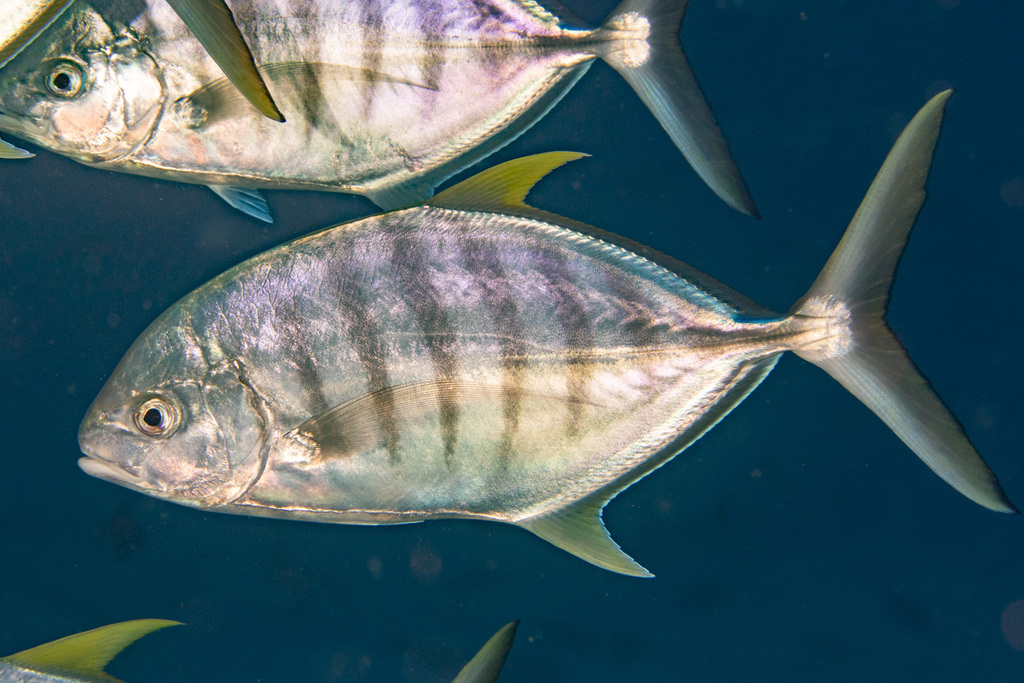
Barred Trevally
Ferdauia ferdau
The blue trevally (Ferdauia ferdau), also known as the banded trevally, barred trevally, Ferdau's trevally or Forskaal's jackfish, is a common, widespread species of pelagic marine fish classified in the jack family, Carangidae. The blue trevally is distributed throughout the tropical and subtropical waters of the Indo-Pacific and central Pacific regions, ranging from South Africa in the west to Hawaii in the east. It is a moderately large fish, growing to a recorded maximum length of 70 cm, with the number of rays in the second dorsal fin and the colouring serving as diagnostic features of the species. The species inhabits waters to depths of 60 m, generally inhabiting reefs, beaches, lagoons, and areas with sandy substrates. It is a predatory fish, taking other fish, prawns, crabs, and molluscs, and very little is known of the species' reproductive biology. The blue trevally is of varying importance to fisheries throughout its range, with some regions having high catches of the fish. It is considered to be a gamefish, and is sought after for its excellent eating qualities.
From the article Blue trevally on Wikipedia (CC BY-SA), quoted section by section
Description
The blue trevally is a moderately large fish, growing to a recorded maximum length of 70 cm and a weight of 8 kg. The species has a compressed, oblong body, with the dorsal profile more convex than the ventral profile. The snout is bluntly rounded, resembling the snouts of the pompanos of the genus Trachinotus and the lips of adults are notably fleshy. Two separate dorsal fins are found, the first having eight spines, while the second consists of one spine and 26 to 34 soft rays. In young adults, the lobe of the second dorsal fin is often falcate, but usually shorter than the head length. The anal fin has two anteriorly detached spines followed by a single spine attached to 21 to 26 soft rays, while the pelvic fin has one spine attached to 20 or 21 soft rays. The lateral line has a gentle anterior arch, with the junction of the curved and straight sections vertically below the 15th to 20th soft rays of the second dorsal fin. The curved section of the lateral line contains 82 to 90 scales, while the straight section has 12 to 17 scales and 26 to 31 scutes. The breast is naked ventrally to origin of the pelvic fins and the base of the pectoral fins, but is interrupted laterally by a moderate band of scales. The upper jaw is highly protractile, containing narrow bands of villiform teeth, which become obsolescent with age, as is the case in the lower jaw. …
Range & habitat
The blue trevally has a wide distribution, inhabiting the tropical and subtropical waters of the Indian, West Pacific and Central Pacific Oceans. It ranges from South Africa in the west, north along the East African coast to the Red Sea and across to India and Southeast Asia. The species ranges south to Australia and Indonesia, and as far as Japan, Hawaii, and a number of Pacific islands, including Micronesia, New Caledonia, and Tonga. The blue trevally inhabits coastal waters to a depth of 60 m, over reefs, beaches, lagoons, and areas with sandy substrates. The species lives pelagically, allowing movement between islands and atolls. It is rarely found in estuaries, suggesting a poor tolerance to low salinities.
Wikipedia: “Distribution and habitat”
Where it lives
Recorded sightings
—
geo-referenced records in GBIF, from museums, herbaria and field observers.
Drag the globe to turn it. Dots are where records exist, not a range map; darker means more records.
In the stacks
Searching the stacks…
Every page naming Ferdauia ferdau in the Biodiversity Heritage Library →
This page is assembled live from iNaturalist, GBIF, Wikipedia, the Source Library and the Internet Archive. It is not yet part of the hand-edited codex. iNaturalist taxon 1360116.