- Animals
- ›Echinoderms
- ›sea urchins and sea cucumbers
- ›Sea Cucumbers
- ›Actinopoda
- ›Holothuriida
- ›Holothuriidae
- ›Holothuria
- ›Halodeima
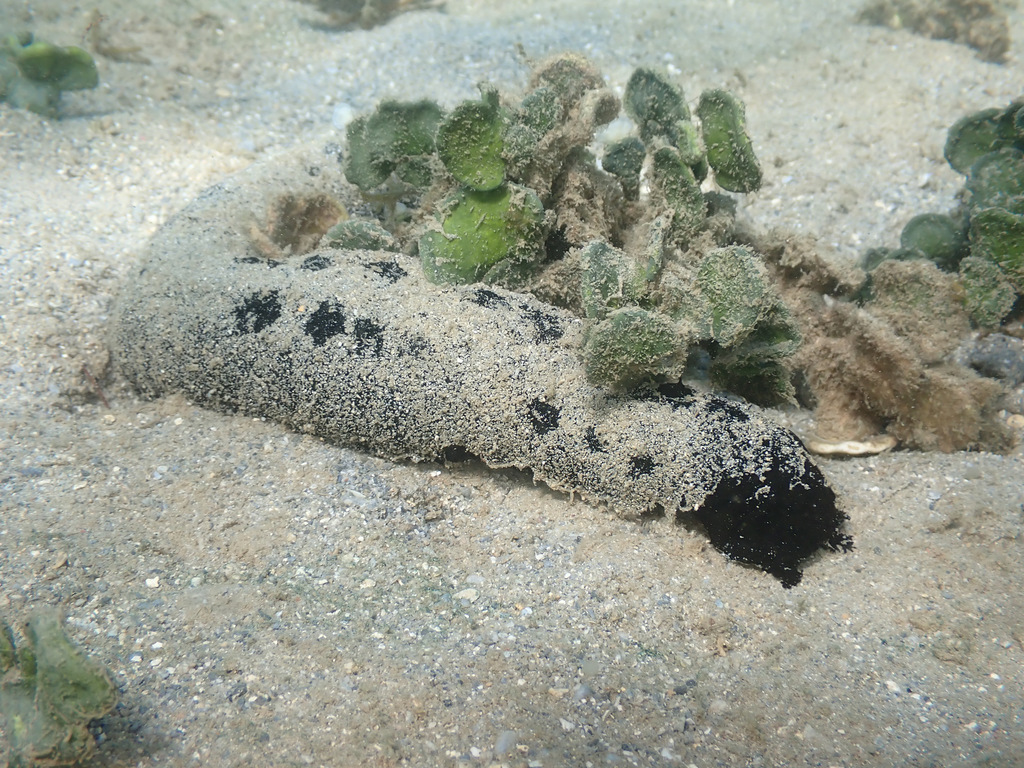
Lollyfish Sea Cucumber
Holothuria atra
Holothuria atra, commonly known as the black sea cucumber or lollyfish, is a species of marine invertebrate in the family Holothuriidae. It was placed in the subgenus Halodeima by Pearson in 1914, making its full scientific name Holothuria (Halodeima) atra. It is the type species of the subgenus.
From the article Holothuria atra on Wikipedia (CC BY-SA), quoted section by section
Description
Holothuria atra is a sea cucumber that can grow to a length of 60 centimetres (24 in) but 20 centimetres (7.9 in) is a more common size. It has a smooth, pliable, entirely black skin which often has sand adhering to it, especially in smaller individuals. The mouth is on the underside at one end and is surrounded by a fringe of 20 black, branched tentacles. The anus is at the other end.
Range & habitat
Holothuria atra is found in the tropical Indo-Pacific region, its range extending from the Red Sea and East Africa to Australia. It is found on the seabed, in shallow waters on reefs and sand flats and in seagrass meadows at depths of up to 20 metres (66 ft). Its colouring makes it conspicuous but it is very often camouflaged by a coating of sand which may also serve to keep it cool by protecting it from the sun's rays. It favours reef flats where it is not fully exposed to the waves but the water is well aerated, and shallows beside slabs of rock from under which cool water wells out when the tide retreats. In such places it is often found in pools above the low tide mark which are warmed by the sun during the day. Holothuria atra seems to tolerate these high temperatures well and individuals appeared healthy and were feeding when the water temperature rose as high as 39 °C.
Wikipedia: “Distribution and habitat”
What it does
Holothuria atra, like many echinoderms, engage in sediment bioturbation—a process which plays an important role in the health of coral reefs. Holothuria atra is often found associated with the polychaete worm Gastrolepidia clavigera, a black worm which crawls about over the sea cucumber's skin. Holothuria atra seems to have few natural predators. Lissocarcinus orbicularis, a small crab, is known to live on this species in a commensal relationship.
Wikipedia: “Ecology”
At the table
In the Pacific Islands, Holothuria atra is collected by diving or by wading at low tide, and used for human consumption; its commercial value, however, is low. On Guam, the toxic red fluid that Holothuria atra releases is utilized to drive octopuses out of hiding holes. Compounds of potential biomedical importance are present in Holothuria atra, including lectin, steroidal sapogenins and triterpene glycoside.
== References ==
Wikipedia: “Uses”
Where it lives
Recorded sightings
—
geo-referenced records in GBIF, from museums, herbaria and field observers.
Drag the globe to turn it. Dots are where records exist, not a range map; darker means more records.
In the stacks
Searching the stacks…
Every page naming Holothuria atra in the Biodiversity Heritage Library →
This page is assembled live from iNaturalist, GBIF, Wikipedia, the Source Library and the Internet Archive. It is not yet part of the hand-edited codex. iNaturalist taxon 55946.