- Animals
- ›Chordates
- ›Vertebrates
- ›Ray-finned Fishes
- ›Spiny-rayed fishes
- ›Perches, Scorpionfishes, Sticklebacks, and Allies
- ›Sculpins and Allies
- ›Fathead Sculpins
- ›Myoxocephalus
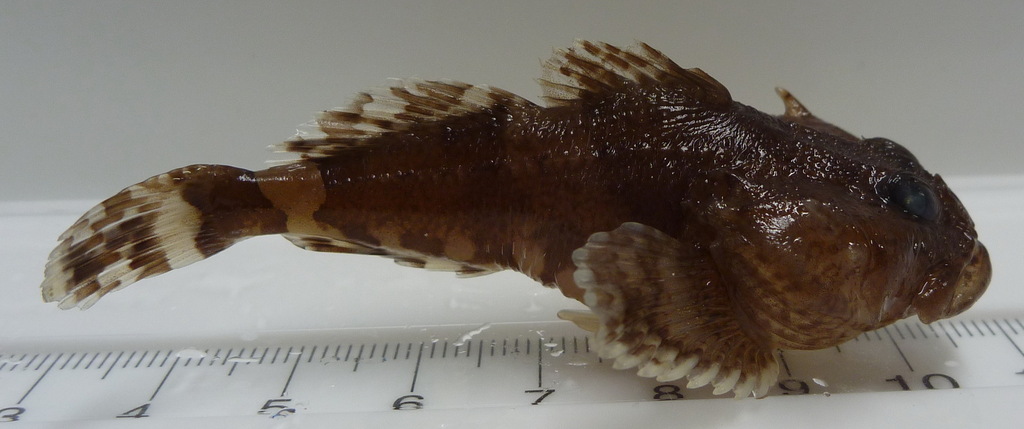
Arctic Sculpin
Myoxocephalus scorpioides
The Arctic sculpin (Myoxocephalus scorpioides) or the northern sculpin, is a predatory species of sculpin in the fish family Cottidae. The species is native to the Arctic Ocean around Canada and Greenland, specifically in James Bay and the Strait of Belle Isle, and towards the Bering Sea. It has the ability to synthesize antifreeze proteins, allowing it to withstand temperatures as low as -2 °C. It serves as the host for Haemobaphes cyclopterina, a parasitic species of...
From the article Myoxocephalus scorpioides on Wikipedia (CC BY-SA), quoted section by section
Description
Myoxocephalus scorpioides has dorsal fins which are supported by 8 or 9 spines and between 14 and 17 soft rays while the anal fin has between 11 and 13 soft rays. The head and body are slightly compressed, but widest towards the head with tentacles on the parts of head behind the eyes. There are 3 spines on the preoperculum, the middle spine being half the length of the top spine. This top spine does not extend to the margin of the operculum and so is comparatively short when compared with most congeners. The caudal peduncle is long and slender and the caudal fin is rounded. The body above the lateral line has scattered plates with many small spines and elevated centres with a few small scattered plates underneath the lateral line. The lateral line has its pores arranged in 3 rows. The overall colour is dark olive to blackish-brown marked with darker mottles or bands. The males have the pectoral fins marked with distinct white spots, while in females they have dark bands. The males also have dark-margined white or silvery spots below the pectoral fins and over the anal fin, dark spots on the breast, lower lip, and have a reddish-orange belly, which is broken by a wide white stripe extending from the pelvic fins to the anal fin. This species attains a maximum published total length of 22 cm (8.7 in).
Range & habitat
Myoxocephalus scorpioides is found in the Arctic Ocean from the East Siberian Sea east through the Arctic Ocean of North America as far as Western Greenland south to Hudson Bay and James Bay, the Strait of Belle Isle and the Gulf of St Lawrence. It is also found in the Bering Sea coasts south to Bristol Bay and the Gulf of Anadyr. It is afound in shallow intertidal waters, down to 25 m (82 ft), rartely 40 m (130 ft), typically on rocky substrates among Fucus seaweeds. Juveniles are frequently recorded near the discharges of freshwater streams in the intertidal zone.
Wikipedia: “Distribution and habitat”
Where it lives
Recorded sightings
—
geo-referenced records in GBIF, from museums, herbaria and field observers.
Drag the globe to turn it. Dots are where records exist, not a range map; darker means more records.
In the stacks
Searching the stacks…
Every page naming Myoxocephalus scorpioides in the Biodiversity Heritage Library →
This page is assembled live from iNaturalist, GBIF, Wikipedia, the Source Library and the Internet Archive. It is not yet part of the hand-edited codex. iNaturalist taxon 225388.