- Animals
- ›Chordates
- ›Vertebrates
- ›Ray-finned Fishes
- ›Spiny-rayed fishes
- ›Perches, Scorpionfishes, Sticklebacks, and Allies
- ›Sculpins and Allies
- ›Typical Sculpins
- ›Leptocottus
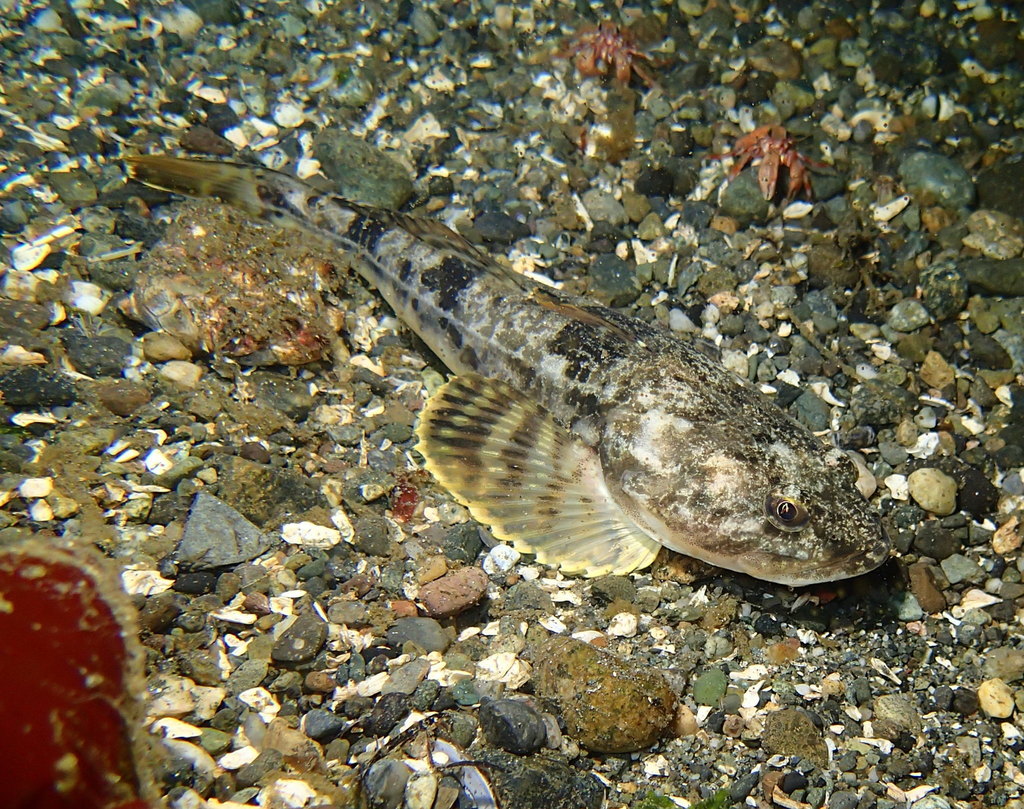
Pacific Staghorn Sculpin
Leptocottus armatus
The Pacific staghorn sculpin, Leptocottus armatus, is a common sculpin (Cottidae) found in shallow coastal waters along the Pacific coast from Alaska to Baja California. The sole member of its genus, it is unusual for having spined antler-like projections on its gill covers; it can raise the projections as a defense mechanism.
From the article Pacific staghorn sculpin on Wikipedia (CC BY-SA), quoted section by section
Description
Pacific staghorn sculpins are slender fish, with a wide, large, highly flattened head with a body which tapers towards the tail. Its overall color is grayish-olive on the upper body, there a few yellow tints and it fades to creamy yellow on the underside. They are reported to be able to change their color to camouflage them. The anal and pelvic fins are lighter and the caudal fin is dusky with 1 or 2 light-colored bars. The dorsal fins are continuous with the first dorsal fin being marked with black spots close to the tips of the rearmost 3 spines and a white band long its base, while the second dorsal fin is dusky with a number of diagonal white to yellowish bands. The pectoral fins are yellow marked with 5 or 6 dark green bars. The large eyes are placed on the top of the head and they have a large wide mouth containing many small teeth. The preoperculum has a large spine that ends in three or four sharp, recurved spinules. The dorsal fins are supported by between 6 and 8 spines and between 15 and 20 soft rays while the anal fin has 14 to 20 rays. The caudal fin is rounded. They lack any scales and the lateral line is straight. This species reaches a maximum total length of 46 cm (18 in) but 35 cm (14 in) is more typical.
Range & habitat
The Pacific staghorn sculpin is found in the eastern Pacific Ocean along the western coast of North America from the Izembek Lagoon, on the southeastern Bering Sea coast of Alaska south as far as San Quintín, Baja California. These sculpins are commonly found near the shore, particularly in bays and estuaries; most often on sandy substrates. As adults they are found in sheltered marine estuaries while the juveniles are found in freshwater streams and upper estuarine environments.
Wikipedia: “Distribution and habitat”
In human culture
The Pacific staghorn sculpin's genus name, Leptocottus, is a combination of leptos, meaning "slender", and Cottus. The specific name armatus means "armed", a reference to the large and sharp spines on the preoperculum.
Wikipedia: “Etymology”
Where it lives
Recorded sightings
—
geo-referenced records in GBIF, from museums, herbaria and field observers.
Drag the globe to turn it. Dots are where records exist, not a range map; darker means more records.
In the stacks
Searching the stacks…
Every page naming Leptocottus armatus in the Biodiversity Heritage Library →
This page is assembled live from iNaturalist, GBIF, Wikipedia, the Source Library and the Internet Archive. It is not yet part of the hand-edited codex. iNaturalist taxon 49163.