- Animals
- ›Chordates
- ›Vertebrates
- ›Ray-finned Fishes
- ›Spiny-rayed fishes
- ›Perches, Scorpionfishes, Sticklebacks, and Allies
- ›Sculpins and Allies
- ›Fathead Sculpins
- ›Triglops
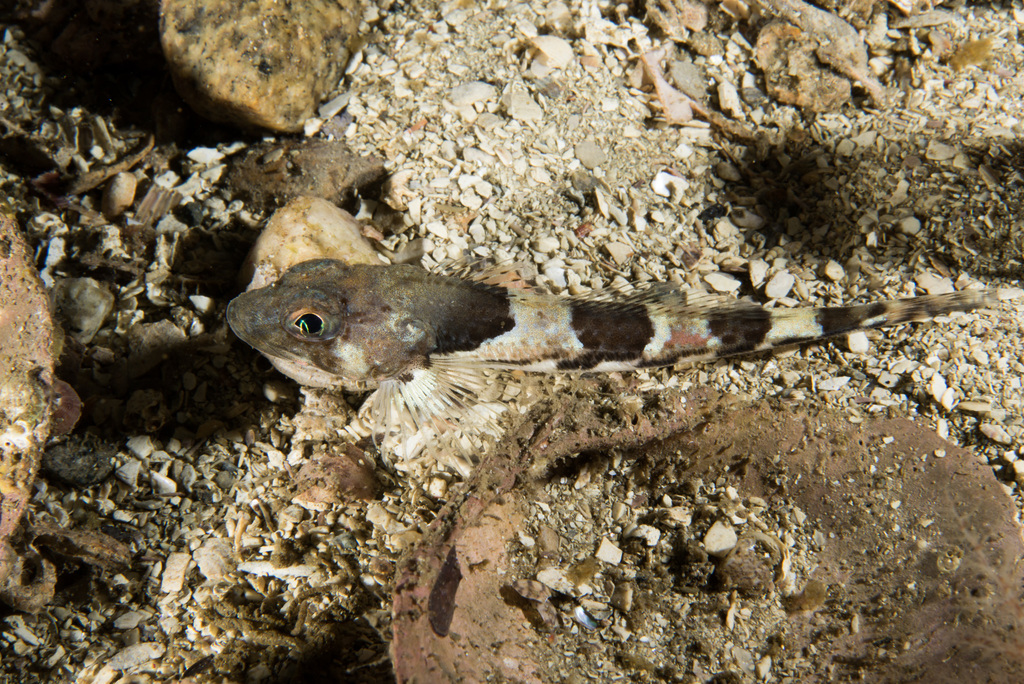
Moustache Sculpin
Triglops murrayi
Triglops murrayi, the moustache sculpin, is a species of marine ray-finned fish belonging to the family Cottidae, the typical sculpins. This fish is found in the North Atlantic Ocean.
From the article Triglops murrayi on Wikipedia (CC BY-SA), quoted section by section
Description
Triglops murrayi is brown on the back and pale brown to cream on the lower body with four blackish-brown saddle-like blotches on the back, these are rather vague in some male fishes. They have a series of dak brown blotches underneath the lateral line that connect to create streaks. The males normally have a clear black blotch on the rear of the first dorsal fin. The base of the caudal fin has dark spots both dorsally and ventrally and the rays of the fin are crossed by between 3 and 6 thin bands, those of males may be hidden by the overall dark coloration of the fin. The upper jaw protrudes slightly. The caudal fin may be truncate or slightly rounded. The third ray of the pelvic fin is longest in females while the second is the longest in males. The males have conical urogenital papilla. The males reach a maximum published standard length of 20 cm (7.9 in) while females reach 15.9 cm (6.3 in).
Range & habitat
Triglops murrayi occurs in the North Atlantic and in the Atlantic sector of the Arctic Ocean. It has been recorded rom the coast of Hudson Bay, the southern end of Baffin Island and Ungava Bay, as far south as Cape Cod and east to Greenland, In the eastern Atlantic it is found along the north coast of Iceland south to the western and northern coasts of Scotland, Orkney, Faroe Islands to the southern extremity of Spitsbergen and Bear Island and along the Scandinavian coast as far north as the White Sea. This is a benthic fish, found on sandy substrates at depths between 7 and 530 m (23 and 1,739 ft), normally at depths from 100 to 200 m (330 to 660 ft).
Wikipedia: “Distribution and habitat”
Where it lives
Recorded sightings
—
geo-referenced records in GBIF, from museums, herbaria and field observers.
Drag the globe to turn it. Dots are where records exist, not a range map; darker means more records.
In the stacks
Searching the stacks…
Every page naming Triglops murrayi in the Biodiversity Heritage Library →
This page is assembled live from iNaturalist, GBIF, Wikipedia, the Source Library and the Internet Archive. It is not yet part of the hand-edited codex. iNaturalist taxon 232945.