- Animals
- ›Chordates
- ›Vertebrates
- ›Ray-finned Fishes
- ›Spiny-rayed fishes
- ›Perches, Scorpionfishes, Sticklebacks, and Allies
- ›Scorpionfishes and Allies
- ›Typical Flatheads
- ›Papilloculiceps
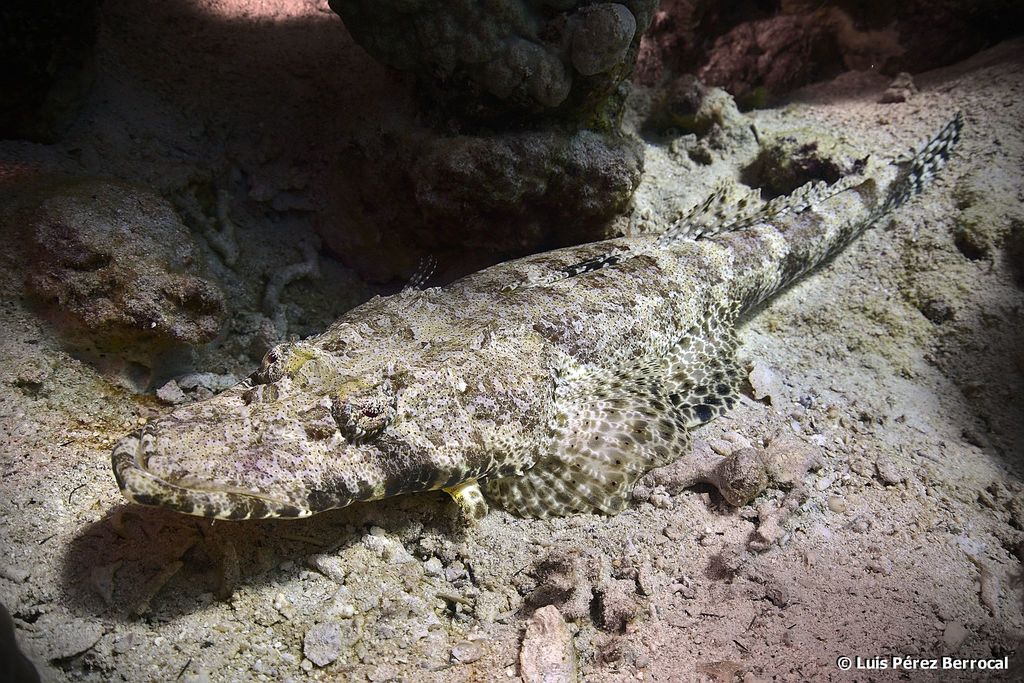
Indian Ocean Crocodilefish
Papilloculiceps longiceps
The tentacled flathead (Papilloculiceps longiceps), also known as the Indian Ocean crocodilefish, Madagascar flathead or longhead flathead, is a species of marine ray-finned fish belonging to the family Platycephalidae, the flatheads. This species is in the western Indian Ocean, including the Red Sea and the Mediterranean, having invaded as a Lessepsian migrant through the Suez Canal. It is the only species in the monotypic genus Papilloculiceps.
From the article Tentacled flathead on Wikipedia (CC BY-SA), quoted section by section
Description
The tentacled flathead has an elongate body with a depressed head with 5 prominent nuchal spines. The ridges on the preoperculum and operculum are smaller dorsally than they are ventrally. There is a spine on the rear of the suborbital ridge which ends with a small spine. There are small spines on the preoperculum. The supraorbital is smooth with a tiny terminal spine, there is one preocular and two parietal spines. The eyes have notable papillae on their upper surfaces. The first dorsal fin has 9 spines and the second dorsal fin and the anal fin each have 11 soft rays. The maximum published total length for this species is 70 cm (28 in), although 50 cm (20 in) is more typical. The body is mottled brownish or greenish dorsally, whitish ventrally. There are 3 or 4 dark bands on the caudal fin and the other fins are marked with large, dark blotches.
Range & habitat
The tentacled flathead is found in the western Indian Ocean from northern KwaZulu-Natal and Madagascar to the northern Red Sea. It also occurs in the Mediterranean Sea, having first been reported there off the coast of Israel in 1986, probably having migrated through the Suez Canal. This species occurs near coral reefs on sand or rubble substrates at depths between 1 and 15 m (3 ft 3 in and 49 ft 3 in).
Wikipedia: “Distribution and habitat”
In human culture
The genus name Papilloculiceps is a combination of papilla ("nipple") and oculus ("eye"), a reference to the small and inconspicuous flattened papilla on the upper surface of the eyeball. The specific name means "long head" and may refer to the flattened, crocodile-like shape of the species' head.
Wikipedia: “Etymology”
Where it lives
Recorded sightings
—
geo-referenced records in GBIF, from museums, herbaria and field observers.
Drag the globe to turn it. Dots are where records exist, not a range map; darker means more records.
In the stacks
Searching the stacks…
Every page naming Papilloculiceps longiceps in the Biodiversity Heritage Library →
This page is assembled live from iNaturalist, GBIF, Wikipedia, the Source Library and the Internet Archive. It is not yet part of the hand-edited codex. iNaturalist taxon 372161.