- Animals
- ›Chordates
- ›Vertebrates
- ›Ray-finned Fishes
- ›Spiny-rayed fishes
- ›Perches, Scorpionfishes, Sticklebacks, and Allies
- ›Sculpins and Allies
- ›Greenlings
- ›Atka Mackerels
- ›Pleurogrammus
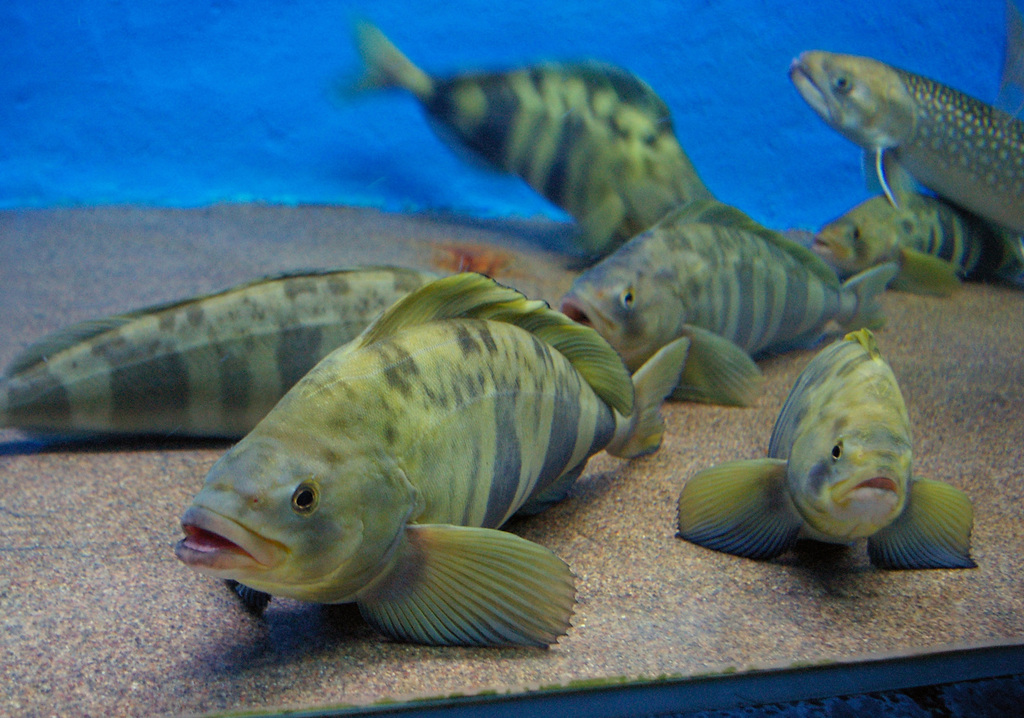
Atka Mackerel
Pleurogrammus monopterygius
The Atka mackerel (Pleurogrammus monopterygius) is a species of greenling, a ray-finned fish in the family Hexagrammidae. Atka mackerel are common in the northern Pacific Ocean, and are one of only two members of the genus Pleurogrammus – the other being the Arabesque greenling (Pleurogrammus azonus). The Atka mackerel was named for Atka Island (Atx̂ax̂ in Aleut), the largest island of the Andreanof islands, a branch of the Aleutians.
From the article Atka mackerel on Wikipedia (CC BY-SA), quoted section by section
Description
Able to live up to 14 years, the largest Atka mackerel recorded was 56.5 centimetres (22.2 in) long; the heaviest recorded weight was 2.0 kilograms (4.4 lb). Adults have five vertical, blackish bands on their bodies, which are normally yellowish. Atka mackerel can be distinguished from other, similar species by the number of spines and rays that they have on their fins. They have 21 spines, and anywhere from 25–29 rays on their dorsal fins, and only one spine (but 24–26 rays) on their anal fins.
Range & habitat
Found exclusively in the northern Pacific, Atka mackerel are known from the Sea of Japan and the waters off Hokkaido, as well as the southern Kuril Islands, and from Stalemate and Bowers Bank in the Aleutian chain to Icy bay, Alaska. They can also be rarely seen as far south as Redondo Beach, California. Atka mackerel can generally be found from the intertidal zone to depths up to 575 metres (1,886 ft).
Migration and breeding. They migrate from shelves to coastal waters to spawn which occurs (in the Aleutians) from July to September. Their eggs adhere to crevices in the rocks, and incubate for 40–45 days. Males guard the clutches of eggs until they hatch.
Wikipedia: “Distribution and habitat”
What it does
The fish feed on copepods and euphausiids. They are, in turn, preyed upon by several species such as bony fishes, (coho salmon, sablefish, Polypera simushirae, Pacific cod, Pacific halibut, and Arrowtooth flounder) mammals (Steller's sea lion), birds (Thick-billed murre), and rays (the Aleutian skate, White-blotched skate, and the Alaska skate) and an important food source for birds, other fish and mammals.
Wikipedia: “Ecology”
Where it lives
Recorded sightings
—
geo-referenced records in GBIF, from museums, herbaria and field observers.
Drag the globe to turn it. Dots are where records exist, not a range map; darker means more records.
In the stacks
Searching the stacks…
Every page naming Pleurogrammus monopterygius in the Biodiversity Heritage Library →
This page is assembled live from iNaturalist, GBIF, Wikipedia, the Source Library and the Internet Archive. It is not yet part of the hand-edited codex. iNaturalist taxon 228388.