- Animals
- ›Chordates
- ›Vertebrates
- ›Ray-finned Fishes
- ›Carps, Characins, Catfishes and Allies
- ›Catfishes
- ›Whale Catfishes
- ›Whale Catfishes
- ›Whalelike Catfishes
- ›Cetopsis
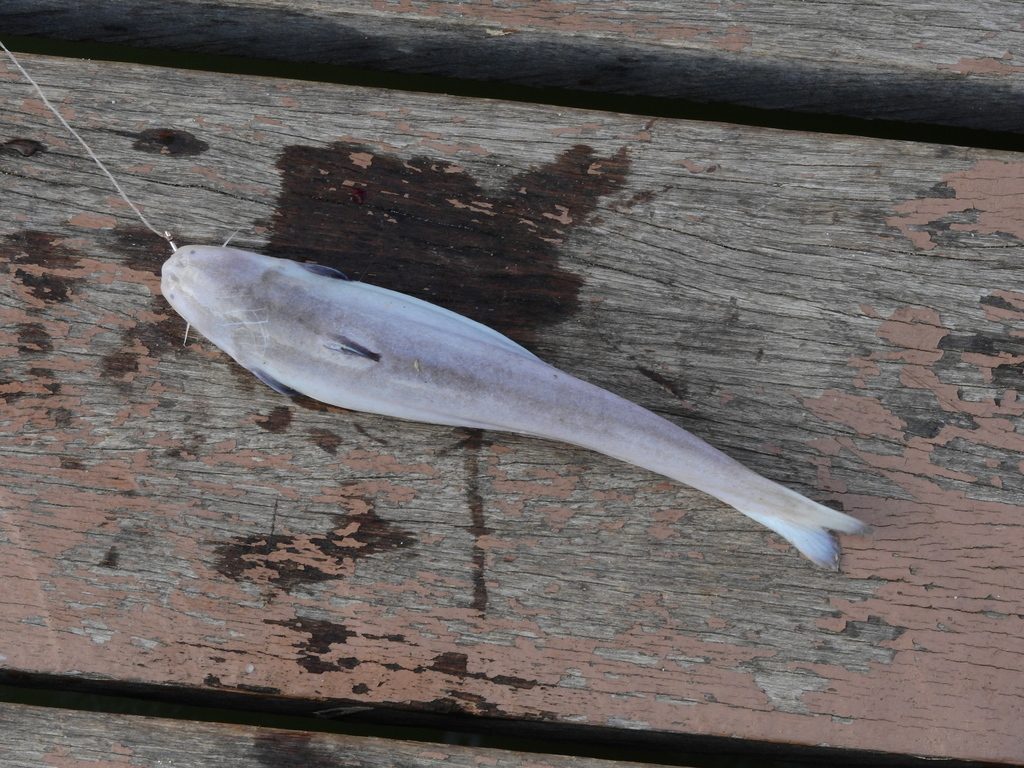
Candiru-Açu
Cetopsis candiru
Cetopsis candiru, also known as candiru, candiru açú, candiru cobra or canero, is a carnivorous species of whale catfish found in the Amazon basin of Peru, Brazil and Bolivia. Similar to Cetopsis coecutiens, Cetopsis candiru is a large species of the genus Cetopsis and a widespread scavenger, known for its voracious feeding and the habit of burrowing into the carcasses of dead animals and humans. Despite its name, it is not closely related to the bloodsucking Candiru (Vandellia cirrhosa).
From the article Cetopsis candiru on Wikipedia (CC BY-SA), quoted section by section
Description
Cetopsis candiru closely resembles its sister species, C. coecutiens, but it may be distinguished through its relatively "shallow" body (body depth 20% of standard length or less) and more incisiform teeth. The body of Cetopsis candiru is elongated and smooth with a broadly rounded, triangular head. The eyes are located on the dorsolateral surface of the head and situated far towards the front of the skull within the first fifth of the head length. They are small, only around as large as the circular anterior nares, which are surrounded by a rim of skin. In addition to the anterior nares, Cetopsis candiru also possesses a second pair of nares further back on the skull that open towards the top of the body, which are also surrounded by tubular skin. The mouth is located low on the head and around half as wide as the head is long. The margins of the lower jaw are shortened and reach approximately as far back as the eyes. The teeth of the premaxilla are incisiform and form a single, gently curved row. In addition to them C. candiru also possesses teeth on the vomer which share their incisiform morphology with those of the premaxilla and are likewise arranged in a single curved row. Finally the dentary mimics the same tooth arrangement, if notably larger compared to the premaxillary and vomerine dentition. Through this C. …
Range & habitat
Cetopsis candiru is known across large parts of the Amazon Basin. Specimens have been discovered in Brazil close to the Amazon River itself, the Rio Tocantins, the Rio Negro, the Rio Purus and the Rio Madeira among others. In Bolivia they occur in various tributaries to the Rio Madeira such as the Rio Beni and in Peru they were recovered from the Rio Ucayali and other tributaries to the Amazon. Some scientists also report the presence of Cetopsis candiru from eastern Ecuador.
Wikipedia: “Distribution”
What it does
Cetopsis candiru is a carnivorous fish and commonly described as a voracious feeder, making use of powerful jaw musculature and a nearly continuous cutting surface of the incisiform dentition. Their distribution overlaps with that of the related Cetopsis coecutiens and both species are known to simultaneously feed on the same bodies. They do however differ in the specifics of their behavior. Cetopsis candiru typically bite into carcasses and twist to create an entry into the body before proceeding to feed from the inside, where they may congregate in vast numbers during feeding frenzies. Due to these habits carcasses that were fed on by C. candiru oftentimes appear almost entirely skeletonized, but retain cartilage, eyeballs and tight skin. Cetopsis coecutiens on the other hand does not remain inside the body and instead will return to it multiple times, each time ripping away chunks of flesh. Both species leave similar circular bitemarks on bodies they scavenged on. They are opportunistic animals, feeding on the carcasses of animals that have drowned or otherwise died and fallen into the water. …
Wikipedia: “Ecology”
Where it lives
Recorded sightings
—
geo-referenced records in GBIF, from museums, herbaria and field observers.
Drag the globe to turn it. Dots are where records exist, not a range map; darker means more records.
In the stacks
Searching the stacks…
Every page naming Cetopsis candiru in the Biodiversity Heritage Library →
This page is assembled live from iNaturalist, GBIF, Wikipedia, the Source Library and the Internet Archive. It is not yet part of the hand-edited codex. iNaturalist taxon 563474.