- Animals
- ›Chordates
- ›Vertebrates
- ›Ray-finned Fishes
- ›Carps, Characins, Catfishes and Allies
- ›Catfishes
- ›Siluroidei
- ›Electric Catfishes
- ›Malapterurus
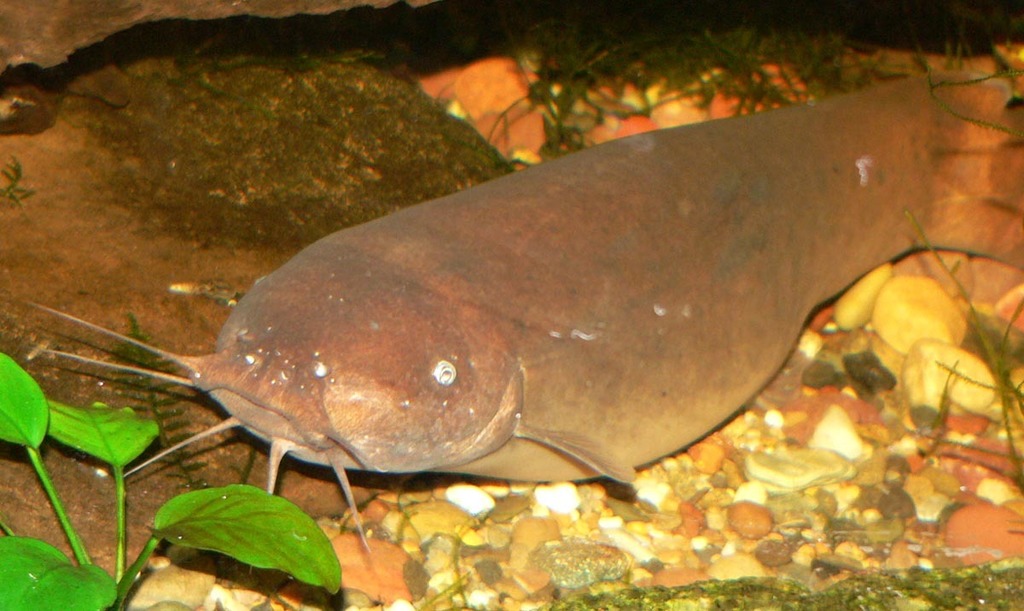
Electric Catfish
Malapterurus electricus
Malapterurus electricus is a thickset fish with six mouth barbels and a single fin on its back, just anterior to the rounded tail fin. It is brownish or grayish, irregularly spotted with black, and attains a length and weight of about 1.2 metres (3 ft 11 in) and 23 kilograms (51 lb) M. electricus is capable of generating and controlling the discharge of up to 450 volts of electricity. It uses its power to defend itself and to capture prey.
From the article Malapterurus electricus on Wikipedia (CC BY-SA), quoted section by section
Range & habitat
In Africa, it occurs in the Nile and tropical Africa and also in Lafia in the state of Nasarawa, Nigeria; and in Lake Turkana, Lake Chad and the Senegal River basin.
Wikipedia: “Distribution”
What it does
In their natural habitat they form pairs and lay their eggs in excavated cavities or holes. The male takes the eggs into his mouth. There have been rumours that they are mouth brooders. It is also unknown how the fry are immune to the electric shocks by the parents.
Wikipedia: “Reproduction”
In human culture
The genus name Malapterurus comes from Ancient Greek μαλακός (malakós) meaning "soft", πτερόν (pterón), meaning "wing", and οὐρά (ourá), meaning "tail". The specific epithet electricus is Latin for electric.
Wikipedia: “Etymology”
Where it lives
Recorded sightings
—
geo-referenced records in GBIF, from museums, herbaria and field observers.
Drag the globe to turn it. Dots are where records exist, not a range map; darker means more records.
In the stacks
Searching the stacks…
Every page naming Malapterurus electricus in the Biodiversity Heritage Library →
This page is assembled live from iNaturalist, GBIF, Wikipedia, the Source Library and the Internet Archive. It is not yet part of the hand-edited codex. iNaturalist taxon 105131.