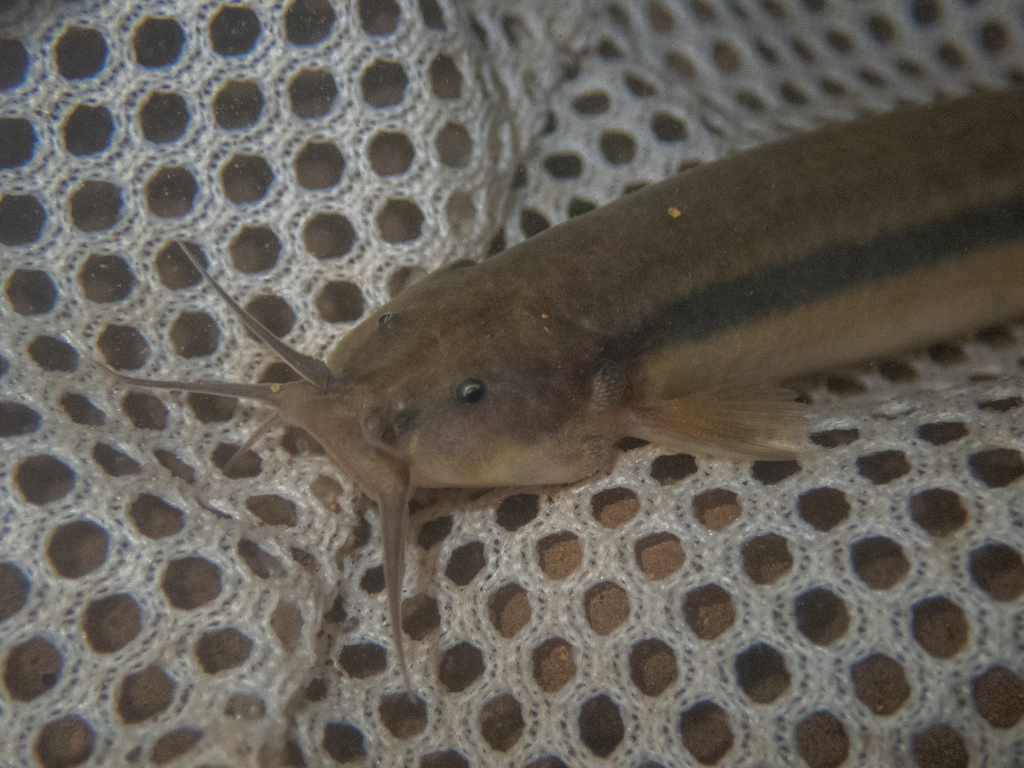


Pencil Catfish
Trichomycterus striatus (Meek & Hildebrand, 1913)
Also calledBabosa (spa) · Barbudito (spa) · Barbudo (spa) · Laucha (spa) · Pez Gato Lápiz (spa)
Descriptions from checklists and floras indexed by GBIF
materials_examined
CAS 64593 (1 ex.) Paratype; FMNH 26660 (1 ex.), 26661 (X-ray), 26662 (X-ray) Paratype; FMNH 55233 (X-ray) Paratype; FMNH 7579 (X-ray) Holotype;
New species of the catfish genus Trichomycterus (Siluriformes, Trichomycteridae) from the headwaters of the rio São Francisco basin, Brazil.
Hábitat
Bosques del cañón de la quebrada La Honda; bosques del cañón del río Lebrija y bosques secundarios de la cuenca del río Negro
Flora y fauna del municipio de Rionegro, Santander
description
Description. Morphometric data provided in Table 1. Body elongate, semi-cylindrical, becoming compressed towards caudal fin (Figs. 1 – 3). Head wide and depressed, lateral contour swollen by well-developed jaw muscles, square to trapezoid in dorsal view; dorsal profile of head straight, ventral profile straight to convex (Figs. 1 – 3). Dorsal profile of trunk convex from nape to dorsal-fin origin, marked by epaxialis; ventral profile straight (Figs. 1 – 3). Dorsal and ventral profile of caudal peduncle straight to slightly convex (Figs. 1 – 3). Greatest body depth at mid-length of trunk; depth uniform posteriorly toward caudal fin. Skin of body with minute papillae, visible only under stereomicroscope. Snout blunt. Mouth subterminal. Maxilla boomerang shaped (Fig. 4). Premaxilla rectangular, with three or four irregular rows of conical teeth (Fig. 4). Dentary with three or four irregular rows of conical teeth, similar to those of premaxilla. Barbels well developed, dorsoventrally flattened and tapered distally; variable in length; maxillary barbel usually largest, reaching the base of the pectoral fin, rictal barbel usually shortest, not reaching the base of the pectoral fin (Figs.
Redescription of Trichomycterus striatus (Meek & Hildebrand, 1913) (Siluriformes: Trichomycteridae), with notes on its geographic distribution
diagnosis
Diagnosis. Trichomycterus striatus can be distinguished from most congeners by body color: yellowish to light brown with a black lateral band and / or small dark brown spots on sides or uniformly light brown (vs. not as described above; see Discussion). In addition, T. striatus differs from all northeastern South American congeners, and possibly all other trichomycterines, by the following combination of characters: eyes relatively well developed, eye diameter 11.0 – 20.9 % of HL [vs. reduced (eye diameter usually less than 10.0 % of HL) in T. gorgona, T. santanderensis, T. steindachneri, T. sketi, T. tetuanensis, and T. uisae; or absent in T. sandovali]; teeth conical (vs. incisiform in T. chapmani, T. gorgona, T. latidens, T. stellatus, and T. transandianus); teeth arranged in 3 – 4 rows in both jaws (vs. two in T. banneaui, T. gorgona, T. maldonadoi, and T. transandianus); anterior section of the infraorbital canal (sensory pores i 1 and i 3) present (vs. absent in T. maldonadoi, T. romeroi, and T. transandianus); presence of a pair of sensory pores s 6 (vs. a single medial pore in T. nigromaculatus); opercular odontodes 11 – 23 (vs. less than 11 in T. montesi, T. sandovali, T.
Redescription of Trichomycterus striatus (Meek & Hildebrand, 1913) (Siluriformes: Trichomycteridae), with notes on its geographic distribution
Where it has been recorded
Recorded sightings
—
geo-referenced records in GBIF, from museums, herbaria and field observers.
Drag the globe to turn it. Dots are where records exist, not a range map; darker means more records.
In the stacks
Searching the stacks…
Every page naming Trichomycterus striatus in the Biodiversity Heritage Library →
From the GBIF Backbone Taxonomy and occurrence records (GBIF.org), with Wikipedia and the Source Library. GBIF species 2343077.