- Animals
- ›Chordates
- ›Vertebrates
- ›Ray-finned Fishes
- ›Carps, Characins, Catfishes and Allies
- ›Catfishes
- ›Siluroidei
- ›Squeakers
- ›Mochokinae
- ›Synodontis
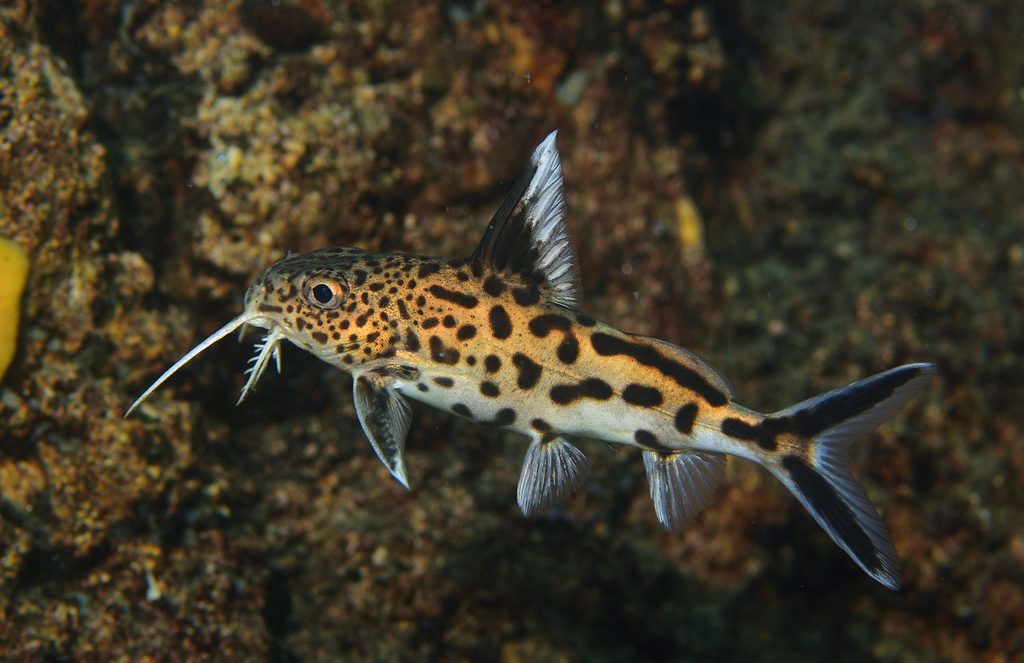
Cuckoo Squeaker
Synodontis multipunctatus
Synodontis multipunctatus, also known as the cuckoo catfish, cuckoo squeaker, or multipunk, is a small catfish from Lake Tanganyika, one of the lakes in the Great Rift Valley system in Africa. It is a brood parasite upon mouthbrooding cichlids. This species grows to a length of 27.5 centimetres (10.8 in) TL. This species is a minor component of local commercial fisheries.
From the article Synodontis multipunctatus on Wikipedia (CC BY-SA), quoted section by section
Description
Synodontis multipunctatus is one of a number of species of upside-down catfish in Lake Tanganyika, which is more famous for its cichlids. It grows to a length of 27.5 centimetres (10.8 in) TL, and gathers in large schools at depths of about 40 metres (130 ft) in the lake. This species has a generalist diet, and it is closely related to another deepwater species, the piscivorous S. granulosus.
What it does
S. multipunctatus is notable for its breeding behaviour - it is a brood parasite, similar to cuckoo birds from which it takes its common name. Lake Tanganyika is home to a number of mouthbrooding cichlids, which care for their eggs and young by carrying them in their mouth. S. multipunctatus uses these, particularly Ctenochromis horei and Simochromis babaulti, as unwitting caretakers for their children. A number of adaptations facilitate this behavior, such as large eggs which resemble their hosts' own, small clutches but frequent egg production, and rapid development compared to other Synodontis and cichlids. The smell of spawning cichlids excites S. multipunctatus, and as the catfish approach the cichlids try to collect their own eggs, as Synodontis species often feed on fish eggs. The catfish release and fertilise their own eggs within the mass of cichlid eggs before the female cichlid finish collecting them; in doing so, the cichlid will collect both its own eggs and those of S. multipunctatus. These eggs will then hatch within the cichlid's mouth, and proceed to eat the cichlid eggs and embryos with their well-developed teeth and jaws. This reproduction method removes the burden of parental care from the S. multipunctatus.
Wikipedia: “Reproduction”
Where it lives
Recorded sightings
—
geo-referenced records in GBIF, from museums, herbaria and field observers.
Drag the globe to turn it. Dots are where records exist, not a range map; darker means more records.
In the stacks
Searching the stacks…
Every page naming Synodontis multipunctatus in the Biodiversity Heritage Library →
This page is assembled live from iNaturalist, GBIF, Wikipedia, the Source Library and the Internet Archive. It is not yet part of the hand-edited codex. iNaturalist taxon 188522.